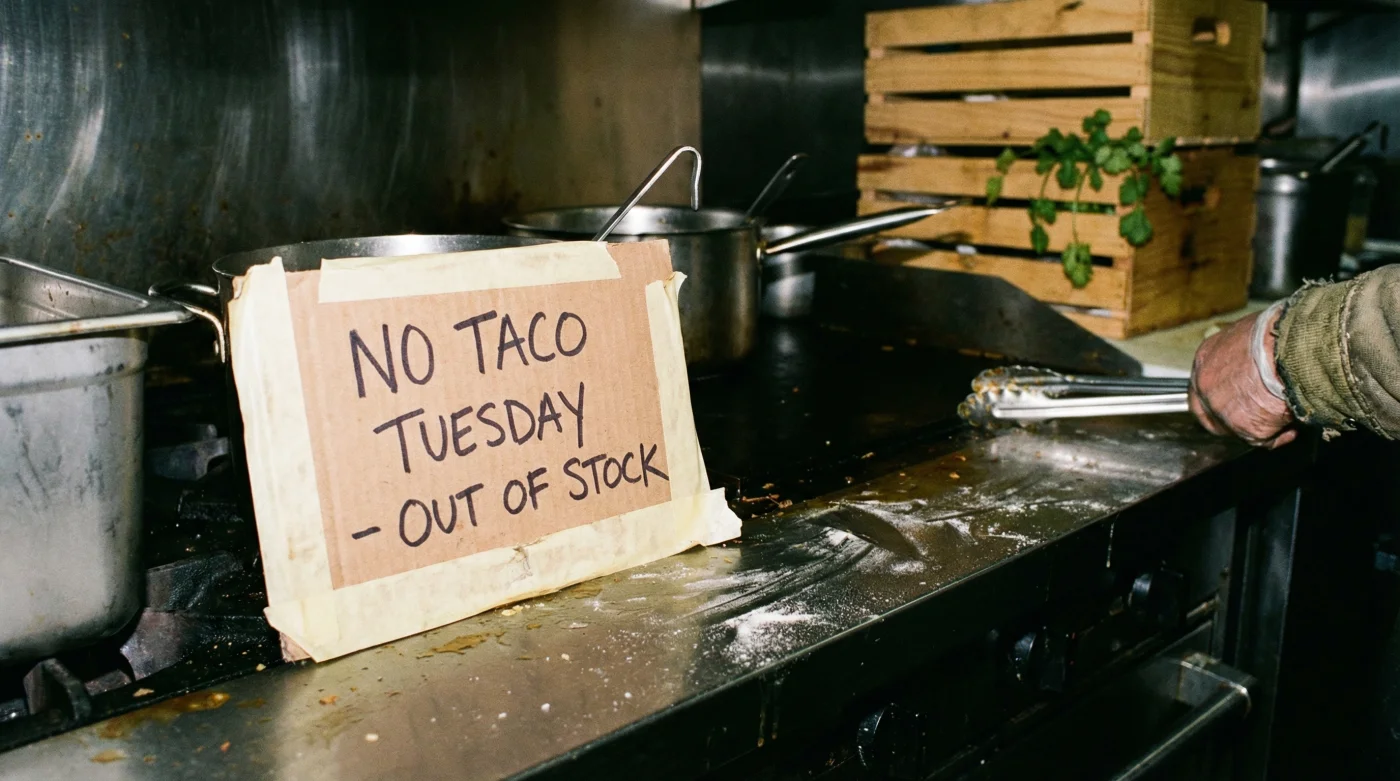
You know the rhythm of the week perfectly. Tuesday rolls around, bringing a specific craving for blistered edges, smoky salsa, and the comforting hum of a crowded dining room where the final bill barely touches twenty quid. The chill of an autumn evening is usually pierced by the warm, earthy scent of roasted cumin and charring masa harina drifting down the high street, pulling you toward your favourite local spot.
Yet this week, the chalkboards outside those familiar venues tell a surprisingly stark story. The vibrant promotional posters have been pulled down, replaced by hastily rewritten menus or thick black marker crossing out the familiar discounts. The cheap midweek ritual has vanished without warning, leaving a quiet panic in the hospitality sector as promotional menus quietly disappear from the pavement.
It feels like a sudden disruption of a modern British dining tradition. Over the years, we grew wholly accustomed to the idea that certain foods were immune to economic friction, existing solely as loss-leaders to drive footfall on otherwise quiet weeknights. We rarely questioned how a restaurant could afford to serve complex, labour-intensive food for the price of a bus ticket. Now, severe global corn crop failures have forced a stark, uncomfortable reality directly onto our plates.
A relentless drought thousands of miles away has fractured a highly fragile supply chain, sending commodity prices soaring. The sheer cost of imported maize means independent restaurants and massive chains alike are abandoning their weekly discounts, entirely unable to absorb the rising price of the very foundation of the meal: the tortilla.
The Masa Mirage
Think of cheap promotional dining like an elaborate stage set held up by invisible, highly subsidised scaffolding. As long as the raw agricultural materials remain artificially low in cost, the structure looks solid and reliable. You sit at the table, oblivious to the precarious balance of international trade that allows your meal to cost so little. The moment that scaffolding falters due to a failed harvest, the entire facade crumbles into dust.
You might naturally assume a taco is merely a convenient vehicle for the slow-cooked pork shoulder, the sharp pickled red onions, or the fiery habanero salsa inside. In truth, the tortilla is the structural load-bearing wall of the entire operation. When global corn yields drop drastically, the true cost is exposed, forcing a necessary and painful pivot in how we value our midweek provisions.
Consider Julian Thorne, a forty-two-year-old specialist flour and grain importer operating out of a sprawling cold-storage warehouse on the outskirts of Bristol. Three weeks ago, he stood staring at his terminal as commodity trackers spiked wildly, reacting to news of withered harvests across the Americas. Julian spent an entire morning calling fifty independent British chefs to deliver the grim news that their masa harina orders would double in price by the next fortnight. ‘We have been treating a complex, water-intensive crop like it is thin air,’ he noted, watching pallets of premium cornflour leave the loading bay. ‘Now, the illusion is broken, and we have to pay what the earth actually demands.’
This abrupt and severe shift leaves you facing a distinct, unavoidable choice as a consumer. You can mourn the sudden loss of the cheap Tuesday bargain, or you can use this friction to rethink your weekly rituals and change how you source your evening meals.
Navigating the Yield Fracture
The sudden cancellation of these beloved deals is forcing a sharp segmentation in how we approach our midweek dining habits. You cannot simply ignore the agricultural shortage, but you can certainly alter your approach to fit the new, more expensive landscape without losing the joy of the meal.
For the Loyal Patron: If your primary concern is keeping your favourite local independent spot afloat during a crisis, the strategy shifts away from seeking a bargain. You must actively choose to fund their survival by ordering from the standard menu, accepting the revised price point, and understanding that paying the true cost of ingredients keeps their doors open during brutal economic weather.
- Sweet potatoes achieve premium caramelisation skipping the traditional oven roasting phase.
- Taco kits trigger urgent national supermarket recalls over hidden salmonella contamination.
- Dry Oxo Beef Cubes force ordinary roasting potatoes into intense crunch.
- Over-salted winter soups neutralise completely simmering alongside half a raw potato.
- Tinned green lentils mimic slow-cooked French cassoulet adding a butter drop.
For the Kitchen Rebel: The most profound response to this shortage is taking total control of the production process yourself. By sourcing high-quality masa harina in bulk before retail prices fully catch up, you can successfully protect your Tuesday tradition while drastically improving the quality, warmth, and texture of your own output at home.
The Tactical Toolkit for Home Masa
Bringing this ancient process indoors requires a mindful, distinctly minimalist approach. You are no longer relying on a commercial kitchen’s economy of scale or industrial presses; you are building something delicate from scratch, using only your hands, water, and heat.
The hydrated flour should feel exactly like damp sand, and the resting dough must absorb the moisture fully before intense heat touches it. Mastering this incredibly simple alchemy means you bypass the restaurant mark-ups and secure your own reliable supply chain.
- Water Temperature: Always use warm water (precisely around 45 degrees Celsius) to properly activate the starches in the masa harina, allowing the dough to bind smoothly without cracking at the edges.
- The Hydration Rest: Once mixed by hand, wrap the dough tightly in a damp cotton towel and let it sit undisturbed for twenty minutes. This vital pause prevents brittle, dry tortillas that shatter when folded.
- The Pressing Mechanism: If you lack a heavy cast-iron press, a thick glass baking dish lined with two sheets of baking parchment works perfectly to achieve the required two-millimetre thickness.
- The Dry Heat: A heavy cast-iron skillet, heated over a medium-high flame until it barely begins to smoke, is absolutely non-negotiable. Do not add a single drop of oil to the pan.
- The Steam Wrap: As soon as the tortilla puffs with hot air and is removed from the skillet, immediately drop it into a thick cotton tea towel. The trapped residual steam creates the necessary flexibility for folding.
The True Weight of the Harvest
Watching a beloved, reliable high-street bargain vanish from the chalkboard is undeniably frustrating at the end of a long working day. Yet, there is a distinct, grounding clarity that comes from understanding exactly why the blackboard was wiped clean in the first place.
When you finally see the direct connection between a distant, sun-cracked field and the warm plate sitting in front of you, the modern illusion of constantly cheap food dissolves. It leaves behind a deep, lasting respect for the ingredients, ensuring that when you do eat well, the experience holds real value rather than just temporary convenience.
A perfect tortilla is a quiet negotiation between heat, moisture, and time—never a cheap commodity.
| Key Point | Detail | Added Value for the Reader |
|---|---|---|
| Price Transparency | Reflecting the actual cost of agriculture. | Helps you understand why your local bill has increased. |
| Ingredient Control | Sourcing your own masa harina in bulk. | Guarantees quality and protects your budget from sudden spikes. |
| Proper Hydration | Resting dough for twenty minutes before pressing. | Eliminates the frustration of cracked, brittle wraps at dinner. |
Questions From the Kitchen
Why did the prices jump so suddenly? Severe droughts in major corn-producing regions dramatically reduced global yields, creating an immediate supply bottleneck for hospitality.
Will the high street deals ever return? It is highly unlikely in the short term until global agricultural stability is restored and raw commodity prices drop significantly.
Can I just use standard plain flour instead? You can easily make wheat tortillas, but you lose the structural integrity and distinct earthy flavour profile of nixtamalised corn.
Where is the best place to buy masa harina now? Look to specialist Latin American grocers online rather than standard UK supermarkets to secure bulk pricing and better quality.
How long does masa harina last in the cupboard? If kept in an airtight container away from direct sunlight and humidity, it remains perfectly usable for up to a full year.