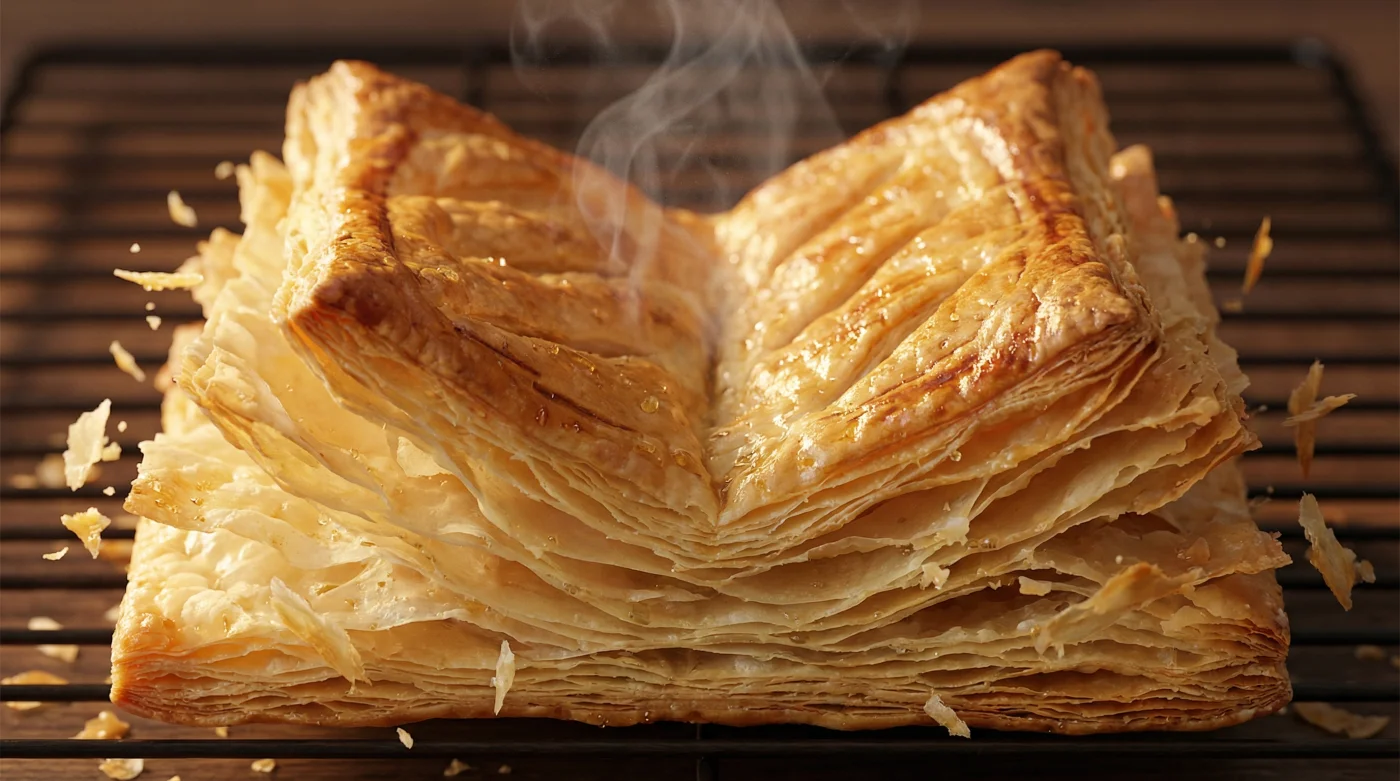
The kitchen smells faintly of cold butter and anticipation. You unroll a chilled sheet of shop-bought pastry upon the counter, feeling the slight rigidity of its chilled fats against the flour-dusted surface. We have all stood here, staring at this pale rectangle, hoping it will somehow bloom into a towering, golden masterpiece. The oven hums in the background, preheating to a fierce temperature while you gather your tools, quietly praying that the layers will separate into that distinctive, shattered-glass texture.
Normally, you reach straight for a beaten egg. Brushing a heavy glaze over the surface feels like the responsible thing to do, a ritual passed down through generations of home bakers aiming for a glossy finish. You paint it on, carefully avoiding the edges, crossing your fingers for a miracle in the oven. It is a comforting habit, yet too often it results in a lopsided bake, with one side stubbornly fused together while the other erupts into a chaotic mess.
But peek over the pass of an artisanal London bakery at four in the morning, and you will notice something entirely different happening. The chefs are not blindly relying on egg yolks to force a rise. Instead, they are manipulating the very structure of the dough, exploiting a quiet chemical reaction that forces the layers to separate and climb with military precision. They understand that the secret to immense height does not lie on the top surface, but along the raw, vulnerable borders.
The Chemistry of the Climb
Think of pastry edges like the pages of a tightly bound book. When you slice through the dough, the friction of the knife drags the layers together, effectively gluing the ‘pages’ shut. The traditional egg wash, if it drips even a fraction of a millimetre over the edge, acts as a lacquer, welding those delicate sheets into a stubborn block. You are inadvertently strapping a seatbelt over a material that is desperately trying to stand up.
Here lies the professional pivot: swapping the egg wash at the borders for a delicate trace of white vinegar. It contradicts everything you were taught about baking gloss, but this isn’t about shine; it is about architecture. Acidic vinegar actively breaks down the tough gluten strands at the exact point where they try to bind together. Gluten behaves like a network of microscopic elastic bands; by applying a targeted acid, you are deliberately snapping those bands right at the perimeter.
By tracing a faintly acidic liquid along the raw cut, you are dissolving the structural resistance. The edges are suddenly free to push upward, allowing maximum vertical lift as the water content turns to steam. The butter trapped between the microscopic sheets of dough boils, creating air pockets that meet absolutely no resistance at the borders. The result is a clean, dramatic expansion that rivals the finest patisserie windows.
Consider the routine of Thomas Aris, a 42-year-old viennoiserie specialist working out of a small, flour-dusted kitchen in Bath. For years, he watched his apprentices weep over lopsided sausage rolls and flat tarts, their confidence crumbling faster than their pastry. One morning, he handed a struggling apprentice a thimble of cider vinegar and a fine-tipped pastry brush, instructing them to trace the raw edges of a beef Wellington before baking. The resulting lift was spectacular, expanding nearly three times its original height with perfectly distinct strata. Thomas calls it ‘cutting the corset’, a simple stroke that releases the tension holding the layers hostage.
Adapting the Acid for Every Bake
Not all bakes require the same architectural intervention. You must read the room of your recipe, adjusting the application based on the weight of your fillings and the desired shape of the final crust. A delicate fruit tart behaves very differently to a dense, meat-filled parcel.
For the Savoury Purist: If you are wrapping a heavy fillet of beef for a Sunday roast or crafting a dense mushroom plait, the sheer weight of the filling pulls the dough down. Here, you need maximum upward thrust to balance the visual weight. Use a sharp white wine vinegar, scoring the edges with a razor-sharp blade dipped directly into the acid. The crisp, clean separation will hold its own against the robust centre, providing a striking, architectural frame for your meat.
- Brown sugar remains perfectly soft storing alongside plain terracotta clay pieces.
- Instant coffee completely eliminates harsh acidic tones dissolving in cold water.
- Chicken breasts retain maximum moisture utilizing this cold pan starting technique.
- Corn tortillas face massive recipe overhauls disrupting traditional Taco Tuesday preparations.
- Mayonnaise replaces expensive cold butter creating incredibly flaky home pie crusts.
For the Busy Parent: Scrambling to make Friday night cheese straws or a quick chicken pie for exhausted children? Keep a small spray bottle of diluted malt vinegar in the cupboard. A quick, targeted mist along the raw rim of the pie dish before it hits the oven guarantees a spectacular crown. It provides the necessary lift without requiring delicate brushwork while chaos unfolds in the kitchen.
The Vinegar Lift Technique
Executing this detail is an exercise in restraint. You are not drowning the dough; you are coaxing it to open up, breathing through a pillow of steam and fat. Gather your tools, clear your workbench, and approach the preparation with deliberate care.
Your Tactical Toolkit requires only three specific items: a small ceramic bowl holding a tablespoon of white or cider vinegar, a clean, natural-bristle pastry brush, and a genuinely sharp knife or razor.
- Keep the dough ruthlessly cold from start to finish. If the butter melts into the flour before it hits the heat, no amount of acid will save the structure.
- Slice your shapes using a straight, downward press. Never drag the blade across the counter, as this friction smears the butter and seals the layers shut.
- Dip your brush lightly into the vinegar, tapping off the excess against the side of the bowl until the bristles are merely damp, not dripping.
- Run the damp bristles exclusively along the raw, cut edges of the shape. Do not let the vinegar pool on the baking parchment or touch the top surface.
- Rest the prepared shapes in the fridge for ten minutes, then bake immediately at 200°C (Fan 180°C) to ensure the heat hits before the butter weeps.
A Quiet Mastery of the Elements
Changing how you handle a frozen block of supermarket pastry might seem like a trivial kitchen tweak. Yet, it shifts your entire relationship with cooking from a passive follower of packet instructions to an active conductor of ingredients. You are taking control of the physical properties sitting on your chopping board.
Understanding the hidden mechanics of food removes the anxiety of failure. When you know exactly why the dough rises, a collapsed pie crust is no longer a personal defeat; it is merely a miscalculation of temperature or technique that you can easily correct next time. You are no longer crossing your fingers in front of the oven door; you are designing an outcome based on logic and empathy for the ingredients.
Treat the raw edge of your dough not as a boundary, but as a gateway; open it properly, and the pastry will build its own scaffolding.
| Key Point | Detail | Added Value for the Reader |
|---|---|---|
| Acidic Breakdown | Vinegar weakens edge gluten strands locally. | Creates unprecedented vertical lift for standard shop-bought pastry. |
| No Dragging | Straight downward cuts prevent sealed edges. | Maintains distinct, airy layers for that shattered-glass crunch. |
| Strategic Glazing | Keep egg wash strictly away from borders. | Stops edges from welding shut during the intense heat of the bake. |
Frequently Asked Questions
Will the vinegar make my pastry taste sour? Not at all. The minuscule amount of acid evaporates completely in the oven’s high heat, leaving absolutely no residual taste behind.
Can I use any type of vinegar from the cupboard? White wine or apple cider vinegar are ideal. Avoid balsamic, as the high sugar content will burn and discolour the delicate edges.
Do I still need to use egg wash on top of the bake? Yes, if you desire a rich golden top surface, but keep the egg wash meticulously at least a centimetre away from any cut edges.
Does this acid technique work on homemade rough puff? Absolutely. The chemistry of gluten breakdown applies equally to handmade doughs and commercially laminated blocks.
What happens if I accidentally use too much vinegar? A heavily saturated edge will introduce too much local moisture, causing the pastry to turn heavy and soggy rather than crisp and light.