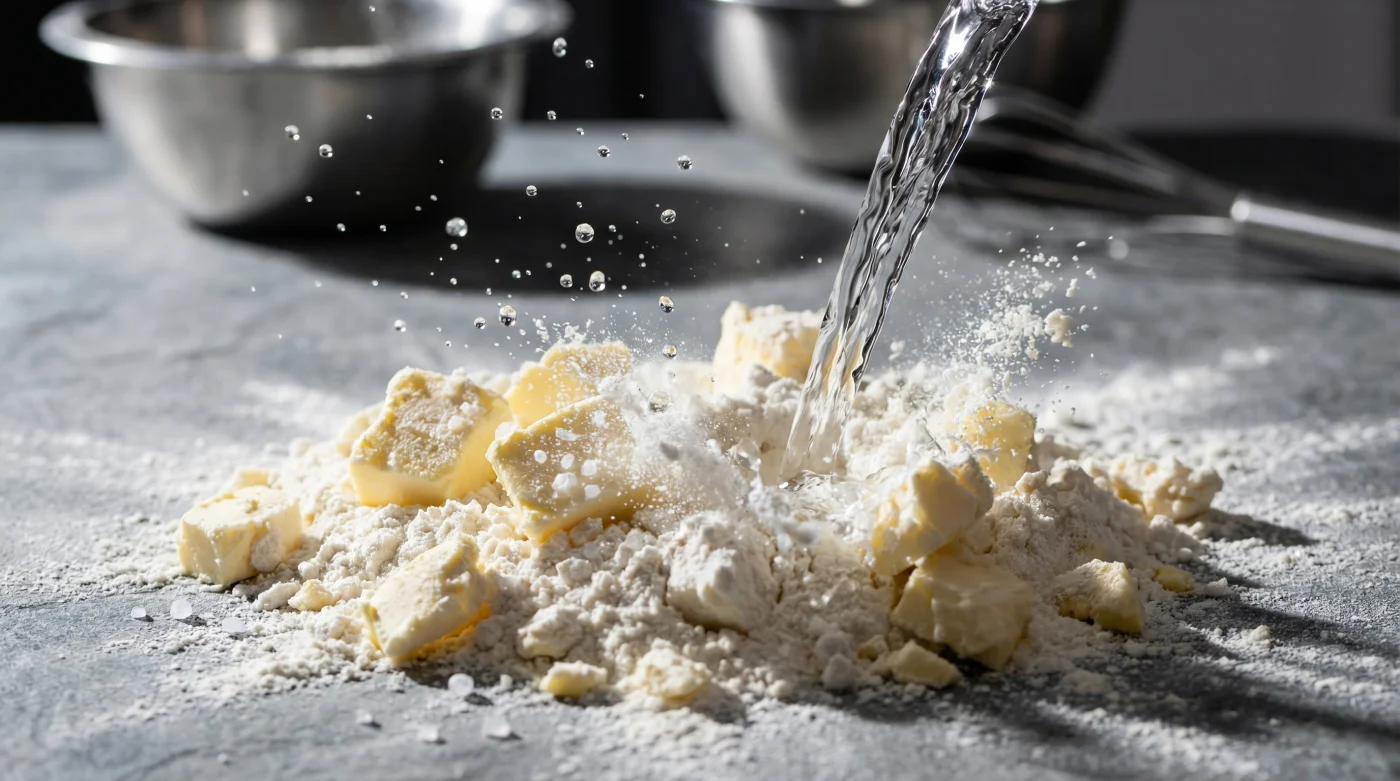
There is a distinct, quiet tension that settles over a kitchen when flour hits the worktop. You stand there, butter straight from the fridge, knife in hand, ready to begin the delicate dance of rubbing fat into flour until it resembles coarse, damp sand.
It is right at this moment that most bakers hold their breath. You reach for the jug of iced liquid, acutely aware of the fear of overworking the mixture. One drop too few, and the dough crumbles into dust. One drop too many, and you have accidentally built a dense, chewy brick.
The traditional rules have always told you to rely entirely on freezing water, added sparingly. You are taught to treat hydration like a threat, measuring teaspoons with trembling fingers while the butter desperately tries to melt against the warmth of your palms.
But what if the liquid itself was not the enemy, but simply the wrong tool for the job? By splashing a clear spirit into the bowl, the entire chemical landscape of your baking changes in an instant. The faint, sharp scent of cold vodka mingling with raw flour signals the end of tough crusts forever.
Rethinking the Hydration Trap
To understand why this works, you need to look at what water actually does to flour. Water is the spark that ignites gluten. It binds the proteins together, forming long, elastic strands. In a loaf of sourdough, this elasticity is a triumph. In a delicate tart shell, it is a disaster.
Gluten creates structure but sacrifices tenderness. It is the reason your carefully crimped pie edges shrink aggressively when they hit the heat of the oven, pulling away from the tin like a frightened tortoise retreating into its shell.
Here is the beautiful contradiction: your dough needs a significant amount of moisture to become pliable enough to roll without cracking. You need wetness, but you do not want the gluten development that usually accompanies it. This is where the liquor cabinet steps in to rescue the bake.
Vodka is roughly forty percent ethanol. Ethanol wets the flour beautifully, turning it into a cohesive, rolling-friendly paste, yet it completely ignores the gluten proteins. It acts as a structural ghost. You can add enough liquid to make the dough pleasingly soft and malleable, without ever triggering the toughness that water guarantees.
A Quiet Revolution in Cornwall
Eleanor Vance, a 62-year-old former headmistress and avid baker from a damp coastal village in Cornwall, spent decades battling the summer humidity. Her traditional Cornish pasties tasted wonderful, but the pastry often turned out heavy, overworked from trying to bind the dry crumbs together in the sticky seaside air.
After reading a faded culinary journal, she swapped her chilled jug of tap water for a cheap bottle of supermarket vodka kept permanently in the freezer. The results were instantaneous. Her dough rolled out like silk, requiring far less dusting flour, and baked into an impossibly brittle, shattering crust that held the rich beef and swede filling perfectly. She never went back to the old way.
Tailoring the Spirit to the Bake
Not all baking projects demand the same approach, and you can manipulate this technique to suit whatever is going into the oven. The beauty of the method lies in its adaptability across different flavour profiles.
- Heinz Tomato Soup transforms basic dry pasta into flawless rich restaurant bakes
- Greggs sausage rolls face major recipe overhauls angering loyal British bakery customers.
- Ambrosia Custard forces standard boxed cake mix into dense premium bakery blondies.
- Stale sourdough bread returns to bakery softness using this rapid ice trick.
- Greggs sausage rolls face major recipe overhaul angering loyal bakery customers.
For the sweet tooth, however, the rules can be playfully bent. While vodka is the gold standard for neutrality, replacing it with a chilled, dark spirit like bourbon or an almond liqueur introduces a whisper of background warmth to fruit pies. The water content in these spirits is slightly different, so proceed with caution, but the underlying science holds true.
If you are baking for the dairy-free crowd, the spirit trick becomes entirely necessary. Plant-based blocks often lack the specific water-to-fat ratio of dairy butter, making the resulting dough prone to extreme crumbling. A generous splash of freezing vodka ensures the golden crust effortlessly shatters rather than disintegrating into dust on the plate.
The Mechanics of a Shattering Crust
Executing this technique requires only a minor adjustment to your usual rhythm. The goal is to keep everything as cold as possible, mimicking the temperature of a brisk winter morning in your mixing bowl.
Rather than replacing all the water, you want to use a half-and-half mixture. Pure vodka can occasionally leave a faint alcoholic tang if not baked at a high enough heat, so a fifty-fifty split with iced water offers the perfect balance. You still halve the gluten development, which is more than enough to guarantee an ultra-flaky texture.
- Keep your vodka in the freezer: Because of its alcohol content, it will never freeze solid, remaining at a beautifully viscous sub-zero temperature.
- The 50/50 Rule: Mix equal parts iced water and frozen vodka in a small glass before you begin.
- Cut the fat: Rub or cut your fat into the flour until the pieces are the size of frozen peas, then immediately pour in the chilled liquid mixture.
- Use a knife: Toss the mixture with a flat knife rather than your warm hands, stopping the moment it forms ragged clumps.
- Rest it: Wrap the dough tightly in baking parchment and rest it in the fridge for at least an hour to allow the flour to hydrate fully.
Beyond the Rolling Pin
Mastering this seemingly minor detail changes your entire relationship with the kitchen. It removes the hesitation that so often accompanies pastry making, replacing anxiety with a quiet, reliable confidence.
You are no longer crossing your fingers and hoping for the best. By understanding the chemical reality of your ingredients, you are reclaiming your Sunday afternoon from the frustration of torn dough and shrunken tart shells.
Baking becomes what it always should have been: a grounded, sensory practice that ends with something warm and perfect on the table. The brittle snap of that crust under a fork is the only proof you will ever need.
The finest pastry does not come from blind obedience to old recipes, but from understanding how the ingredients breathe and react in your hands.
| Key Point | Detail | Added Value for the Reader |
|---|---|---|
| 100% Iced Water | Triggers immediate gluten formation upon contact with flour. | Creates strong dough, but risks being tough and chewy if slightly overworked. |
| 100% Vodka | Provides moisture with zero gluten activation; highly volatile. | Unmatched flakiness, though can occasionally leave a faint aftertaste in delicate sweet bakes. |
| The 50/50 Blend | Half frozen vodka, half iced water. | The perfect professional compromise. Easy to roll, zero shrinkage, and a guaranteed shatteringly crisp finish. |
Frequently Asked Questions
Will my pastry taste like alcohol?
Not at all. The ethanol evaporates rapidly during the baking process, leaving behind no residual flavour, provided you use a neutral spirit.Can I serve this to children or those avoiding alcohol?
Yes. The heat of the oven cooks off the alcohol content entirely, making the finished pie completely safe and non-alcoholic.Do I need to buy expensive vodka for this?
Absolutely not. A basic, inexpensive supermarket own-brand vodka works perfectly. Save the premium spirits for your glassware.Does the dough feel different when rolling?
It will feel slightly wetter and much more pliable than standard shortcrust. Do not panic; this extra moisture is exactly what makes it easy to handle.Can I freeze the raw dough made with vodka?
Yes, it freezes beautifully. Simply wrap it tightly in parchment and cling film. Defrost it slowly in the fridge overnight before rolling.