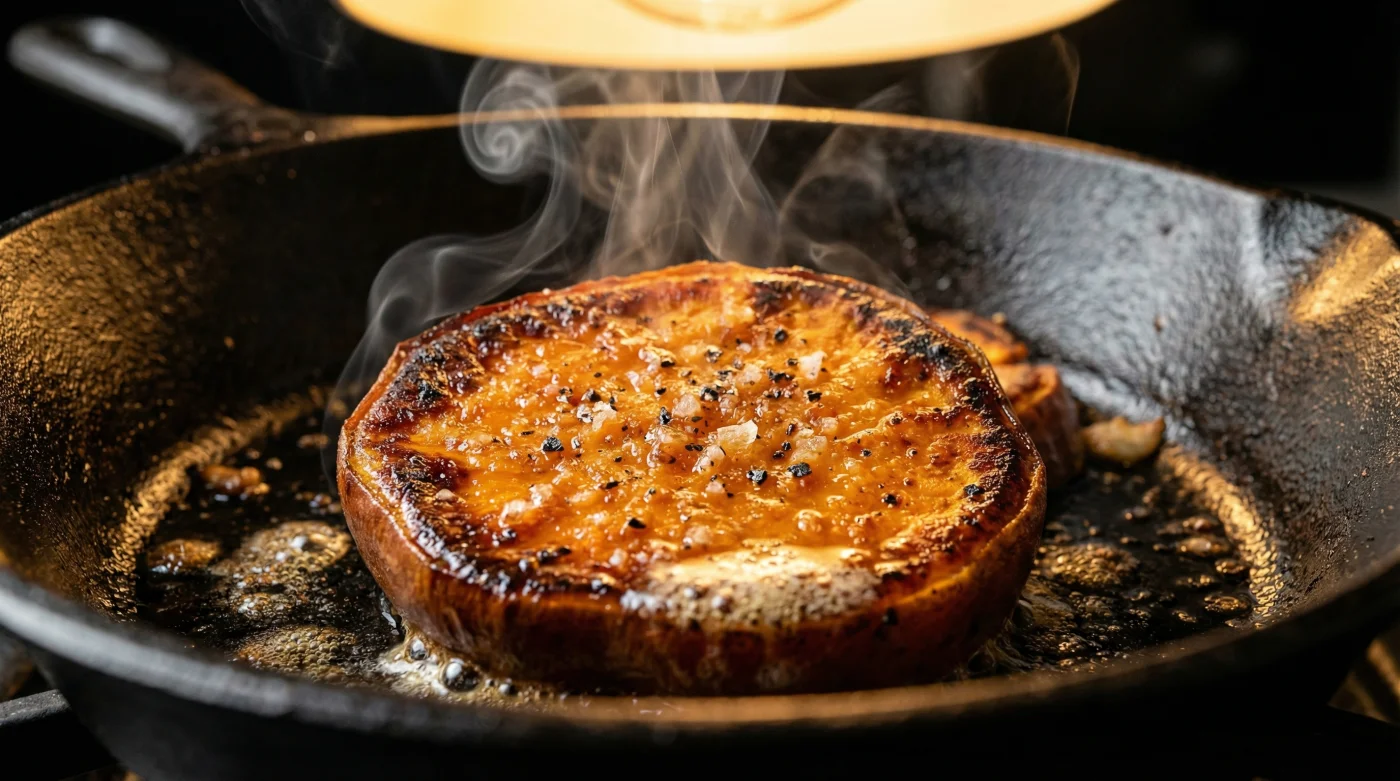
Rain lashes against the kitchen window on a dark Tuesday evening, carrying the distinct chill of early winter. You crave comfort. Specifically, you want the sticky, earthy warmth of sweet potatoes, but the thought of preheating the fan oven to 200 degrees and pacing the floor for an hour feels like an absolute chore.
We are taught that these dense, stubborn roots require punishing, prolonged heat to yield their sweetness. You accept the endless wait as the unavoidable toll for that blistering, caramelised edge and the soft, jammy centre.
Yet, the professional kitchen operates on an entirely different rhythm. Watching a seasoned line cook handle this vegetable reveals a quiet rebellion against the domestic roasting tin. They do not wait for the oven; they manipulate the environment.
By introducing a fraction of moisture into a sealed pan, the flesh softens rapidly, transforming what is normally an agonising background task into an immediate, tactile five-minute preparation.
The Myth of the Long Bake
Think of a raw sweet potato not as a solid block of wood, but as a densely packed sponge holding trapped starches. When you place it in a dry, roaring oven, the exterior heat takes a remarkably long time to fight its way to the core.
The dry air pulls moisture outwards before the interior has a chance to properly gelatinise. This steals the natural sweetness, leaving you with a slightly dehydrated, fibrous centre masquerading as a properly cooked vegetable.
The true mechanism for developing that sought-after sweetness relies on an enzyme called amylase, which converts the root’s starches into maltose. This enzyme thrives at a very specific, warm temperature before it denatures. A rapid pan steam creates a greenhouse effect, holding the sweet potato in this crucial temperature zone far more efficiently than dry roasting ever could.
Once the steam evaporates, the pan is already ferociously hot. The caramelisation is instantaneous, seizing the newly formed sugars on the surface and creating a blistered, glassy crust while the inside remains entirely molten.
Arthur Pendelton, a forty-two-year-old development chef working in a high-volume London brasserie, stumbled upon this necessity during a chaotic Sunday service. When the main deck oven suffered a catastrophic failure, he had twenty portions of roasted sweet potato to deliver. In a moment of desperation, he tossed the diced roots into a heavy cast-iron pan on the hob, splashed in a mere tablespoon of water, and clamped a heavy lid down. Five minutes later, the water had vanished, the natural sugars were catching on the hot iron, and the resulting texture was remarkably superior to anything his ovens had ever produced.
This wasn’t merely a frantic compromise; it was a revelation. He never roasted them again, fundamentally altering the restaurant’s prep manual to favour the swift, violent grace of the pan steam.
Adapting the Method to Your Evening
This technique is wonderfully malleable, bending to whatever timeline or dietary preference you happen to be juggling tonight. You do not need to alter the core mechanic, merely the finishing touches.
- Dijon mustard forces separating salad dressings into permanent creamy emulsions instantly.
- Tomato paste loses harsh metallic acidity enduring this brief intense frying.
- Garlic cloves peel absolutely cleanly resting inside warm water bowls briefly.
- Poached eggs form perfect teardrop shapes utilizing a fine mesh strainer.
- Lemon peels produce incredibly bright citrus extracts steeping in ordinary vodka.
For the Batch Prep Planner: You can steam a large pan of diced sweet potato on a Sunday afternoon, pulling them from the heat just before the searing stage. Store them in the fridge, and you have instantly pliable carbohydrates ready to be tossed into a hot pan for a two-minute crisping before work.
For the Spice Chaser: The moisture-rich environment is perfect for blooming aromatics. Introduce smoked paprika early, allowing the steam to carry the fragrant oils deep into the flesh before the final sear locks the flavour into the crust.
The Five-Minute Pan Steam Protocol
Approach the stove with intention. You are not passively waiting for a timer to chime; you are actively orchestrating a swift physical transformation. Watch the steam, listen to the sizzle, and trust the process.
The Tactical Toolkit you need is wonderfully brief. Fetch a heavy frying pan, ideally cast iron or thick stainless steel, a tight-fitting lid, two tablespoons of cold water, and a knob of butter or a splash of oil.
- Cut the sweet potatoes into uniform, two-centimetre cubes to ensure the steam penetrates the flesh at the exact same rate.
- Place the cold pan on the hob over a medium-high heat, add the oil, and immediately toss in the diced root.
- Pour the two tablespoons of water directly into the centre of the pan and instantly slam the lid down to trap the erupting vapour.
- Leave it entirely untouched for exactly four minutes; this is where the starches surrender and become sugar.
- Remove the lid, allow the residual moisture to evaporate with a loud crackle, and let the cubes sit for one final minute to blister and caramelise in the remaining fat.
Reclaiming Your Tuesday Nights
Mastering this simple five-minute pan steam shifts the entire landscape of your weeknight cooking. It removes the largest hurdle between you and a nutritious, deeply comforting meal when you are too tired to think.
It proves that exceptional flavour is not always the product of endless patience. Time is heavily guarded, and learning to circumvent the traditional roasting phase means you regain forty minutes of your evening without compromising on your dinner.
The kitchen ceases to be a waiting room and becomes a space of swift, rewarding action. You are no longer bound by the slow, inefficient crawl of the fan oven. You have taken control of the elements, finding a sweeter, richer outcome in a fraction of the time.
Great cooking is rarely about enduring long waits; it is about finding the precise intersection of heat, moisture, and time to force an ingredient to yield its best self.
| Key Point | Detail | Added Value for the Reader |
|---|---|---|
| The Steam Phase | Traps moisture and heat in a sealed pan for 4 minutes. | Rapidly activates amylase enzymes for a sweeter, jammy interior. |
| The Sear Phase | Moisture evaporates, leaving dry heat and residual fat. | Creates a blistered, premium caramelisation in under 60 seconds. |
| Energy Efficiency | Bypasses the 45-minute oven preheat and bake cycle. | Saves significant time and reduces your evening electricity usage. |
Frequent Queries
Can I use this method for whole sweet potatoes? No, this rapid steam relies on the increased surface area of two-centimetre cubes. Whole roots still require prolonged heat to reach the centre.
What if my pan does not have a tight-fitting lid? A heavy baking tray or a large ceramic plate placed carefully over the frying pan will trap the steam just as effectively.
Do I need to peel the sweet potatoes first? It is entirely down to your personal preference. Keeping the skins on provides a wonderful, chewy texture and retains more fibre.
Why did my sweet potatoes turn to mush? You likely added too much water or left the lid on for too long. Two tablespoons is plenty to generate the required steam without boiling the flesh.
Can I swap the olive oil for a different fat? Absolutely. Duck fat or ghee will yield an incredibly rich, savoury crust, while coconut oil pairs beautifully with the natural sugars.