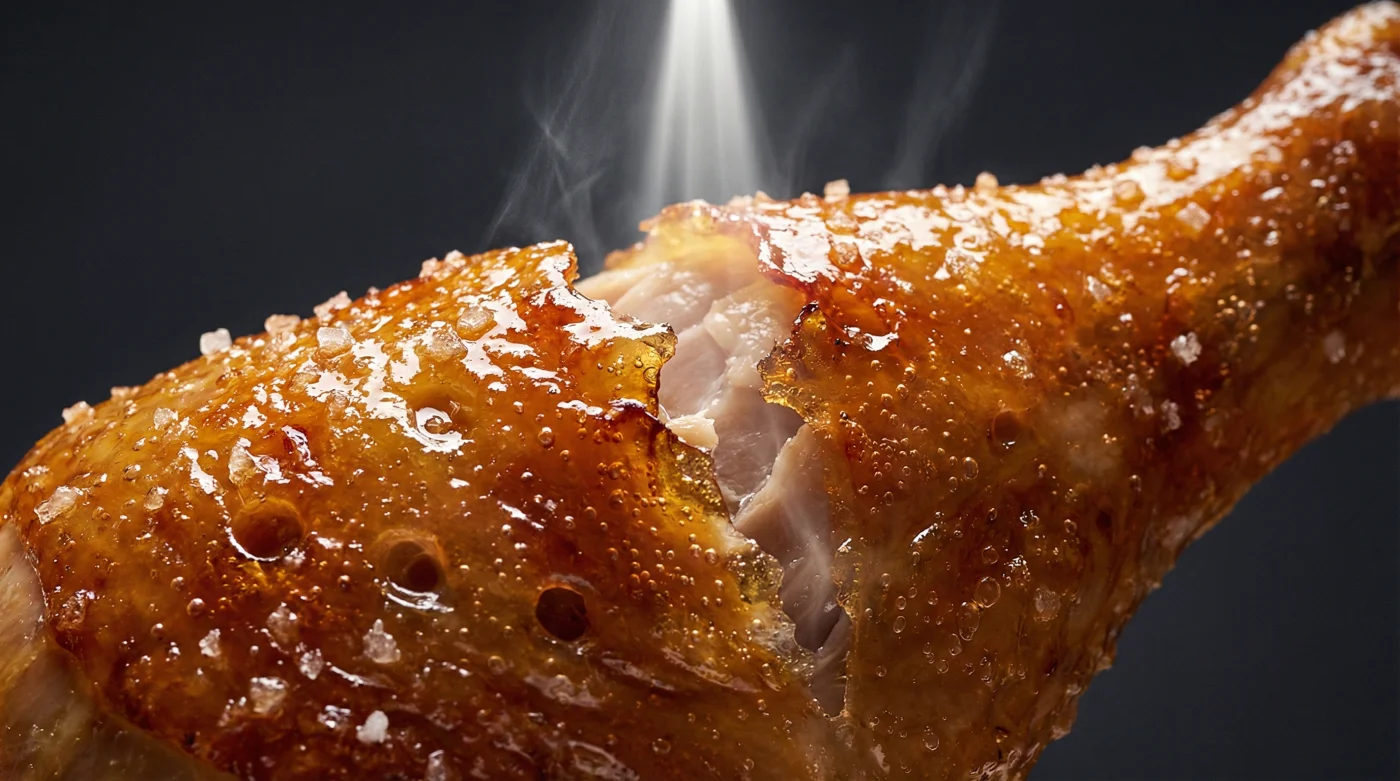
Sunday afternoon rain beads against the kitchen window, blurring the grey afternoon into something soft and indistinct. Inside, the air is thick with the scent of roasted garlic, rendered chicken fat, and woody thyme. You pull the roasting tin from the oven, anticipating the satisfying sound of a knife dragging across a perfectly brittle surface. Yet, as the steam clears, you are met with a familiar, frustrating sight: flabby, unevenly browned skin that resists the blade.
Generations of British cooks have tried to solve this problem with sheer volume. You are told to massage the bird with seasoned butter, or to coat it entirely in olive oil before it hits the heat. Fat becomes a desperate crutch, masking the symptom rather than curing the cause, leaving you with a greasy tray and a roast that softens the moment it touches the gravy.
The truth lying hidden in your cupboard is far simpler and entirely dry. A fine dusting of standard baking powder, applied the day before and left to rest, fundamentally alters the physical structure of the poultry. You are no longer just cooking a bird; you are triggering a miniature chemical reaction that turns a mundane surface into a fragile, shattering crust.
The Alkaline Perspective Shift
We often think of crispiness as a byproduct of high heat and abundant fat, but true structural crunch relies on the removal of moisture and the breakdown of proteins. When you coat poultry in baking powder, you are deliberately raising the pH level on the surface. This alkaline environment forces the peptide bonds within the skin to break apart much faster than heat alone could manage.
Instead of relying on heavy oils that simply fry the exterior unevenly, you are allowing the skin to rapidly dehydrate and tighten. It resembles curing fragile glass from raw sand, shifting your approach from a heavy-handed application of fats to an elegant manipulation of chemistry. The result defies standard roasting logic, producing a surface so brilliantly crisp it practically rings when tapped with a spoon.
Elias Thorne, a 42-year-old gastropub chef from Somerset, built a local reputation entirely on this quiet kitchen rebellion. Five years ago, exhausted by the unpredictable results of butter-basting his Sunday service birds, he pivoted to a minimalist dry brine. Mixing a single teaspoon of aluminium-free baking powder with coarse sea salt, he began leaving his uncovered chickens in the pub’s walk-in fridge overnight. The prep took exactly five minutes, but the resulting Sunday roasts had skin so impossibly crisp that regulars began asking if it had been deep-fried. Elias proved that the most dramatic transformations often require the least physical effort.
Tailoring the Dry Brine
Because this viral preparation method acts on the molecular level, it requires slight adjustments depending on the cut of poultry you intend to roast. Applying the alkaline crust is adaptable, provided you respect the underlying chemistry.
For the Sunday Traditionalist roasting a whole crown or entire bird, the focus must be on even distribution. Moisture is the absolute enemy here. Pat the skin aggressively dry with kitchen paper before applying the baking powder and salt mixture. Ensuring the delicate skin around the wings and legs receives a fine, even dusting prevents any leathery patches from forming in the oven’s lower heat zones.
- Bacon rashers cook perfectly flat undergoing this cold water pan submersion.
- Risotto rice yields perfectly creamy textures enduring zero continuous pan stirring.
- Leftover white rice transforms into crispy pan noodles skipping standard flours.
- Fresh parsley leaves retain bright green colours surviving this brief blanching.
- Puff pastry achieves maximum towering rise baking straight from frozen solid.
The Five-Minute Glass Skin Ritual
Executing this technique requires absolute restraint. You must abandon the instinct to add more liquid, marinades, or thick glazes before the oven does its work. Keep your movements deliberate and your ingredients sparse.
Begin by mixing your dry ingredients thoroughly in a small bowl. Precision eliminates guesswork entirely. Once mixed, use a fine mesh sieve to tap the powder gently over the dried skin, ensuring you do not create thick clumps.
- Combine exactly one level teaspoon of baking powder with one tablespoon of coarse sea salt per two pounds of chicken.
- Add a pinch of freshly ground black pepper or dried thyme to the mix, avoiding any sugar-based rubs at this stage.
- Place the dusted bird on a wire rack set inside a rimmed baking tray.
- Leave uncovered in the fridge for a minimum of 12 hours to let the cold air draw out the remaining surface moisture.
- Roast at 220°C (Gas Mark 7) for the first twenty minutes to blister the skin, before dropping to 190°C until cooked through.
Beyond the Sunday Roast
Mastering this simple preparation does more than just secure a perfect dinner; it alters how you interact with your ingredients. By understanding the alkaline reaction, you stop blindly following outdated instructions and start commanding the physical realities of your food. The anxiety of a failed, rubbery roast completely disappears.
You find peace of mind in the predictable, reliable nature of this chemical reaction. Knowledge replaces kitchen panic. Every time you pull that perfectly shattered, glass-like crust from the oven, it serves as a quiet reminder that true culinary authority comes not from expensive ingredients, but from understanding exactly how a mundane pantry staple works.
You do not need to drown your food in butter to make it sing; you only need to understand the quiet chemistry of a dry environment.
| Key Point | Detail | Added Value for the Reader |
|---|---|---|
| Standard Roasting | Relies on butter or heavy oil for browning. | Greasy finish with unpredictable, often soft skin. |
| Baking Powder Method | Raises surface pH to break down peptide bonds. | Guarantees a glass-like crunch without added fats. |
| Fridge Resting | 12-24 hours uncovered on a wire rack. | Allows the skin to fully dehydrate for maximum blistering. |
Frequently Asked Questions
Will I taste the baking powder on the finished chicken?
Not at all. As long as you use the correct ratio—one teaspoon per two pounds of meat—and ensure the powder is thoroughly mixed with salt, the flavour completely dissipates during the roasting process.Can I use baking soda instead of baking powder?
You should avoid it. Baking soda is purely alkaline and much stronger, which often leaves a distinct metallic, soapy taste on the skin. Baking powder is buffered and far safer for this technique.Does this work for wet-brined birds?
It entirely defeats the object. Wet brining introduces excessive moisture to the skin, while this technique relies entirely on dehydration to create that brittle, glassy texture.What if I only have a few hours before dinner?
Even resting the dusted chicken uncovered in the fridge for forty-five minutes will yield noticeably better results than roasting immediately, though an overnight rest remains the gold standard.Should I baste the chicken while it roasts?
Resist the urge. Basting pours liquid back over the skin you have just worked so hard to dry out. Leave it undisturbed to achieve the ultimate crunch.