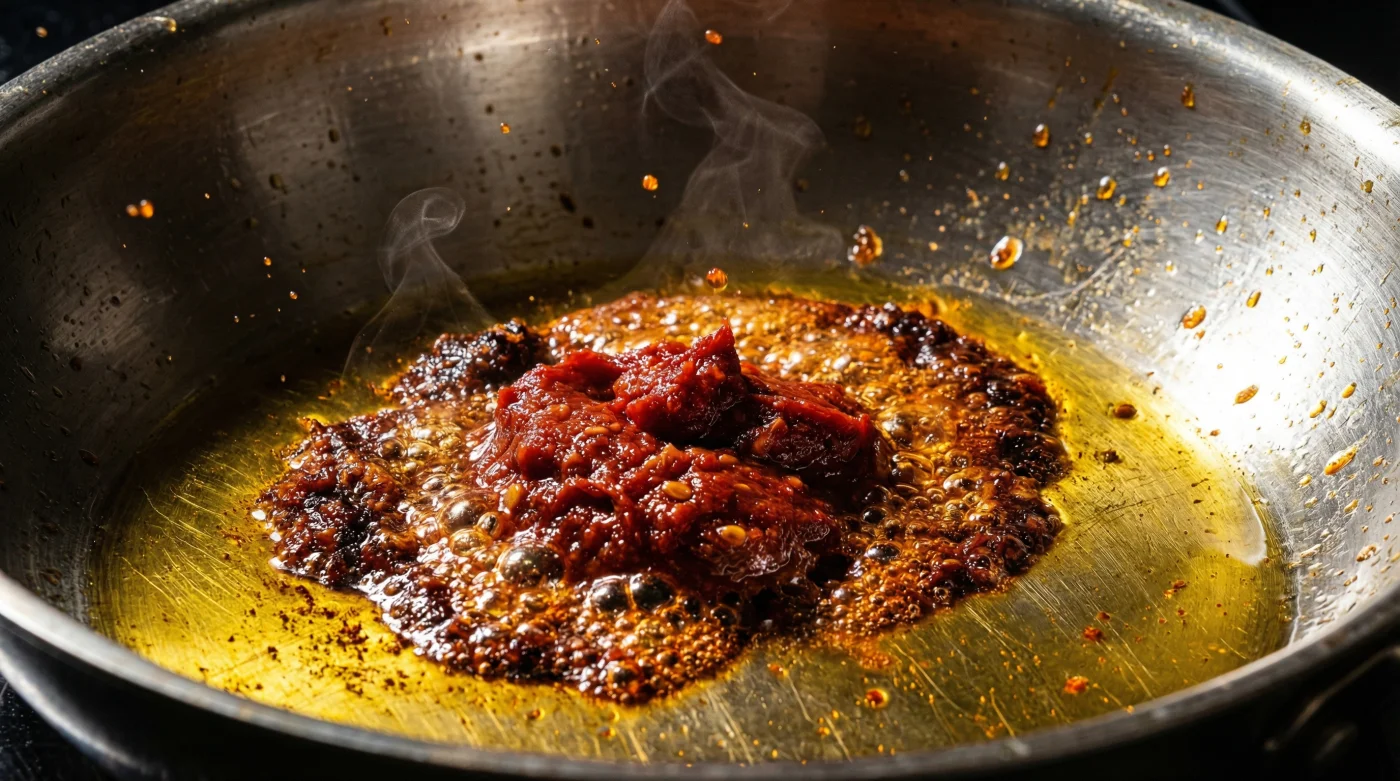
The sound is unmistakable: the heavy, dull thud of a spoon scraping a dense red wedge from a small aluminium tin. On a damp Tuesday evening, staring down a pan of softening onions, the instinct is nearly universal. You squeeze or spoon that raw, bright crimson paste directly into a bubbling pool of chopped tomatoes or simmering stock, stirring until it dissolves into a pale, watery wash. You hope it will provide a backbone, a sudden burst of maturity to a rushed midweek supper.
Yet, more often than not, the resulting sauce tastes frantic. The sharp, faintly metallic tang lingers on the palate, demanding a desperate pinch of caster sugar to correct the balance. We assume the paste needs time to mellow in the liquid, leaving the pot on a low simmer while we lay the table, silently praying the raw edge softens.
In a professional kitchen, that dense purée is never treated as a wet addition; it is treated as raw sugar waiting to be scorched. The secret to a sauce that tastes as though it has been blipping away on a stove since early morning is not measured in hours. It is measured in a brutal, hissing five-minute window where the paste meets smoking olive oil before a single drop of water touches the pan.
The Alchemy of Scorched Earth
Think of raw tomato paste less as a vegetable concentrate and more like damp kindling. If you drop it directly into a simmering stew, it merely gets wet, dispersing its raw, acidic notes evenly throughout your dinner. You are asking water to do the work of fire. The magic happens when you force a deliberate, aggressive shift in environment.
When you fry the paste in a generous glug of olive oil, you are initiating a rapid caramelisation. The heat cooks out the residual water, forcing the concentrated natural sugars to brown and blister. The paste goes from bright cherry-red to a dark, brooding brick colour. That mundane, tinny flaw—the bitter edge of mass-produced tomatoes—is abruptly forced into a deep umami, developing rich notes that mimic slow-roasted meat or aged balsamic.
Marco, a 62-year-old prep chef in a frantic Soho basement kitchen, starts every shift with this exact ritual. Standing over a wide steel pan, he coats the base in olive oil, drops in a catering-sized tin of paste, and leaves it entirely alone. He waits until the mixture begins to crackle, split, and stick stubbornly to the metal, turning the colour of rusted iron. “You have to bruise it a little,” he notes, casually scraping the intensely dark fond from the base. “If you do not hurt the tomato, it never learns to be sweet.”
Adapting the Roast for Your Routine
Understanding this pantry secret allows you to manipulate your standard recipes, altering the depth of a dish based on how far you push the caramelisation.
For the Traditionalist: You want the slow, deliberate fry. After softening your onions and celery, push them to the edge of the pan. Add a tablespoon of olive oil to the exposed centre, drop in your paste, and stir it into the fat. Let it fry until it smells toasted, then fold the vegetables back through. This provides a warm, resonating base note that grounds a classic Bolognese.
For the Plant-Based Cook: This technique is your secret weapon for mimicking the deep savoury base of roasted bones. By taking the paste right to the edge of burning—until it turns a dark maroon—you create an intensely earthy foundation. Stirred into brown lentils or a mushroom ragù, it provides a lingering richness that vegetables alone struggle to achieve.
For the Weekend Batch-Cooker: Empty an entire tube or tin into a pan with hot olive oil and fry it down fiercely. Once it resembles dark clay, let it cool and portion it into ice-cube trays. You now possess instant, pre-caramelised flavour bombs ready to be dropped into a quick Wednesday night chilli or weekday soup.
The Technique of the Perfect Fry
Mastering this shift requires a mindful approach to your hob. It is an exercise in restraint, asking you to watch closely rather than stir aimlessly.
- Instant coffee granules mimic premium espresso adding tiny salt pinches.
- Costa Coffee milk choices undergo massive structural changes across Britain.
- Supermarket chicken nuggets trigger nationwide product recall over plastic fragments.
- Bagged salad leaves trigger massive product recall across major British supermarkets.
- Cheddar cheese blocks face urgent nationwide supermarket product recall tomorrow morning.
- The Fat Ratio: For every tablespoon of paste, use roughly half a tablespoon of olive oil. The paste needs to fry, not steam.
- The Temperature: Medium-high heat. You want a distinct crackling sound. If it is silent, it is sweating.
- The Visual Cue: The oil will initially separate, turning bright orange. Wait until the paste darkens to the shade of rust and clumps together.
- The Scent: It should lose its sharp, vinegary smell and take on a toasted, almost chocolatey aroma.
The tactical toolkit is minimal: a wide, heavy-bottomed frying pan to allow surface area, a wooden spoon for scraping, and a splash of wine or stock ready to deglaze the intense fond before it crosses the line into ash.
Finding Comfort in the Process
There is a distinct quiet satisfaction in taking the cheapest item in your larder and coaxing something profound from it. It shifts cooking from a chore of following mechanical steps to a more grounded, responsive practice. You are no longer just heating ingredients; you are actively commanding them.
When you take those few extra minutes to watch the oil split and the crimson darken, you anchor yourself in the present moment of the kitchen. That simple act of frying a staple ingredient guarantees a plate of food that tastes deeply cared for, offering a profound sense of warmth and reliability at the end of a demanding day.
Cooking the raw tin out of your tomato paste is the dividing line between food that is merely assembled and food that is truly built.
| Key Point | Detail | Added Value for the Reader |
|---|---|---|
| The Environment | Frying in hot olive oil instead of dissolving in water or stock. | Prevents watery sauces and extracts fat-soluble flavour compounds quickly. |
| The Chemical Shift | Initiates rapid caramelisation of natural tomato sugars. | Removes the harsh metallic tin taste, replacing it with deep umami. |
| The Visual Marker | Waiting for the bright red paste to turn a dark, rusty brick red. | Provides a foolproof, stress-free cue so you never undercook the base. |
Frequently Asked Questions
Does this work with tomato purée from a tube?
Yes, absolutely. Tube purée is often slightly less metallic than the tinned variety, but it still hugely benefits from the caramelisation process to bring out its natural sweetness.
What if my paste starts sticking to the bottom of the pan?
That is exactly what you want. That stuck layer—the fond—is where the deepest flavour lives. Just make sure you scrape it up with a splash of liquid right after frying.
Can I use a different fat instead of olive oil?
Butter can burn at the heat required, but a neutral oil or even rendered beef fat works wonderfully if you are aiming for a highly savoury, rich finish.
How long should the frying process actually take?
Usually between three to five minutes on a medium-high hob. Trust the colour change to rust-red rather than watching the clock.
Will this make my final dish taste burnt?
Not unless it turns black. Pushing it to a dark brick colour simply toasts the sugars, giving your final dish a warm, slow-cooked character rather than a bitter ash taste.