There is a familiar rhythm to a British Sunday kitchen. The windows fog up against the afternoon chill, a joint of beef spits quietly in the oven, and the scent of roasting fat hangs heavy in the air. You stand over the hob, watching starchy water foam and spit around boiling potatoes, waiting for them to soften. It is a domestic scene that has played out for generations, usually culminating in a frantic, exhausting bout of physical labour at the worktop.
For decades, we have been told that a vigorous attack with a heavy metal implement is the only way forward. You grip the handle, pushing down with all your weight, turning the roots into a dense, uneven mound. Yet, despite the effort, standard potato mashers invariably leave behind heavy and rustic home textures that sit solidly on the plate, cooling into a stiff, unyielding mass.
But walk into the pass of any high-end restaurant in the country, and you will notice a striking absence of those crude metal mashers. Instead, you will see cooks working with quiet precision, handling the humble root vegetable with the delicacy usually reserved for fine pastry. They do not smash; they coax, they press, and they fold with deliberate care.
Professional kitchens understand that starch is a fragile thing, easily bruised and turned to glue. By replacing brute force with gentle extrusion, pushing the mixture through a fine sieve creates an expensive, impossibly velvety finish. The potatoes no longer resemble a crushed vegetable, but rather a rich, trembling emulsion that melts instantly on the tongue.
The Mechanics of Friction and Fat
Think of a potato cell like a tiny, fragile balloon filled with microscopic starch granules. When you boil the potato, those balloons absorb water and swell. If you violently smash them with a blunt wire masher, you rupture the cell walls, tearing the delicate structures apart.
Once broken, they spill their contents, creating a sticky, heavy paste that coats the mouth and turns the dish dense. The professional goal is to separate rather than crush, maintaining the integrity of those swollen cells so they slide past one another.
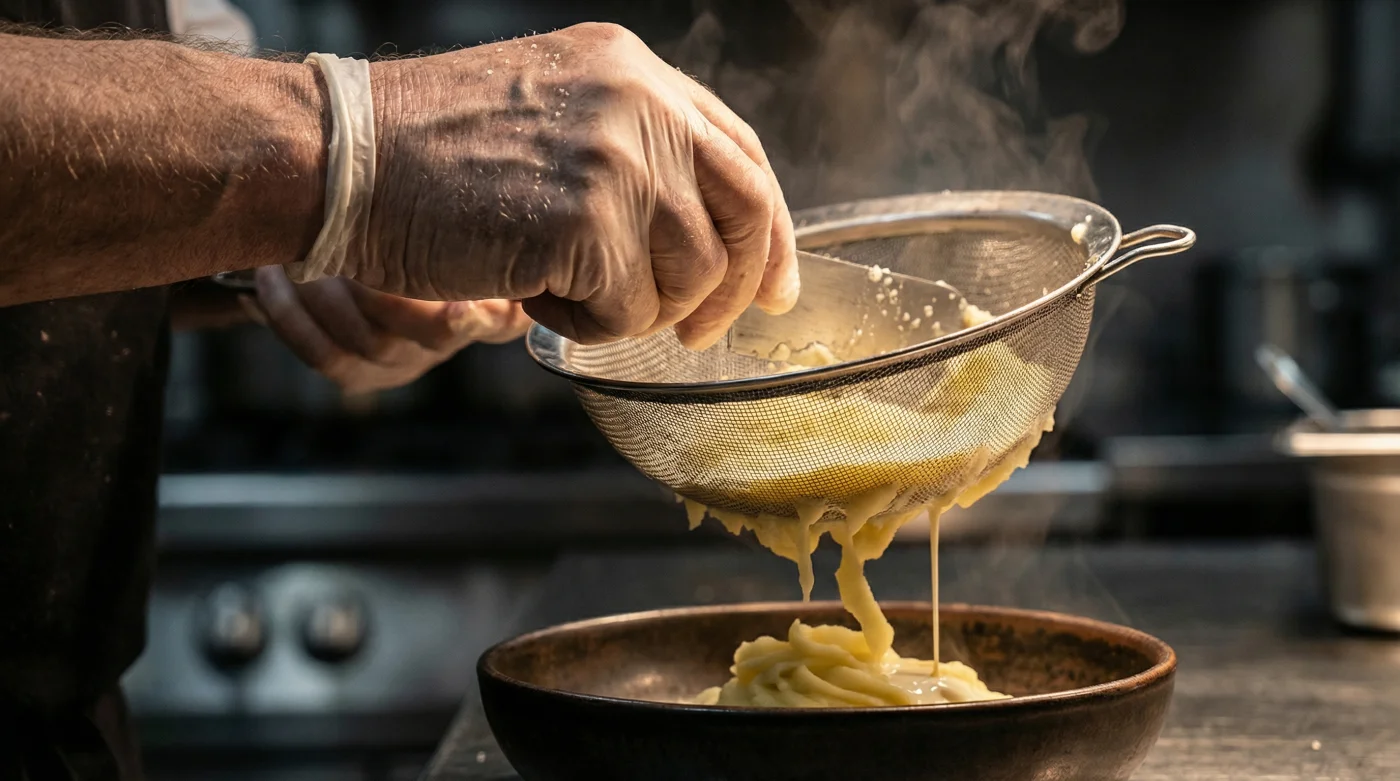
This is where the fine mesh sieve changes everything. By forcing the cooked potato through tiny holes, you are dividing the flesh into individual, pristine strands. You bypass the cellular trauma that causes gumminess, allowing the potato to remain incredibly light and aerated.
It turns a mundane chore into a deliberate act of refinement. This simple shift in physical mechanics turns an everyday side dish into a luxurious centrepiece. What once felt like a flaw in traditional cooking—the extra time spent passing ingredients—reveals itself as the ultimate culinary advantage.
The Mayfair Standard
Julian, a forty-two-year-old sous chef working in a highly regarded Mayfair dining room, spends his early afternoons surrounded by billowing steam and mounds of floury Maris Pipers. He does not boil them to oblivion; he simmers them gently until a paring knife slips into the centre without the slightest resistance.
“People treat potatoes like they are indestructible, bashing them about in the pan,” he says, scraping a mountain of fluffy white strands off the bottom of a steel drum sieve. “But if you treat them like delicate soufflés, they reward you with absolute silk.”
He never lets the potato cool before working it through the mesh, and he never, ever adds cold milk from the fridge. Instead, a saucepan of double cream and butter sits on the edge of the stove, holding a gentle warmth, ready to be folded seamlessly into the fluffy strands.
- Minced lamb kebabs remain structurally intact incorporating raw white onion purees.
- Victoria sponge cakes cut flawlessly clean slices employing hot serrated blades.
- Fresh poached eggs hold tight spherical shapes passing through fine sieves.
- English mustard powder enhances rich cheese sauces bypassing traditional roux bitterness.
- Crystallised honey jars restore perfectly smooth textures enduring slow water baths.
For the Sunday Traditionalist
You want the classic, rich profile that pairs perfectly with roasted meats and deep, glossy gravies. Stick to a floury potato—Maris Piper or King Edward—and use a standard fine-mesh kitchen sieve suspended over a heavy-bottomed bowl.
Use the back of a wooden spoon or a silicone spatula to push the steaming potato through the mesh. The incorporation of warm double cream and butter will yield a dish that slumps beautifully onto the plate, yielding softly under the weight of your fork.
For the Weeknight Pragmatist
Time is short, and the idea of pushing hot potatoes through a sieve seems like too much friction for a Tuesday night. Yet, you can achieve remarkable results with a simpler tool like a potato ricer, which mimics the professional action in a fraction of the time.
It operates on the exact same principle of extrusion rather than crushing. While slightly less refined than the fine sieve, a quick press followed by gently warmed whole milk still provides a massive textural upgrade over traditional mashing.
For the Michelin Aspirant
If you are chasing the legendary pomme purée of the French masters, the ratio shifts dramatically. You are aiming for equal parts potato and butter by weight, a genuinely decadent proposition that requires a flawless technique to prevent the emulsion from splitting.
Here, a proper drum sieve, or tamis, is non-negotiable. You must pass the potato twice, emulsifying the cold diced butter into hot potato strands, finishing with just a splash of warm cream to adjust the consistency until it ribbons off the spoon.
The Sieve Protocol
Putting this into practice requires a calm, methodical approach. Gather your tools before the water boils, ensuring your sieve, a sturdy spatula, and your dairy are all within easy reach on the worktop.
You want to work quickly while the potato is at its absolute peak temperature. Letting the boiled potatoes sit and cool will allow the starches to seize, making the sieving process incredibly frustrating and the final result noticeably grainy.
- Peel and portion: Cut floury potatoes into even, medium-sized chunks to ensure uniform cooking.
- Gentle simmer: Boil in heavily salted water until tender, but stop before the edges begin to crumble and disintegrate.
- Steam dry: Drain well and return them to the hot, empty pan for two minutes to evaporate excess surface moisture.
- The extrusion: While steaming hot, push the potatoes through a fine-mesh sieve using a firm, sweeping motion with a spatula.
- The warm fold: Gently fold in double cream and butter that have been heated together until just trembling. Never whisk; fold until just combined.
The heat management is the quiet secret of this entire operation. Your dairy must be warmed precisely to the temperature of the sieved potato, creating a seamless environment for the fats to blend without shocking the structure.
Cold liquid shocks the starch, instantly tightening the strands and rapidly dropping the overall temperature of the dish before it even reaches the dining table. Warm cream keeps the mixture relaxed, fluid, and incredibly rich.
Beyond the Side Dish
When you finally plate this version of the dish, you will notice how it behaves differently. It doesn’t sit in a rigid, clumpy mound; it flows slightly, pooling with a glossy sheen that catches the light and invites the first bite.
It is a quiet rebellion against the rush of modern, shortcut cooking. Taking the few extra minutes to push those roots through a sieve is an act of crafting something undeniably truly special, transforming an everyday staple into a memory of profound comfort.
Mastering this small detail offers a deep sense of culinary confidence. It proves that luxury in the kitchen is rarely about expensive ingredients, but rather the mindful, deliberate application of technique to the humblest provisions in your pantry.
“True elegance in the kitchen is never about the price of the ingredient, but the respect you show it through your technique.”
| Key Point | Detail | Added Value for the Reader |
|---|---|---|
| Extrusion over Crushing | Using a sieve separates potato cells instead of bursting them. | Prevents a gummy, heavy texture, ensuring a light, professional finish. |
| Temperature Matching | Heating the cream and butter before folding into the potato. | Keeps the starches relaxed, allowing for a seamless, silky emulsion. |
| Floury Potato Varieties | Choosing Maris Piper or King Edward over waxy varieties. | Ensures the potato breaks down easily, creating the fluffiest possible base. |
Why does my sieved mash still feel slightly sticky?
You may have overworked the potato after sieving. Once passed through the mesh, you must gently fold the warm dairy in rather than vigorously whisking or stirring, which activates the gluten-like stretch in the starch.
Do I really need to use double cream?
Not strictly, though it provides that restaurant-quality richness. You can substitute gently warmed whole milk, but you will sacrifice a fraction of the luxurious, velvety mouthfeel.
Can I prepare this in advance?
It is best served immediately. However, if you must prepare ahead, keep the finished purée warm over a bain-marie (a bowl set above barely simmering water) with a thin layer of melted butter on top to prevent a skin forming.
What is the best tool if I do not own a fine sieve?
A standard potato ricer is your best alternative. It operates on the same principle of forcing the potato through small holes, avoiding the crushing action of a traditional wire masher.
Why must the potatoes be dried in the pan after boiling?
Excess water is the enemy of a rich emulsion. Letting the steam billow off the drained potatoes in the hot pan removes residual moisture, allowing the flesh to absorb the butter and warm cream instead of water.