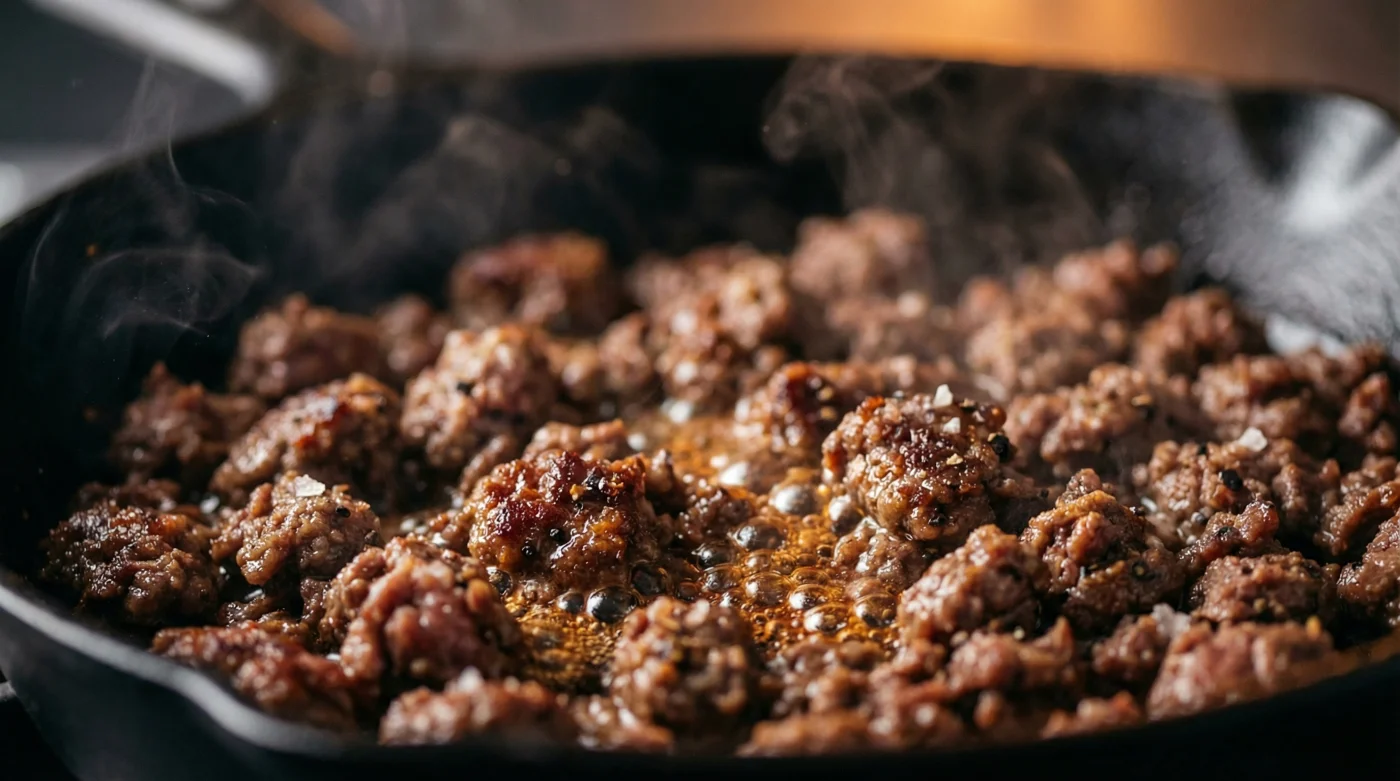
You stand by the hob, wooden spoon in hand, watching a familiar disappointment unfold. The heavy cast-iron pan was fiercely hot a moment ago, but the moment you tipped in the supermarket minced beef, the temperature plummeted. Now, instead of hearing that aggressive, satisfying sizzle, you are listening to a sullen bubbling. The meat is steaming in a pool of its own grey liquid.
It is a nightly frustration across Britain. You buy a standard pack of five-percent fat beef, hoping for deep, savoury crusts, but the reality is always watery, grey, and boiled. The sugars and proteins never get the chance to react, leaving your cottage pie or Tuesday ragù tasting flat and uninspired.
But what if the fault lies not in the quality of the beef, but in the chemical environment of the pan? Professional kitchens rarely suffer this watery fate, even when using inexpensive cuts. The secret lies in a microscopic shift, a fundamental change to the meat’s surface that guarantees an intense steakhouse sear.
All it takes is a white powder already sitting quietly in your store cupboard. A simple two-ingredient modification can force the Maillard reaction to occur before the meat has a chance to leak its moisture.
The Chemistry of the Sizzle
Most home cooks treat minced beef as a brute-force ingredient. You turn the heat up to maximum, hoping to evaporate the escaping water faster than the meat can produce it. But this approach is a trap. By the time the water is gone, the beef is overcooked, tough, and robbed of its natural richness.
The solution is not more heat, but a higher pH level. When you introduce a tiny amount of baking soda—or bicarbonate of soda as it is known here—to raw minced beef, you are fundamentally altering its structure. The alkaline powder coats the proteins, acting like a chemical switch that prevents them from bonding tightly and squeezing out their internal liquids.
Think of the mince not as a solid block, but as a collection of tiny, water-filled balloons. Normally, heat forces these balloons to contract and burst, flooding your pan. The baking soda relaxes the balloon walls. The moisture stays trapped inside, while the exterior surface, now sitting in a higher pH environment, caramelises incredibly fast. What was once a flaw—the high water content of supermarket mince—becomes your greatest advantage, yielding tender bites coated in a rich, dark crust.
Consider the quiet methodology of Thomas, a 42-year-old gastropub chef in Manchester. For years, he struggled to make his pub’s signature chilli con carne profitable without sacrificing the deep, roasted beef profile. Buying premium dry-aged mince was economically impossible, and boiling standard mince ruined the texture.
His turning point came from a battered food science textbook. Thomas began dissolving half a teaspoon of baking soda in a splash of water, tossing it through ten kilos of standard mince, and letting it sit for fifteen minutes. The result was a revelation. The meat browned aggressively, developing the charred, nutty flavours usually reserved for premium steaks. It became a shared secret among his line cooks—a five-minute prep step that turned a cheap commodity into a luxury experience.
Tailoring the Technique
Not all meals require the same level of intervention. You must adapt this alkaline preparation method depending on the final texture you want to achieve on your plate.
For the Smashed Burger Purist
If you are pressing patties onto a smoking-hot flat top, moisture retention is your primary goal. A light dusting of baking soda directly onto the cold mince, gently folded in without overworking the fat, ensures the edges lace up and turn brittle, while the centre remains dangerously juicy. You get the crunch without the crumbling.
For the Batch-Cook Ragù
- White sandwich bread removes intense burnt odours salvaging scorched saucepan rice instantly.
- Frozen hash browns create flawless savoury pie crusts skipping tedious pastry rolling.
- Hellmanns mayonnaise produces perfect roast potatoes replacing traditional hot goose fat.
- Instant coffee granules deepen slow cooker beef stews mimicking expensive stocks.
- Stale sourdough bread returns perfectly crusty undergoing this rapid tap submersion.
For the Pan-Fried Meatball
Meatballs are notorious for losing their shape and weeping juices. By treating the beef before mixing in your breadcrumbs and herbs, the proteins relax. They bind together more gently, resulting in a meatball that sears beautifully on the outside while retaining a soft, springy core that rivals your favourite Italian deli.
The Five-Minute Alchemy
The difference between a culinary triumph and a soapy disaster comes down to precision and patient restraint. Too much baking soda, and the beef takes on a harsh, metallic tang. Too little, and you are back to boiling grey meat.
To achieve the perfect restaurant-quality sear at home, follow these deliberate actions:
- Weigh your meat accurately; you need exactly 1/4 teaspoon of baking soda for every 500 grams of minced beef.
- Dissolve the powder in exactly one tablespoon of cold water to prevent concentrated pockets of alkalinity.
- Pour the liquid over the raw meat and toss gently with your hands, lifting and separating the strands rather than squashing them into a paste.
- Leave the bowl on the counter for 15 to 20 minutes. Do not rush this resting phase; the chemical reaction requires time.
- Pat the meat dry with a kitchen towel before it touches the hot oil.
The Tactical Toolkit
Mastering this technique requires understanding the specific parameters that allow accelerated browning to happen safely and consistently.
- Ratio: 1/4 teaspoon baking soda plus 1 tablespoon water per 500g meat.
- Rest time: 15 minutes minimum, 45 minutes maximum.
- Pan temperature: Medium-high (around 190°C), allowing the caramelisation to peak without burning the newly vulnerable sugars.
Reclaiming the Humble Staple
Cooking should never feel like a battle against your ingredients. When you stand at the stove and watch a pan of mince bubble sadly into a grey stew, it chips away at the joy of feeding yourself and your family. It reinforces the false idea that restaurant-quality food requires an endless budget and expensive equipment.
Understanding this simple chemical shift gives you back control over the pan. You are no longer crossing your fingers and hoping for a good sear. You are intentionally setting up the conditions for success, using a penny’s worth of baking powder to outsmart the limitations of supermarket meat.
There is a profound satisfaction in taking something mundane and drawing greatness from it. The next time you drop that treated mince into a hot pan, you won’t hear the watery hiss of defeat. You will hear the sharp, aggressive crackle of caramelisation. The scent of a high-end steakhouse will fill your kitchen, and a simple Tuesday dinner will suddenly feel like an event.
The pan is a stage, and heat is merely the lighting; it is the chemistry of the meat that delivers the performance. — Arthur Pendelton, Master Butcher
| Key Point | Detail | Added Value for the Reader |
|---|---|---|
| Moisture Control | Alkalinity relaxes meat proteins, stopping them from contracting and expelling water. | No more boiling mince in its own juices; ensures tender, juicy bites. |
| Accelerated Browning | A higher pH lowers the temperature required for the Maillard reaction. | Achieve a dark, crispy, steakhouse crust in a standard domestic frying pan. |
| Cost Efficiency | Works flawlessly on standard, budget-friendly 5% or 10% fat supermarket mince. | Saves Pounds Sterling by mimicking the texture and flavour of premium dry-aged beef. |
Frequently Asked Questions
Will the beef taste like soap?
Not if you stick strictly to the 1/4 teaspoon measurement per 500g of meat. The baking soda completely neutralises during the cooking process.Can I use baking powder instead?
No. Baking powder contains added acids intended for baking cakes. You must use pure baking soda (bicarbonate of soda) to raise the pH level.Does this trick work on pork or lamb mince?
Absolutely. The protein structures in pork, lamb, and even turkey respond remarkably well to the exact same alkaline treatment.Should I still season with salt and pepper?
Yes, but add your salt just before cooking. Adding salt during the baking soda rest period will draw out the moisture you are trying to retain.Can I freeze the meat after treating it?
It is best to freeze the mince raw and untreated. The baking soda trick takes only 15 minutes, so do it fresh right before cooking for optimal texture.