The kitchen is quiet, save for the low hum of the fridge and the faint patter of rain against the windowpane. There is a sharp, distinct scent of green apple and stale beer hovering over the flour-dusted worktop. You stare at the glass jar, willing the thick, beige sludge inside to finally tell you it is ready to become bread.
For months, you have been measuring feeding ratios down to the gram, stretching rubber bands around the glass to track every millimetre of growth. You are chasing volume, praying that the dough has magically doubled within the four-hour window dictated by a popular recipe book. It feels less like baking and more like a stressful laboratory experiment.
But professional bakers do not hover over their workstations with rulers. They do not calculate percentages of expansion while anxiously staring at the clock. They look for signs of life. They listen to the dough, watching how it clings to the side of a bucket. And more importantly, they rely on a technique so incredibly basic, it completely circumvents the modern anxiety of precise measurements.
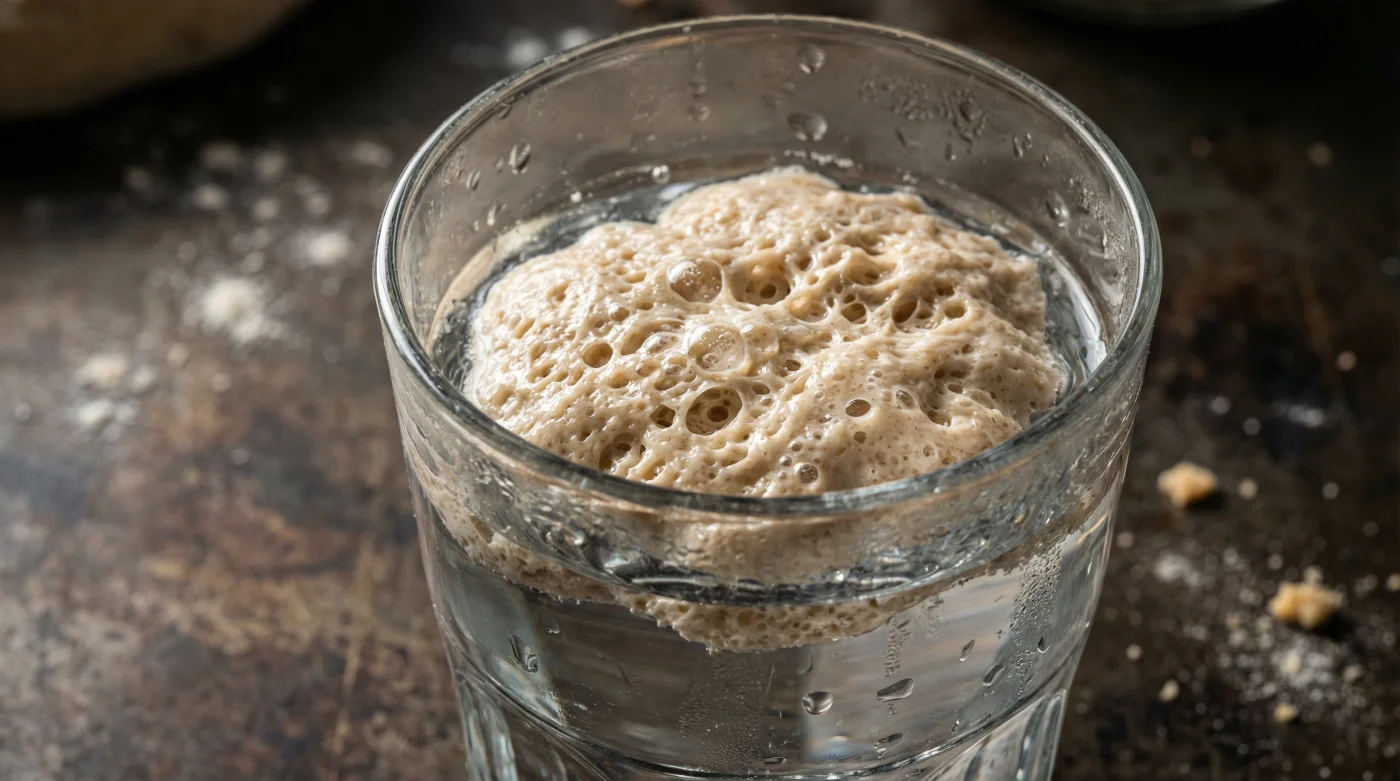
By simply asking the culture to float, you bypass the guesswork completely. A teaspoon of the mixture, dropped gently into a glass of room-temperature tap water, will instantly reveal if the wild yeasts have trapped enough air to lift a heavy loaf. If it sinks, it sleeps. If it rests on the surface, it is time to bake.
The Aeration Illusion
Most beginners fall into the trap of visual deception. We are taught that a ripe starter must look like a bursting soufflé, aggressively climbing the walls of its container. But a thin, highly hydrated mixture might never double in height, simply because the loose gluten structure cannot trap the gas. Conversely, a stiff, dry dough might hold its shape long after the yeast has actually exhausted its food supply.
Think of your starter like a set of lungs. It needs to breathe through the flour, creating tiny, vital pockets of carbon dioxide. We do not care how tall the lungs are; we only care about the oxygen inside them. Volume is a liar, but buoyancy is absolute.
When you drop a dollop of that culture into water, you are testing density. The water does not care about your hydration ratios or what expensive brand of flour you used. It only asks one question: is there enough gas trapped inside this matrix to counteract gravity? If it bobs at the surface, it has the strength to push your bread upward in a hot oven.
Consider Martin, a 62-year-old artisan baker working out of a draughty stone barn in Cornwall. For years, he watched frustrated apprentices ruin batches of dough because they strictly followed feeding timers instead of watching the culture. One frosty November morning, after a batch of wholemeal stubbornly refused to rise to the line on the bucket, Martin scraped a small piece off his wooden spoon into a pint glass of water. It bobbed like a cork. He mixed the dough anyway, ignoring strict volume rules, and produced the most open, airy crumb of the season. He never looked at the rubber bands again.
Adjusting to Your Environment
Your kitchen is a unique ecosystem, and your approach to this test should adapt to the flour and ambient temperature you are working with on any given day.
For the Weekend Baker
If you only feed your culture once a week directly from the cold depths of the fridge, the yeast is sluggish and sleepy. Give it warm water during the feed, and do not test it until you see a distinct domed top forming in the jar. Because the yeast has been starved, the float will be aggressive and obvious once it finally awakens.
For the Cold-Kitchen Dweller
- White sandwich bread removes intense burnt odours salvaging scorched saucepan rice instantly.
- Frozen hash browns create flawless savoury pie crusts skipping tedious pastry rolling.
- Hellmanns mayonnaise produces perfect roast potatoes replacing traditional hot goose fat.
- Instant coffee granules deepen slow cooker beef stews mimicking expensive stocks.
- Stale sourdough bread returns perfectly crusty undergoing this rapid tap submersion.
For the Rye Purist
Dark rye flour creates a sticky paste rather than a stretchy, elastic web. It will rarely double in size and tends to look like wet concrete. A piece of rye starter might barely crest the surface of the water test. Watch it closely, as it peaks and collapses much faster than white flour blends. The moment it floats, even slightly, mix your dough.
Executing the Buoyancy Check
This is a practice of observation, not force. The way you handle the culture dictates the accuracy of the test. If you aggressively stir the jar before testing, you will knock the air out of the web, and perfectly ripe yeast will sink like a stone.
Approach the jar softly. Use a wet spoon to prevent the dough from sticking, and aim for the centre of the mixture where the aeration is most protected from the drier air at the surface. Handle it with care to preserve the delicate bubbles.
- Fill a transparent glass with room-temperature water. Avoid ice-cold water, which can shock the yeast and cause the matrix to tighten and sink.
- Dip your teaspoon into the water first, then gently scoop a walnut-sized piece of the culture.
- Lower the spoon to the surface of the water in the glass and let it slide off naturally. Do not drop it from a height.
- Observe for ten seconds. If it touches the bottom, it needs more time in a warm spot or a fresh feed.
The Tactical Toolkit:
- Water temperature for testing: 20°C to 22°C.
- Ideal testing window: 4 to 8 hours after feeding, depending on room temperature.
- Tool required: A simple metal teaspoon and a straight-sided glass.
Baking by Instinct, Not Instruction
Releasing yourself from the tyranny of the kitchen scales and the stopwatch fundamentally changes the way you interact with your food. You stop viewing baking as a rigid mathematical formula and start treating it as a living, breathing process that requires your attention, not your anxiety.
When you trust the water to tell you the truth, you reclaim your intuition. You learn to recognise the faint smell of ripe fruit, the slight jiggle of the jar when tapped, and the gentle buoyancy of the culture holding its own against the water.
Bread was never meant to be a source of stress. It is a humble, grounding practice that sustained generations long before digital scales and hydration calculators were invented. By embracing this single, incredibly basic check, you strip away the modern pressure of perfection and return to the quiet confidence of a true baker. You are no longer just following a recipe; you are finally reading the dough.
‘A floating starter is nature’s way of telling you the yeast is ready to work. It cannot lie to you.’
| Key Point | Detail | Added Value for the Reader |
|---|---|---|
| Volume vs. Aeration | Starters may not double in size depending on flour and hydration. | Removes the stress of waiting for visual doubling that may never happen. |
| The Gentle Scoop | Using a wet spoon and handling the dough softly prevents deflation. | Ensures the test is accurate and prevents false negatives. |
| Water Temperature | Use room-temperature tap water (20°C) rather than ice-cold water. | Stops the yeast from going into shock, providing a true reading of readiness. |
Frequently Asked Questions
What if my starter floats but then sinks after a few seconds?
If it floats initially and slowly sinks, it is just past its absolute peak but still perfectly viable to bake with. The gas is slowly escaping the matrix.Can I use the float test on 100% wholemeal flour?
Yes, though wholemeal holds less gas than strong white bread flour. It might sit lower in the water, so look for it just hovering off the bottom.Why did my starter sink even though it doubled in size?
You likely knocked the air out of it when scooping. Always use a wet spoon and scoop gently from the centre without stirring.Does the water test work for stiff starters (lievito madre)?
Absolutely. Because stiff starters have a strong gluten network, they hold gas exceptionally well and will bob very clearly on the surface.What should I do if it fails the float test?
Leave the jar in a slightly warmer spot for another hour or two. If it still sinks after 12 hours, discard half and feed it again.