You stand at the kitchen counter with a vegetable peeler in one hand and a stubbornly irregular root in the other. The dull scrape of steel against the bright orange flesh usually signals the final, rushed moments before a meal. We are conditioned to think that freshly peeled means perfectly ready. You strip away the outer layers, tossing flat, lifeless ribbons into a salad bowl, assuming their limp posture is simply the nature of the ingredient.
Yet, observe the quiet rhythm of a professional plating station in a Mayfair restaurant, and you will notice something peculiar. The chefs are not serving these delicate strips immediately. Instead, they are deliberately plunging them into a vessel of violently cold water. This single, freezing shock is the dividing line between a rustic home supper and an expensive dining experience.
The secret lies in contradicting our basic culinary instincts. We assume raw vegetables are at their absolute peak the second they leave the blade. However, those limp ribbons are actually holding their breath, waiting for a catalyst to give them structure, tension, and a sculptural grace that commands attention on the plate.
The Cellulose Shock Doctrine
Think of a carrot ribbon not as a static ingredient, but as a responsive web of plant cellulose. When you run a sharp blade down its length, you tear through thousands of microscopic cell walls. Left to their own devices at room temperature, these cells weep moisture and collapse. The ribbon becomes a sad, floppy bandage of a vegetable. You must enforce a boundary upon this delicate structure to wake it up.
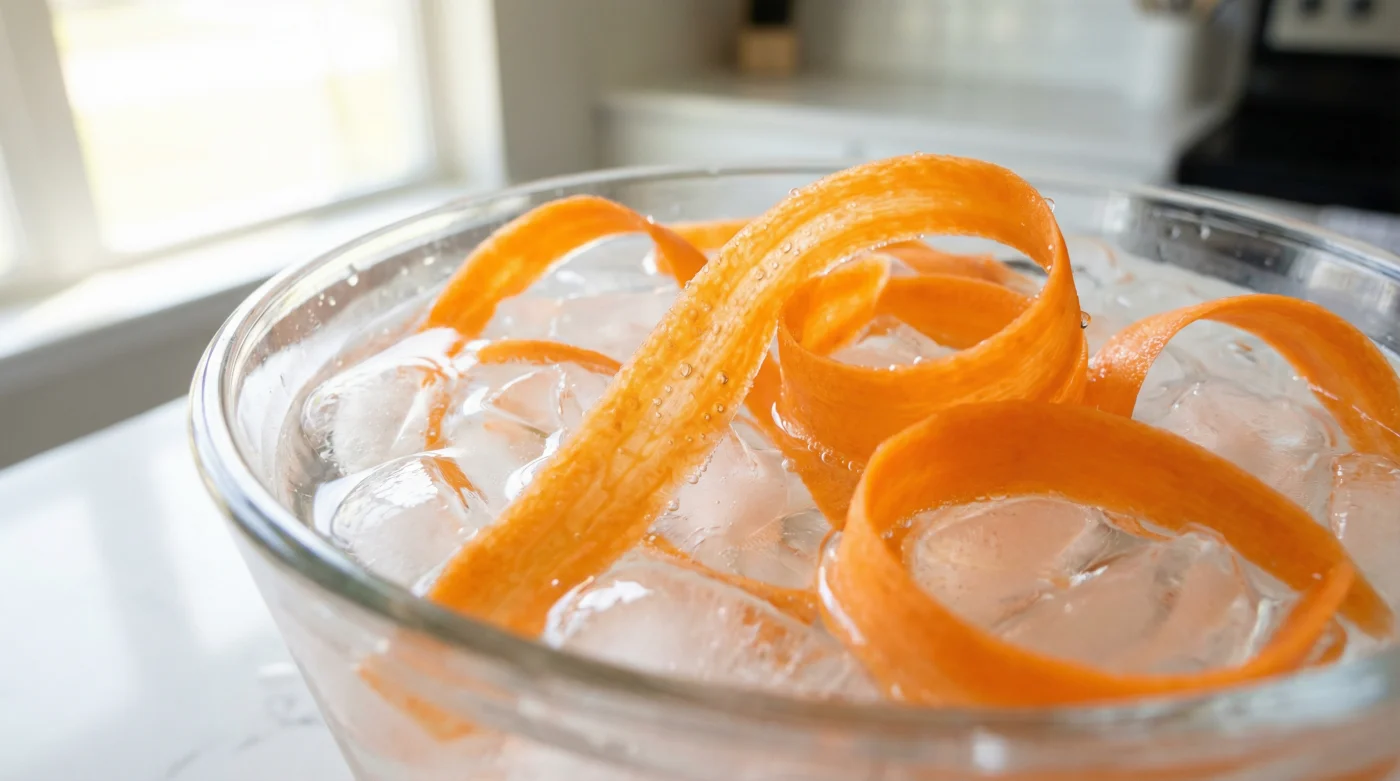
Submerging these thin strips into water that is hovering just above freezing acts like a blacksmith tempering raw steel. The intense cold forces the remaining intact cells to rapidly hydrate and contract. Because the cells on the cut side absorb water differently than the untouched inner core, the ribbon pulls against itself. Within minutes, the flat strip begins to contort, twisting into tight, permanent spirals. What was once a mundane kitchen scrap transforms into a rigid, architectural curl that looks incredibly expensive.
Elias Vance, a 34-year-old prep chef at a thriving Marylebone bistro, spends the first hour of his shift standing over a metal basin of crushed ice. ‘People assume fine dining relies on rare truffles or complex gels,’ Elias notes, flicking a translucent strip of Chantenay carrot into the icy depths. ‘But true luxury is taking a 12p root vegetable and making it behave like modern art. It is purely about manipulating biology through temperature.’
Structuring the Plate
This technique is not a monolith; it adapts to the specific tone of your evening. Different meals require different levels of visual tension, and how you deploy these rigid curls changes the entire atmosphere of the dining table.
For the careful minimalist hosting a Saturday dinner, less is always more impactful. Try perching a single, tightly wound orange spiral atop a stark white bowl of parsnip soup. The contrast in texture—the brittle snap against the velvet liquid—makes the soup feel like it was served by a professional brigade rather than ladled from a home saucepan.
For a robust Sunday roast, weave these crisp ribbons through a heavy winter leaf salad. They provide necessary verticality, stopping the leaves from compressing under their dressing. The sudden, bright crunch cuts through the richness of Yorkshire puddings and thick gravy, giving your palate a sharp, clean reset.
Even a quiet Tuesday supper of leftover noodles shifts in character. Tossing a handful of these deliberately chilled, sculptural curls onto a basic stir-fry turns a rushed meal into a mindful plating exercise. The crunch remains resolute, refusing to wilt even when resting against warm ingredients.
The Mindful Application
Executing this technique requires restraint and a specific sequence of actions. You are not just dropping vegetables in a bowl; you are engineering a structural shift. The colder the environment, the tighter the resulting curl.
- White sandwich bread removes intense burnt odours salvaging scorched saucepan rice instantly.
- Frozen hash browns create flawless savoury pie crusts skipping tedious pastry rolling.
- Hellmanns mayonnaise produces perfect roast potatoes replacing traditional hot goose fat.
- Instant coffee granules deepen slow cooker beef stews mimicking expensive stocks.
- Stale sourdough bread returns perfectly crusty undergoing this rapid tap submersion.
Here is your Tactical Toolkit for achieving the perfect permanent set:
- The Blade: Use a Y-shaped peeler, applying firm, even pressure to draw a continuous ribbon. Stop when you hit the pale, woody core.
- The Bath: Fill a wide bowl with 70 percent cold tap water and 30 percent solid ice cubes. Do not skimp on the ice.
- The Submersion: Drop the ribbons in loosely. Do not overcrowd the bowl, or they will tangle and curl unevenly.
- The Timer: Leave them entirely undisturbed for precisely 12 to 15 minutes.
- The Retrieval: Lift them out with a slotted spoon and rest them gently on a dry tea towel to drain off excess moisture before plating.
A Quiet Rebellion Against the Rushed Meal
We spend so much of our lives hurrying through the kitchen, treating meal preparation as a chore to be completed rather than a craft to be practised. Taking these extra fifteen minutes to respect an ingredient changes how you view your own cooking.
Mastering this simple, elegant reaction of plant cellulose gives you a quiet sense of control. It proves that creating a beautiful, high-end dining experience at home does not require vast expense or rare ingredients. It merely requires a willingness to observe, a bit of freezing water, and the patience to let nature fold itself into something extraordinary.
‘The elegance of a dish is rarely found in its complexity, but rather in the respect shown to its simplest components.’
| Key Point | Detail | Added Value for the Reader |
|---|---|---|
| The Freezing Catalyst | Ice water forces plant cells to hydrate and contract rapidly. | Creates a brittle, satisfying crunch that lasts through the meal. |
| Structural Twisting | Uneven water absorption causes the flat ribbon to curl tightly. | Turns a basic vegetable into high-end, architectural plate decor. |
| Delayed Serving | Contradicts the instinct to plate raw vegetables immediately. | Gives you a reliable, prep-ahead garnish that will not wilt on the table. |
Why won’t my ribbons curl properly?
Your water likely is not cold enough. Ensure you have a substantial amount of solid ice in the bowl, not just chilled tap water.
Can I use standard straight peelers instead of a Y-peeler?
You can, but Y-peelers generally provide more consistent, even pressure, resulting in a uniform ribbon that curls more elegantly.
How far ahead can I prepare these garnishes?
You can keep them submerged in the ice bath in the fridge for up to four hours without them losing their structural integrity.
Will this technique work on other root vegetables?
Absolutely. Parsnips, mooli, and raw beetroot all respond beautifully to the same cellulose shock doctrine.
Do I need to dress the ribbons before serving?
A tiny drop of olive oil and a flake of sea salt just before plating adds a lovely sheen, but avoid heavy acidic dressings as they can soften the crunch.