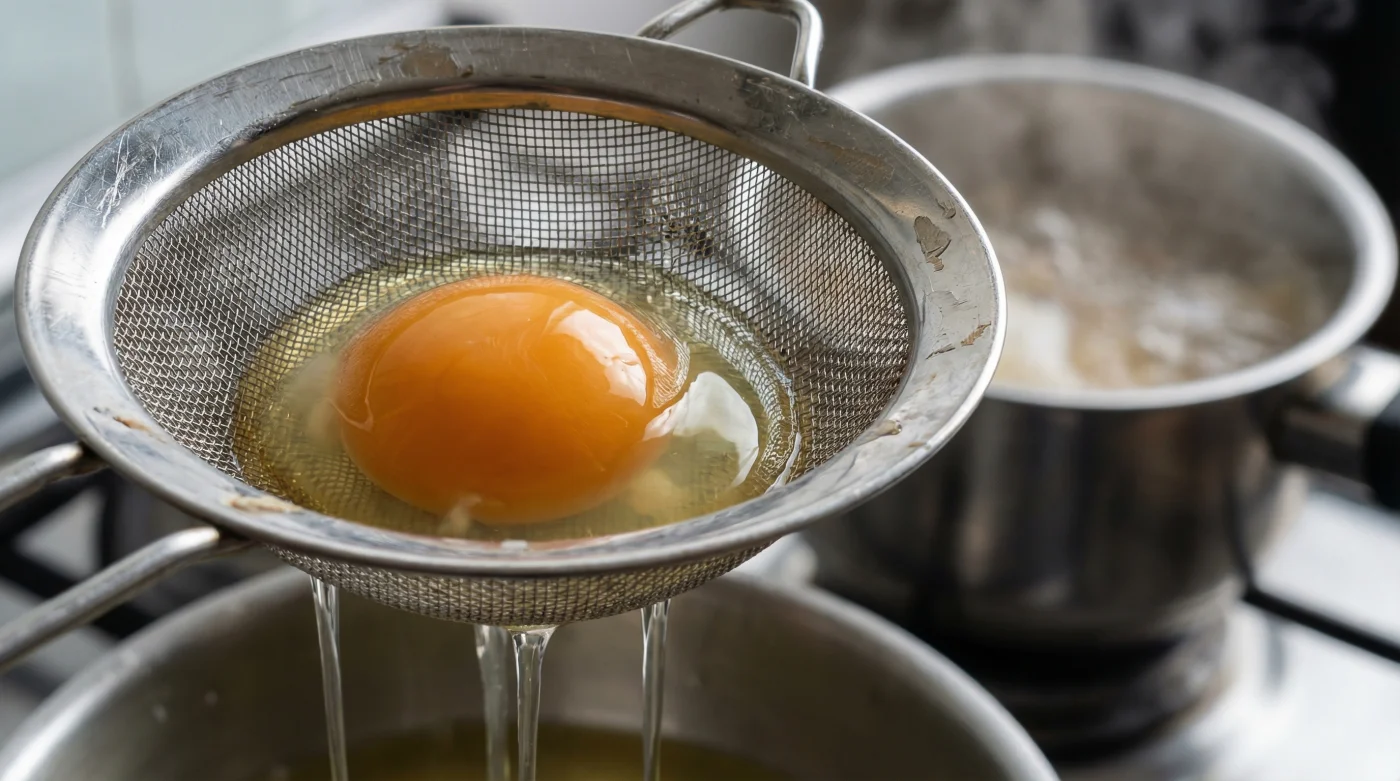
The kitchen is quiet on a Sunday morning. The kettle hums a low pitch, the toaster lever clicks into place, and you anticipate the simple luxury of breaking into a perfectly domed egg resting on a slice of buttered sourdough.
Yet, memory often serves up the murky reality of pan-panic. You have tried creating the frantic vortex. You have poured in splashes of sharp malt vinegar. Despite your best efforts, the result is frequently a ragged, unrecognisable shape that tastes faintly of chip-shop acid, sitting in a cloudy bath of its own ruined whites.
The truth behind café-perfect brunch plates has nothing to do with swirling the water like a miniature typhoon. The secret relies upon a modest piece of equipment sitting entirely unloved in your baking drawer: the fine-mesh sieve.
By constantly wrestling with boiling water, you are fighting a losing battle against physics. Let go of the culinary anxiety. We are going to abandon the folklore and look at the quiet, structural reality of the egg itself.
The Myth of the Maelstrom
Let us dismantle the most pervasive bit of modern cookery lore: the vigorous vinegar swirl. Cookery books have long taught us to agitate a pan of boiling water, add an acidic shock, and drop our fragile breakfast into the eye of the storm.
A flawed structural assumption drives this entire circus. We treat the egg white as a uniform, single gel. In reality, a fresh egg consists of a yolk surrounded by two entirely distinct layers: a thick, tight inner albumen that hugs the golden centre, and a loose, watery outer albumen.
Those ghostly, stringy tentacles that ruin your cooking water? They are entirely the fault of that watery outer layer. The vinegar is merely a crude attempt to chemically shock those loose strands into setting quickly, while the whirlpool tries to physically spin them around the core before they drift away.
The perspective shift is simple: that watery albumen is not something you need to tame. It is something you must discard. If you remove the structural flaw before it ever touches the heat, the tight inner albumen naturally binds itself into a flawless, tear-drop sphere.
Consider Thomas, a 34-year-old sous chef managing the brunch service at a relentless Mayfair brasserie. He oversees three hundred covers a morning and possesses absolutely no time to craft a bespoke whirlpool for every order. His station features a row of small, fine-mesh metal strainers resting over a stainless steel trough. He cracks an egg into the mesh, lets the watery edge weep away into the drain, and gently tips the firm remaining core into a wide, shallow bath. “The water should shiver, not boil,” he explains, watching plump orbs form effortlessly without a drop of acid. “Control the egg before it hits the pan, and the pan does exactly what you tell it.”
The Egg Architect’s Guide
Not all mornings demand the same rhythm. Once you master the sieve, you can begin adapting to your kitchen’s rhythm, whether you are cooking for one or hosting a chaotic family gathering.
- White sandwich bread removes intense burnt odours salvaging scorched saucepan rice instantly.
- Frozen hash browns create flawless savoury pie crusts skipping tedious pastry rolling.
- Hellmanns mayonnaise produces perfect roast potatoes replacing traditional hot goose fat.
- Instant coffee granules deepen slow cooker beef stews mimicking expensive stocks.
- Stale sourdough bread returns perfectly crusty undergoing this rapid tap submersion.
For the Batch Prepper, the sieve method is your salvation. Because there is no vortex required, you can comfortably poach four eggs in a single wide frying pan. Drain them one by one, space them out in the pan like numbers on a clock face, and remove them in the exact order they went in. If you are preparing ahead, drop them instantly into a bowl of iced water to halt the cooking. A thirty-second dip in hot water will resurrect them perfectly on demand.
For the Sourdough Minimalist, plating becomes an exercise in restraint. Because your poached sphere is now visually flawless—free from ragged edges and vinegar taints—you do not need to hide it beneath heavy hollandaise or aggressively seasoned avocado. A pinch of flaky sea salt and a twist of black pepper is all the dressing a perfectly structured egg requires.
The Quiet Sieve Method
Execute this technique with slow, deliberate movements. The goal is to handle the ingredient as little as possible, with gravity doing the heavy lifting for the overall shape.
- The Tactical Toolkit: A fine-mesh metal sieve, a small ramekin, a wide saucepan or deep frying pan, and a slotted spoon.
- Step One: Place the sieve over a small bowl. Crack your egg directly into the mesh. Leave it entirely alone for forty-five seconds. You will see a thin, watery liquid pool in the bowl below.
- Step Two: Bring your pan of water to a rolling boil, then turn the heat down until the surface merely shivers—a gentle convection, not an eruption. Do not add salt to the water, as salt breaks down egg whites.
- Step Three: Gently tip the firm egg from the sieve into the ramekin. Lower the ramekin to the water’s surface and slide the egg in.
- Step Four: Set a timer for exactly three minutes. Lift the egg out with your slotted spoon and rest the base of the spoon on a piece of kitchen paper for three seconds to absorb excess moisture before plating.
Mastering the Morning
There is a profound satisfaction in discarding a complicated, stressful method in favour of a simple, logical one. We spend so much of our time following inherited rules without questioning the mechanics behind them.
Reclaiming your kitchen confidence starts with these small victories. When you understand the anatomy of your ingredients, you stop fighting them. The anxiety of the morning rush dissolves, replaced by the quiet predictability of a technique that works every single time.
A perfectly poached egg is no longer a roll of the dice or a trick reserved for professional kitchens. It is simply a matter of knowing what to keep, what to let go of, and having the patience to watch the water shiver.
“True culinary skill isn’t about moving faster; it is about stripping away the unnecessary steps until only the essential action remains.”
| Key Point | Detail | Added Value for You |
|---|---|---|
| The Vinegar Swirl | Agitates the pan and alters the water’s pH balance. | Eliminating this removes the sour taste and the stress of timing the vortex perfectly. |
| The Sieve Drain | Removes the watery outer albumen via gravity. | Guarantees a tight, spherical shape with zero wispy, floating tentacles. |
| Water Temperature | Keeping the water ‘shivering’ rather than violently boiling. | Prevents the delicate protein structure from being torn apart during the cook. |
The Culinary Clinic: Frequently Asked Questions
Does the egg stick to the metal mesh of the sieve?
If the egg is fresh, the tight inner albumen holds itself together beautifully. Gently tipping the sieve is all it takes to slide it out. If it sticks stubbornly, the egg is likely quite old.Why shouldn’t I salt the cooking water?
Salt fundamentally alters the density of the water and encourages the egg white proteins to separate rather than bind. Save the flaky sea salt for the final plating.Can I use a plastic colander instead?
The holes in a standard colander are far too large; you risk losing the entire egg. A fine-mesh tea strainer or baking sieve is entirely necessary to separate the two types of albumen.How do I know if my eggs are fresh enough?
The fresher the egg, the thicker the inner albumen. An older egg will drain almost entirely through the sieve because its structural integrity has degraded over time in the shell.Do I need to cover the pan while it cooks?
Leaving the pan uncovered allows you to monitor the heat. You want to maintain that gentle, shivering convection. Putting a lid on often traps heat and causes a sudden, violent boil that will tear the egg.