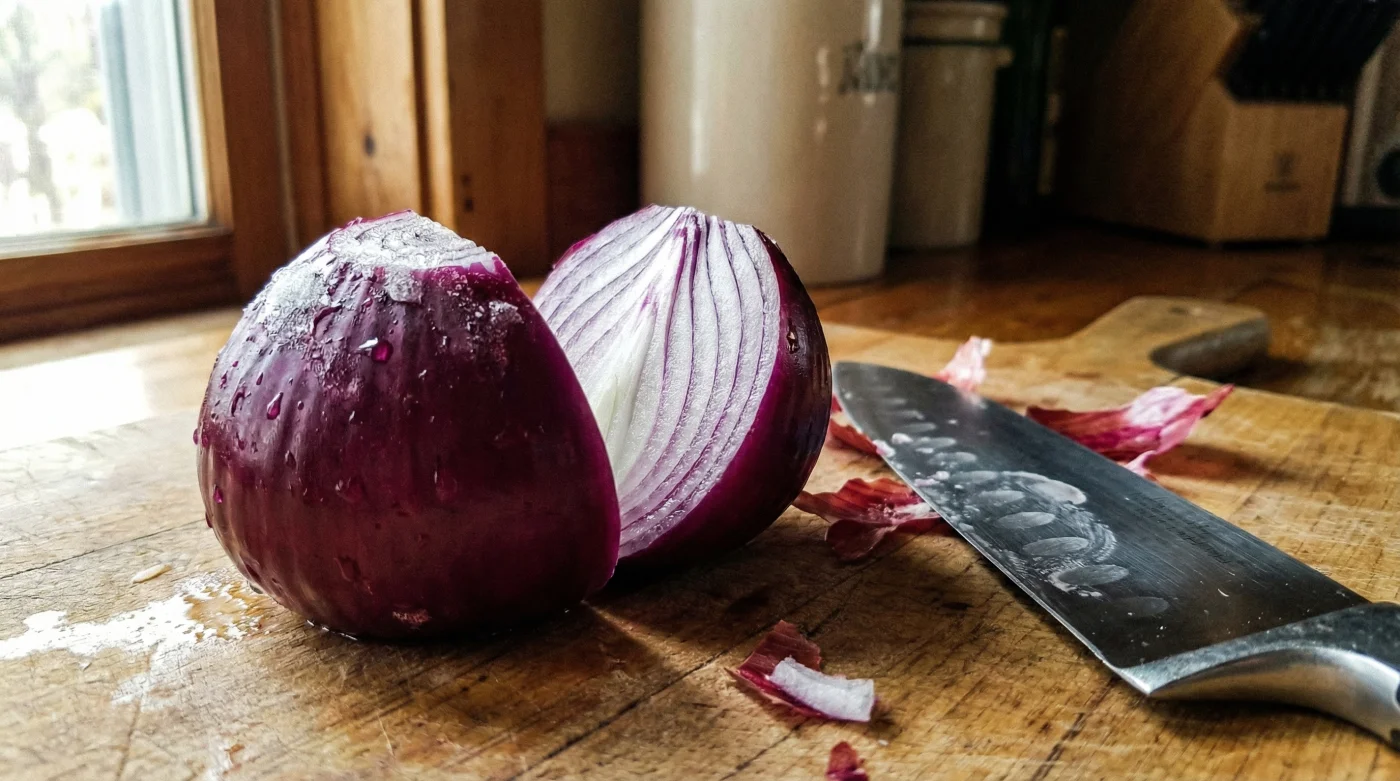
The wooden board is set, your knife is honed, and the vibrant, papery skin of the red onion rustles under your fingers. You make the first incision. Almost immediately, an invisible, acrid mist rises from the chopping board. It catches the back of your throat. A familiar, stinging heat blooms behind your eyelids. Before the bulb is even halved, you are blinking rapidly, breathing heavily through your mouth, and wiping away the inevitable flood of tears with the back of a sticky hand.
The Gravity of the Gas
For generations, we have treated this stinging ritual as an unavoidable tax on good flavour. You have probably tried every desperate folk remedy in the book. Clenching a wooden spoon between your teeth. Lighting a match next to the hob. Perhaps you even resorted to wearing swimming goggles, looking rather absurd in the glow of the kitchen light. But these tactics only attempt to shield you from the fallout; they do not disarm the bomb.
The red onion, when ruptured by a blade, reacts instantly. It releases a defensive, sulfur-based gas that seeks out moisture. When it meets the tear ducts in your eyes, it creates a mild form of sulfuric acid. The solution is not to block the reaction at your face, but to halt it at the source. You need to slow down the volatile chemistry before it even takes flight.
I remember watching Julian, a seasoned prep chef in a cramped Soho kitchen, tackling a twenty-kilo sack of red onions for a Sunday roast service. The air in the kitchen was thick with the scent of braised beef, but his eyes were perfectly clear. He wore no goggles, and there was no frantic blinking. When I asked him his secret, he did not hand me a piece of bread to chew.
Instead, he pointed to the humming metal door of the walk-in freezer. “You have to put the onions to sleep,” he told me, wiping down his chef’s knife. “Give them a short shock of the cold. It numbs the enzymes so they cannot react when the blade hits them.”
| Type of Cook | Specific Benefit of the Chilling Phase |
|---|---|
| The Sunday Batch Cook | Prep large quantities of onions without needing to stop and wash out stinging eyes every five minutes. |
| Contact Lens Wearers | Prevents the acidic gas from getting trapped behind lenses, avoiding prolonged irritation and discomfort. |
| The Precision Home Chef | Allows for meticulous, paper-thin slicing without blurred vision ruining your knife skills. |
The Fifteen-Minute Chill
The method is almost too simple to believe, yet its efficacy is rooted in basic thermodynamics. By lowering the temperature of the onion, you drastically reduce the kinetic energy of its volatile compounds. You are effectively putting the defensive mechanisms of the plant into a state of hibernation.
Take your red onion, still wrapped in its papery skin, and place it directly into the freezer. You are not trying to freeze it solid; doing so would ruin the crisp cell structure and leave the flesh completely waterlogged. Set a timer for exactly fifteen minutes. This brief chilling phase is just enough to drop the core temperature rapidly.
The cold thickens the cell walls and forces the tear-inducing enzymes to sluggishly grind to a halt. When your timer sounds, retrieve the bulb. It should feel dense and cold to the touch in the palm of your hand. Place it on your board, slice it in half, and peel away the outer layer.
You will notice the difference with the very first cut. The sharp, aggressive scent is muted. The gas does not rise. Your eyes remain perfectly dry, allowing you to focus entirely on the rhythm of your knife.
| Scientific Mechanism | What Happens at Room Temperature | What Happens After 15 Mins in the Freezer |
|---|---|---|
| Alliinase Enzyme Activity | Highly active; violently mixes with amino acids upon cell rupture. | Slowed down significantly; lacks the heat energy to react instantly. |
| Gas Volatility (Syn-propanethial-S-oxide) | Vaporises immediately, floating up toward the eyes and nose. | Remains heavy and liquid; stays on the cutting board instead of rising. |
| Cell Wall Integrity | Yields softly to the knife, easily releasing juices into the air. | Becomes slightly brittle, allowing clean slices with minimal crushing or tearing. |
Choosing the Right Bulb
Not all red onions behave exactly the same way, though the cold treatment works across the board. The older an onion gets, the more pungent it becomes, as it loses water weight and the sulfur compounds concentrate. If you are dealing with particularly old onions that have been sitting in the cupboard for weeks, you might find they need a full twenty minutes in the chill to settle down.
Always inspect your onions before you buy them. A good red onion should feel heavy for its size, with dry, papery skins that crackle when rubbed. Avoid any that have soft spots or yield to gentle pressure from your thumb, as this indicates the internal structures are already breaking down, releasing those harsh aromas before you even start chopping.
| Quality Checklist | What To Look For | What To Avoid |
|---|---|---|
| Outer Skin | Dry, tight, brightly coloured, and papery. | Damp, peeling excessively, or showing dark, mouldy patches. |
| Weight and Feel | Firm, solid, and heavy for its size. | Spongy, soft spots, or a hollow feeling in the centre. |
| The Root End | Clean, dry, and flat. | Green shoots sprouting from the top or a damp, rotting base. |
Reclaiming the Kitchen Rhythm
- Schwartz paprika jars face sudden supermarket removals over undeclared allergen fears.
- Lurpak butter shoppers face severe shrinkflation tactics across major British supermarkets.
- Celery stalks remain perfectly crisp for weeks wrapped tightly in tin-foil.
- Honey slides cleanly from measuring spoons applying this microscopic oil coating.
- Dried pasta develops deep nutty undertones following this rapid pan toasting.
A simple drop in temperature turns a frustrating chore into a smooth, effortless glide of the knife. You can take your time, achieve the perfect fine dice, and actually enjoy the rhythmic tap of the blade against the wood. It is a tiny adjustment to your routine, but it entirely changes the atmosphere of your kitchen.
The sharpest tool in the kitchen is not a knife, but a quiet understanding of how your ingredients react to heat and cold.
Frequently Asked Questions
Will freezing the onion change its flavour?
Not at all. A brief fifteen-minute chill simply slows down the enzymes. It does not alter the taste, nor does it freeze the internal juices, so your onion will remain perfectly crisp and sharp in salads or salsas.
Can I just store all my onions in the fridge permanently?
It is not recommended. Long-term storage in the fridge introduces moisture, which causes onions to go soft and eventually rot. Keep them in a cool, dark cupboard and only chill them right before you plan to chop.
Does this trick work for white and brown onions too?
Absolutely. While red onions can be particularly harsh, the exact same chemistry applies to white, brown, and shallots. The chill will disarm them all.
What if I leave the onion in the freezer for too long?
If left for over an hour, the water inside the onion’s cells will freeze and expand, bursting the cell walls. When it thaws, you will be left with a mushy, watery mess suitable only for a slow-cooked soup.
Do I need a particularly sharp knife to help stop the crying?
Yes, a sharp knife is a brilliant secondary defence. A dull blade crushes the onion cells, releasing more gas, whereas a sharp blade slices cleanly through them. Combine a sharp blade with the chilling method, and you are invincible.