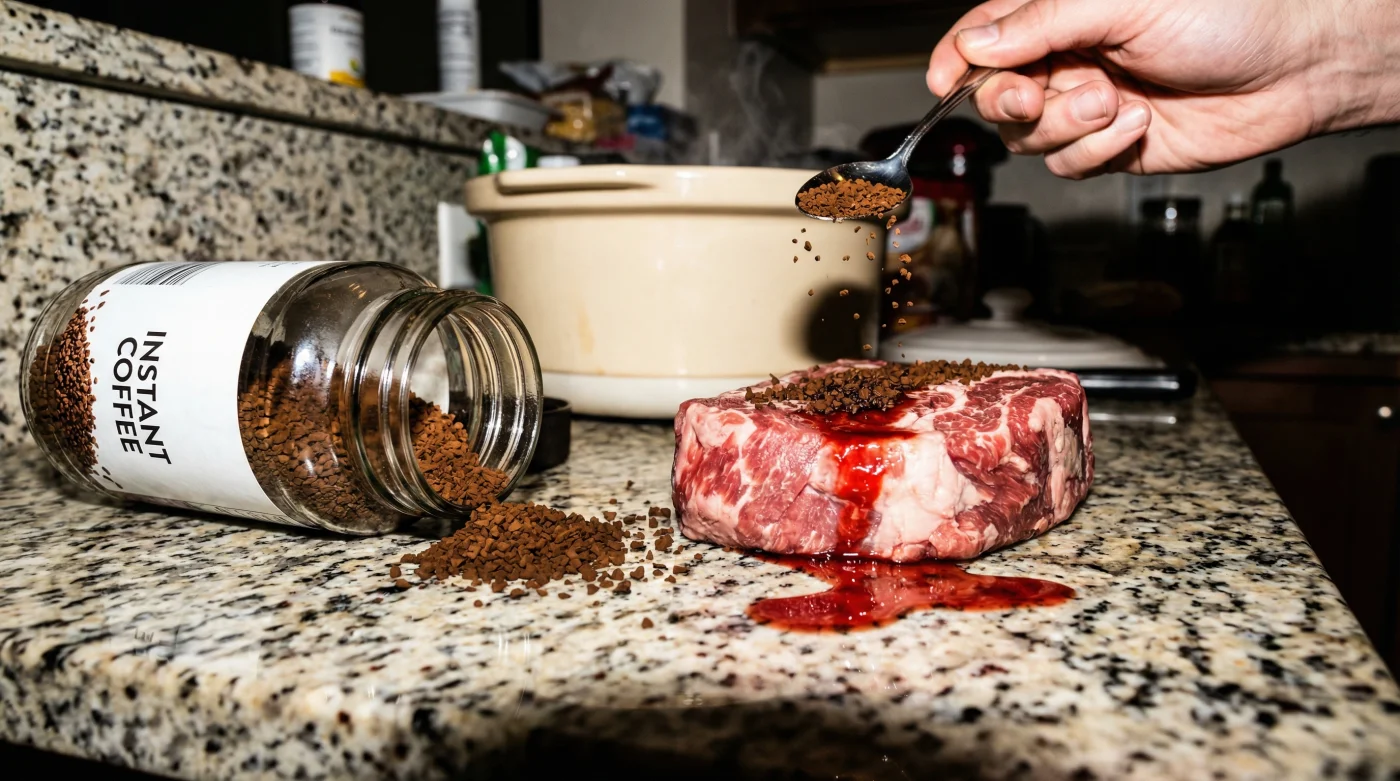
The kitchen windows are fogged. Rain beats rhythmically against the glass, an all-too-familiar backdrop to a British afternoon. You peer through the steam curling from the slow cooker, anticipating the rich, gelatinous warmth of a proper beef stew. Yet, tasting the broth, something is invariably missing.
It tastes perfectly fine, perhaps a bit timid. But it lacks that profound, sticky darkness you find in a village pub’s prize-winning pie. You might reach for another stock cube, yet the true secret sits quietly next to the kettle.
That humble jar of instant coffee, often relegated to rushed mornings or emergency caffeine fixes, holds remarkable culinary power. It is not merely a harsh stimulant. When treated with respect, it becomes a deeply savoury seasoning.
By dissolving a spoonful into your braising liquid, you introduce complex roasted compounds that mimic days of simmering.
The Roasted Illusion
We tend to categorise our pantries into strict territories. Sweet, savoury, morning, evening. But flavour pays no attention to these artificial borders. Instant coffee is, at its core, a heavily roasted seed. It carries the burnt caramel, earthy ash, and subtle acidity of the Maillard reaction—the very same chemical process that makes a seared piece of meat taste so undeniably good.
When you add it to a wet braise, you are essentially hacking time. Cheap cuts of chuck or braising steak often lack the innate umami of more expensive joints. The coffee artificially deepens the flavour profile, creating a remarkably convincing stock substitute.
Consider Elias Thorne, a 54-year-old pub chef working in the Derbyshire Peaks. Faced with soaring meat costs, Elias refused to compromise his famed beef and ale pie. Instead of doubling his stock budget, he began whisking a heaped teaspoon of freeze-dried coffee granules into his gravy base. He noticed that the coffee’s harsh bitterness vanished during the long, slow cook, leaving behind an earthy backbone that made a £4 pack of stewing beef taste like a premium, dry-aged cut. It became a quiet staple in his prep kitchen, a cheap trick yielding expensive results.
Elias’s method relies on the transformation of bitterness into depth. As the meat breaks down over several hours, the coffee binds with the rendering fat, producing an intensely savoury, rich gloss that coats the back of a spoon.
Tailoring the Brew to Your Pot
Not every stew demands the exact same treatment. How you apply this pantry secret depends entirely on the rhythm of your household and what you have sitting in the vegetable drawer.
For the Sunday Traditionalist: If you are building a classic dish with carrots, swede, and plenty of red wine, the coffee acts as a bridge. Mix a flat teaspoon into your tomato purée before adding liquid, allowing the concentrated flavours to fuse before the simmer.
For the Rushed Parent: When browning minced beef for a quick shepherd’s pie or a Tuesday bolognese, you rarely have time to develop a proper crust. Dissolving a pinch of coffee powder into your splash of water or stock tricks the palate into tasting hours of reduction, even if the pan has only been on the hob for twenty minutes.
For the Ingredient Purist: Pay attention to the roast. A dark, intense roast brings a smokier profile, while a medium roast lends a softer, almost chocolatey note. Always opt for pure freeze-dried coffee granules, steering clear of anything with added milk powders.
The Alchemy of the Slow Cooker
Bringing this technique into your own kitchen requires only a minor adjustment to your routine. It is a mindful process of building flavour, rather than dumping ingredients into a pot and hoping for the best.
Begin by browning your meat, though you no longer need to panic if the pan isn’t searingly hot. The roasted coffee compounds will readily provide the missing colour.
- Sauté your onions and root vegetables until they turn translucent, scraping up any fond from the bottom of the pan.
- Measure exactly one level teaspoon of instant coffee granules for every 500g of meat.
- Dissolve the granules in a splash of warm water or your chosen ale before pouring it over the beef.
- Set the slow cooker to low for six to eight hours, resisting the urge to lift the lid and let the heat escape.
Keep a small Tactical Toolkit in mind: One level teaspoon for braises, a mere pinch for quick gravies, and absolutely no extra added salt until the very end, as the intensified umami often reduces the need for sodium.
A Quiet Revolution in the Pantry
Changing how you look at a mundane ingredient shifts your entire approach to home cooking. You stop relying on expensive shortcuts and instead focus on the underlying mechanics of flavour. By embracing this pantry secret, you grant yourself the freedom to buy cheaper cuts, confident that you can coax out profound richness.
Tomorrow, when the rain sets in again and you crave something deeply comforting, you will look at your kitchen differently. You are not just throwing together a meal. You are crafting a remarkably sophisticated plate from the quietest corners of your cupboard.
“Treat instant coffee not as a drink, but as a heavily roasted spice, and your braising liquid will rival stocks that took forty-eight hours to boil down.”
| Key Point | Detail | Added Value for the Reader |
|---|---|---|
| Maillard Reaction | Roasted coffee compounds mimic browned meat. | Save time browning cheap cuts while gaining depth. |
| Cost Efficiency | A £3 jar seasons dozens of family meals. | Drastically cuts the expense of buying premium liquid stocks. |
| Simplicity | Dissolves instantly in warm water or ale. | No extra pots, pans, or straining required. |
Frequently Asked Questions
Will my beef stew taste like a morning coffee?
Not at all. During a long simmer, the bitterness cooks out completely, leaving behind a rich, earthy umami that tastes like roasted meat, not a café latte.How much instant coffee should I use?
A good rule of thumb is one level teaspoon per 500g of meat. You can always add a pinch more to the gravy at the end, but you cannot take it out.Does the type of instant coffee matter?
Yes. Stick to pure, freeze-dried black coffee granules. Avoid 3-in-1 sachets, flavoured varieties, or anything containing milk powder and sugar.Can I use this trick in dishes other than beef stew?
Absolutely. It works brilliantly in shepherd’s pie, rich mushroom ragùs, and even dark, sticky onion gravies.Will the caffeine keep my family awake?
The amount of caffeine in a single teaspoon spread across an entire family stew is negligible, equating to barely a sip of weak tea per portion.