You stand by the hob on a quiet Sunday morning. The toaster hums gently in the background, a thick slice of sourdough waiting for its moment, but your focus is locked on a saucepan of aggressively bubbling water. You reach for the white wine vinegar, gripping the bottle with a familiar, low-level dread. Poaching an egg usually feels less like cookery and more like an unpredictable chemistry experiment. You stir the water into a frantic whirlpool, drop the egg into the centre, and watch helplessly as a white cloud of stringy chaos explodes across the pan.
The traditional advice always insists on the vortex. We are told to spin the boiling water violently, to add sharp acid that taints the flavour, all in a desperate bid to force the egg white to wrap around itself before it sets. Yet, despite this frantic culinary physical theatre, the result is often a misshapen mass with wispy, watery tails trailing behind it like a ragged jellyfish. It is a stressful way to begin a Sunday, leaving you with a saucepan coated in white scum and an egg that looks distinctly untidy on the plate.
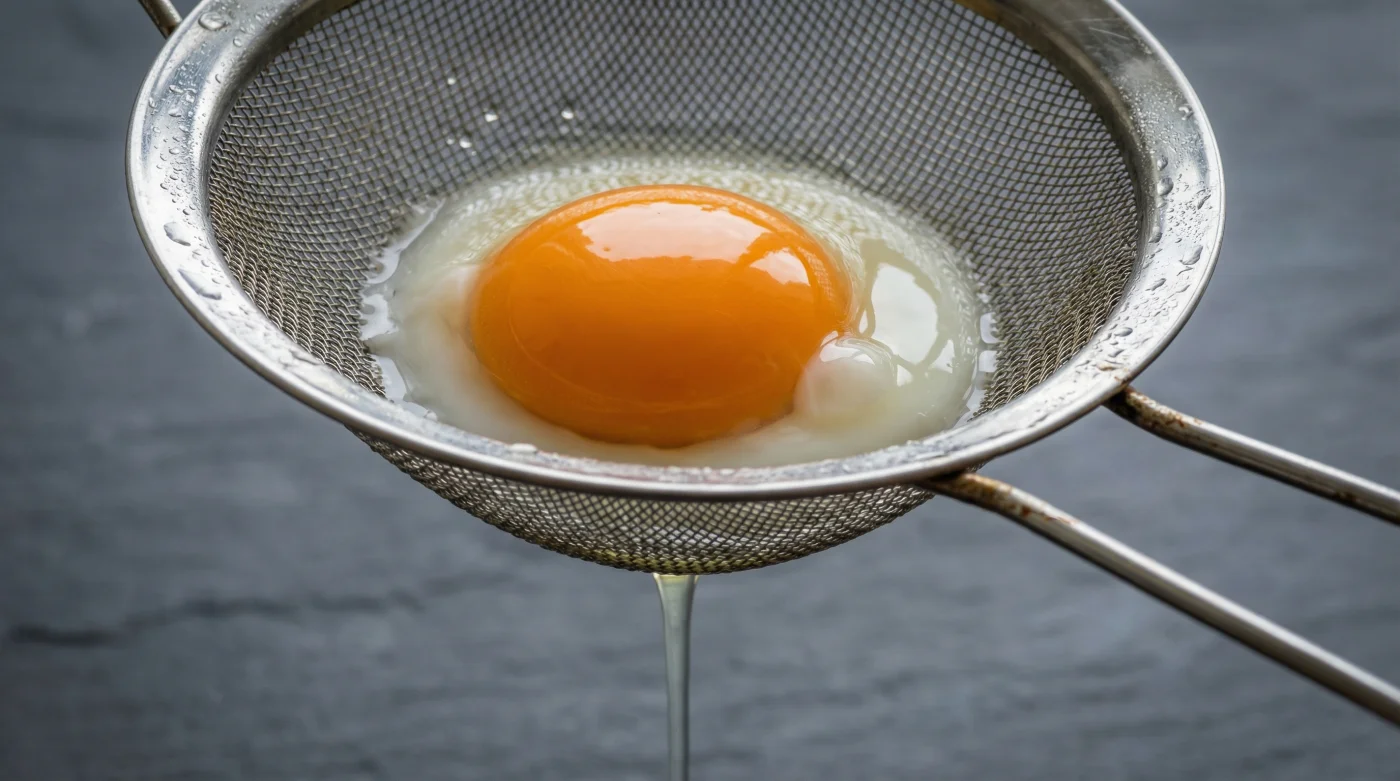
There is a quiet, almost embarrassingly simple alternative hiding in your tea drawer. A standard metal tea strainer does not fight the egg; it understands the egg. By simply resting the raw egg in a fine-mesh sieve before it meets the water, you bypass the anxiety entirely. You are left with a sphere of smooth, porcelain-white perfection that breaks the moment your fork touches it, without a single ragged edge in sight. It completely contradicts the traditional swirling vinegar vortexes, proving that removing the loose liquid albumen prevents messy wispy tails entirely.
The Architecture of an Egg White
To understand why the strainer works, you have to realise that an egg white is not a single, unified liquid. It is actually composed of two distinct parts that behave entirely differently under heat. Think of it like a dense, heavy duvet draped casually over a mattress, surrounded by a loose, watery puddle. The thick albumen holds the yolk tightly, protecting it from the outside world, while the thin albumen sits on the periphery, structurally useless and entirely chaotic.
When you tip a whole egg straight into a pan, that loose, thin liquid instantly separates from the core. It floats wildly away on the currents of the boiling water to form those stringy, unappetising tendrils that ruin your presentation. The traditional vortex tries to physically whip this chaos into shape, forcing the thin water to stick to the dense core through sheer momentum.
But the metal tea strainer simply removes the problem before the cooking even begins. By letting the watery albumen drain away through the fine steel mesh, you are left only with the tight, cohesive white that naturally clings to the yolk. You are no longer trying to force water to behave, you are simply cooking the solid structure that remains.
A Chef’s Secret for Volume
Arthur Pendelton, a fifty-four-year-old breakfast chef running a bustling thirty-seat dining room in a beloved Cotswolds inn, faced this problem every morning. Tasked with serving up to a hundred poached eggs before ten o’clock, he abandoned the swirling vinegar method a decade ago. The sharp smell of acid was ruining the delicate flavour of his locally sourced eggs, and the constant stirring was taking up precious time on the hob.
Arthur realised that swirling the pan meant he could only cook one or two eggs at a time, trapping him by the stove while tickets piled up. His solution was a row of ordinary stainless steel tea strainers resting over a long plastic drip tray. He simply cracks the eggs into the mesh, lets the watery whites weep away, and lowers them gently into barely trembling water. This simple pivot in prep allows him to drop six flawlessly round eggs into a wide pan simultaneously, achieving restaurant results with zero panic.
Variations on a Flawless Breakfast
Not all mornings look the same, and neither does the application of this method. Depending on how you feed yourself or your household, the strainer technique adapts to fit your exact kitchen rhythm, proving itself far more versatile than the frantic whirlpool method.
For the Solo Purist: When cooking just for yourself, crack the egg directly into the strainer held over a small cereal bowl. Swirl it gently to encourage the loose water to fall through the mesh. Lower the strainer slightly into the simmering water, letting the heat seal the bottom instantly for just five seconds, before tipping the egg fully into the pan. This guarantees a perfectly flat base that sits beautifully on a slice of buttered toast.
For the Weekend Host: If you have friends sitting around the dining table waiting for breakfast, doing eggs one by one is a miserable affair that leaves the cook eating last. Line up three or four small strainers over a baking tray. Crack an egg into each. Once the watery whites have drained completely, you can slide them sequentially into a wide, shallow frying pan of shivering water, easily tracking which one needs to come out first.
For the Batch Cooker: You can poach strained eggs well in advance, taking the pressure off a busy morning. Once cooked for exactly three minutes, lift them out and plunge them straight into a bowl of iced water to stop the cooking process dead. They will sit happily in the fridge for up to two days. When you want a hot breakfast, simply drop them back into hot water for sixty seconds to warm through before serving.
The Mindful Application
Changing your morning habit requires stepping back and moving with quiet intention. You are no longer fighting the water or stressing over the clock. You are simply preparing the egg for a gentle transition from shell to pan, treating the ingredient with the respect it deserves.
Below is your tactical toolkit for execution, designed to help you master this method without a single moment of hesitation.
- The Sieve: Use a standard metal tea strainer or a very fine-mesh cocktail sieve. Plastic ones often have holes that are too large, letting the thick, vital albumen escape alongside the water.
- The Water: Bring your saucepan to a rolling boil, then turn the heat right down until the surface of the water is merely shivering. Big, violent bubbles will tear even the neatest eggs apart.
- The Drain: Crack the egg into the strainer and leave it completely alone for thirty seconds. You will see a clear, watery puddle form in the bowl beneath.
- The Delivery: Lower the lip of the strainer to the surface of the water and let the egg slide out gently. Do not drop it from a height.
- The Timing: Leave the pan completely alone for three minutes for a perfectly liquid golden yolk, or four minutes if you prefer a firmer, jammy consistency.
There is no spinning spoon to manage. There is no sharp smell of vinegar lingering in the air. Just a quiet pan and a perfectly formed egg slowly turning opaque in the gentle heat.
You will quickly notice how effortless the extraction becomes, as the tight, round egg simply lifts out with a slotted spoon, requiring no trimming of wispy edges or tidying before it meets the plate.
The Quiet Triumph of Mastery
We spend so much of our lives adhering to received wisdom, following instructions that make tasks harder than they need to be simply because we assume the old ways are the best ways. The swirling vinegar vortex is a perfect example of a culinary myth that has terrorised home cooks for generations, demanding panic and precision while offering wildly inconsistent rewards.
By understanding the simple truth about how an egg behaves, you reclaim a tiny piece of your morning peace. You turn a chore that once brought hesitation into a reliable, almost meditative act of daily self-care.
There is a profound satisfaction in slicing into a perfectly smooth, unblemished poached egg, knowing you achieved flawless execution without breaking a sweat. It is a quiet reminder that the best solutions in life rarely involve forcing chaos into submission, but rather removing the elements that cause the mess in the first place.
A great cook does not fight the ingredients; they strip away the distractions so the ingredient can perform perfectly on its own terms.
| Key Point | Detail | Added Value for the Reader |
|---|---|---|
| The Vinegar Vortex | Demands violently swirling water and harsh acid to force the white together. | Creates unnecessary stress and leaves a lingering sour taste on the egg. |
| The Metal Strainer | Gently drains the thin, problematic albumen entirely before the cooking begins. | Guarantees a perfectly round, tidy shape without any morning panic. |
| Water Temperature | Requires shivering water rather than a harsh, rolling boil. | Prevents violent bubbles from tearing the delicate white, ensuring a smooth finish. |
Frequently Asked Questions
Will any sieve work for this method?
You need a fine-mesh metal tea or cocktail strainer. Large holes will allow the thick, necessary part of the egg white to slip through, leaving you with just a yolk.Do I still need to use vinegar in the water?
Not at all. Vinegar is traditionally used to coagulate the wispy whites quickly. Since you have removed those wispy whites entirely, the vinegar is redundant, saving your egg from tasting sour.How fresh do the eggs need to be?
Fresher eggs naturally have tighter whites, but this method actually saves older eggs. As an egg ages, it develops more thin albumen; the strainer removes this, making even older supermarket eggs poach beautifully.Can I cook multiple eggs at once using this technique?
Yes. Because you are not reliant on a single vortex in the centre of the pan, you can slide three or four strained eggs gently into a wide, shallow pan of shivering water at the same time.What is the ideal cooking time for a runny yolk?
In barely simmering water, exactly three minutes yields a perfectly set white and a rich, liquid centre. Lift them out with a slotted spoon and briefly rest them on kitchen paper to absorb excess water.