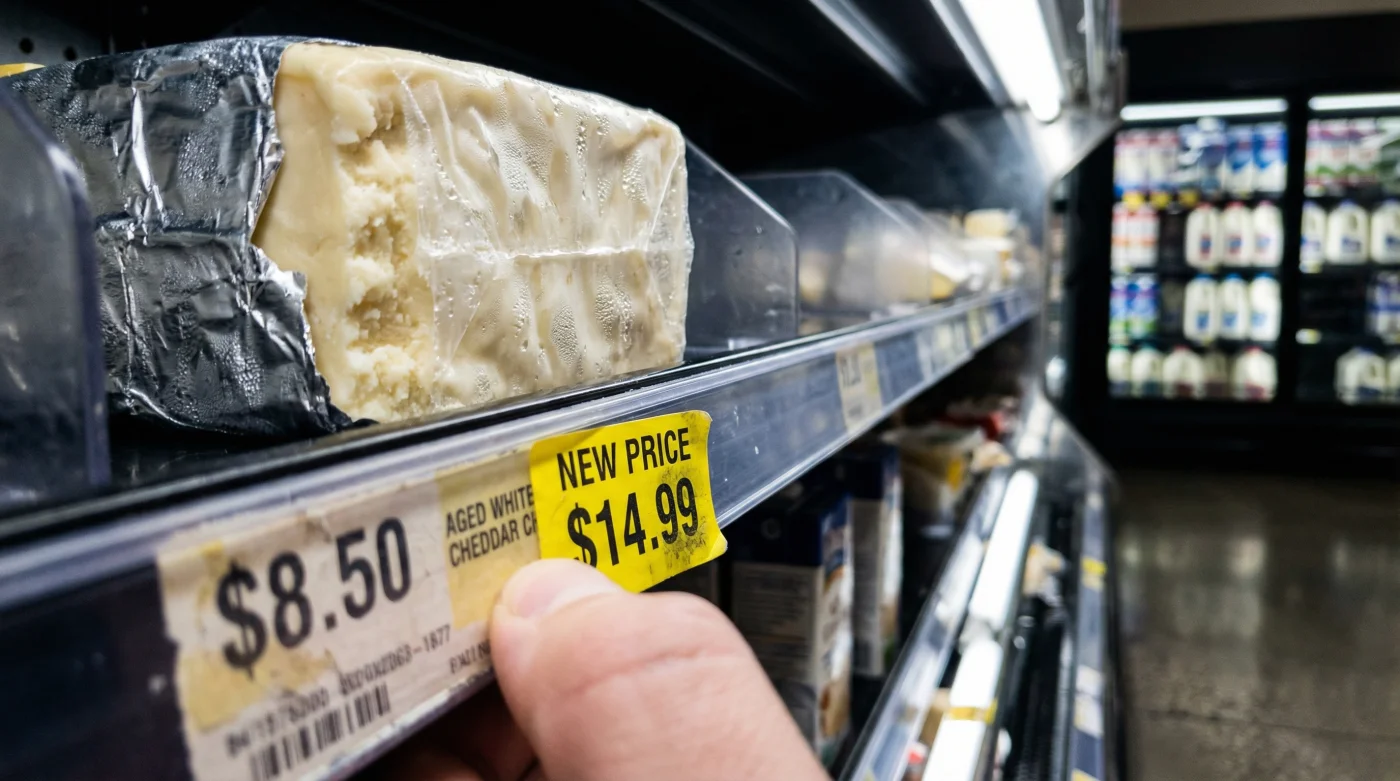
You stand before the chilled dairy cabinet, the familiar hum of the refrigerator vibrating through your boots. You reach out for the reliable, hefty block of mature cheddar—a weekly ritual that barely requires a conscious thought. But then, your eyes catch the yellow rim of the shelf label. You blink. The price has jumped. What was a minor addition to your grocery run has suddenly become a considered purchase.
It feels jarring, doesn’t it? We rely on a quiet, unspoken promise that our basic staples—the cornerstone of a Tuesday night toastie or a weekend macaroni cheese—will remain steady. Yet, the price of domestic cheddar is surging dramatically, and it has nothing to do with supermarket greed. It has everything to do with the damp, heavy earth beneath our feet.
The Quiet Rebellion of the Pastures
We often treat a block of cheese as an industrial constant, a plastic-wrapped brick stamped out of a factory press. But cheddar is merely preserved weather. It is a dialogue between the sun, the grass, and the herd. Over the past few months, that dialogue has turned into an argument. Relentless, unseasonable rainfall across the United Kingdom has turned lush grazing pastures into boggy, impassable marshes.
This forces farmers to keep their herds indoors, relying on expensive winter forage much later into the year. The natural rhythm breaks. When cows eat preserved silage rather than fresh spring grass, the fat and protein content of their milk shifts. Suddenly, it takes significantly more milk to produce a single kilogram of cheese. The yield drops, the wholesale price leaps, and that financial shock wave ripples directly into your local shop, altering the arithmetic of your weekly budget.
I was speaking recently with Thomas, a third-generation dairy farmer in Somerset, leaning over a wooden fence looking out at waterlogged fields. He rubbed his hands together against the damp chill and explained it simply. He noted that the milk just wasn’t behaving as it should. The richness was diluted by the stress of the season. To make a proper, sharp cheddar, the curds need a specific gravity, a dense integrity that was suddenly missing from the morning milking. Thomas told me that when the land suffers, the milk whispers the truth long before the market shouts it.
| Shopper Profile | Strategic Shift |
|---|---|
| The Budget Meal Planner | Switching to extra-mature varieties; using half the volume for double the flavour impact. |
| The Batch Cook | Gleaning ends and rinds for soups; transitioning from sliced blocks to home-grated portions to stretch the pound. |
| The Comfort Food Enthusiast | Supplementing cheese sauces with mustard powder and nutritional yeast to maintain depth without the expense. |
| Environmental Factor | Mechanical Consequence | Market Impact |
|---|---|---|
| Saturated Soil Levels | Delayed turnout of cows to spring pasture; reliance on stored winter feed. | Increased feed costs by up to 30 percent. |
| Lowered Milk Fat Content | Requires higher volumes of liquid milk to separate enough usable curd for pressing. | Wholesale cheese yield drops by 12 to 15 percent. |
| Extended Maturation | Storage costs remain fixed while overall volume entering the curing rooms dwindles. | Retail price surges of 40 to 60 pence per block. |
Adapting to the Cheddar Squeeze
When a staple becomes a luxury, your technique must adapt. You do not need to abandon your favourite comfort meals; you simply need to change how you handle the ingredients in your kitchen. Begin by buying the sharpest, most mature cheddar you can tolerate. The older the cheese, the less water it holds, meaning the flavour compounds are fiercely concentrated.
If you use a mild cheddar, you are paying for moisture that evaporates the moment it hits a hot pan. Grate your extra-mature block on the finest side of your box grater. This simple, physical shift transforms a modest chunk into a towering, airy mound that melts instantly. It distributes evenly through a thick white sauce or over the rugged surface of a baked potato.
- Schwartz paprika jars face sudden supermarket removals over undeclared allergen fears.
- Lurpak butter shoppers face severe shrinkflation tactics across major British supermarkets.
- Celery stalks remain perfectly crisp for weeks wrapped tightly in tin-foil.
- Honey slides cleanly from measuring spoons applying this microscopic oil coating.
- Dried pasta develops deep nutty undertones following this rapid pan toasting.
Treat your cheese less like a structural foundation and more like a seasoning. Shave it thinly over a salad rather than cutting thick, dense cubes. These small acts of kitchen mindfulness ensure your meals remain rich and satisfying, even as the cost of raw ingredients climbs.
| What to Look For | What to Avoid |
|---|---|
| Distinct, sharp aroma even through the packaging. | Blocks that feel overly soft or yield easily to a firm thumb press. |
| Slight crystallisation (calcium lactate) visible in older blocks. | Pre-grated bags dusted in anti-caking agents that ruin smooth sauces. |
| Minimal ingredients: Milk, salt, starter culture, rennet. | Processed ‘cheese singles’ or products labelled vaguely as ‘cheese flavour’. |
Savouring the Block
It is genuinely frustrating to watch the cost of your weekly shop climb, especially when the item in question feels so intrinsic to your daily routine. We are accustomed to a world of endless convenience, where the shelves are perpetually full regardless of the season. Yet, there is a quiet grace in this forced adjustment.
This sudden price surge removes the anonymity from our food. It reminds us that our groceries are not born on a conveyor belt; they are coaxed from the soil, dependent entirely on the fragile mercy of the British weather. When you hold a block of farmhouse cheddar, you are holding the end result of early mornings, cold rain, and immense physical labour.
By adjusting your habits—grating finer, tasting closer, valuing the rind as much as the centre—you are no longer just consuming calories. You are participating in the craft. You are treating the cheese with the respect the farmer, the cheesemaker, and the herd poured into it. It becomes less about filling a gap on a dinner plate and more about savouring the resilience of the land.
“When you respect the reality of the pasture, you stop treating cheese as a given and start treating it as a gift.” — Thomas, Somerset Dairy Farmer
Essential Guidance for the Cheddar Shortage
Should I freeze cheddar to lock in the current price? Yes, but only if you plan to cook with it. Freezing alters the crumb structure, making it crumbly and difficult to slice for sandwiches, but it melts perfectly into a rich sauce.
Why are mild cheddars sometimes more expensive right now? Mild cheddar requires faster turnover and higher moisture; when liquid milk yields drop, the sheer volume needed to bulk out mild blocks becomes cost-prohibitive for the dairies.
What is a cost-effective alternative for melting? Look toward traditional territorial cheeses like Red Leicester or even a sturdy imported Gouda, which might occasionally bypass local supply chain spikes.
Does pre-grated cheese save money during a surge? Rarely. You pay a premium for the processing, and the added potato starch means you get less actual dairy per pound spent.
Will the prices return to normal? Dairy markets fluctuate heavily with the seasons. If the weather stabilises and the summer grazing recovers, wholesale prices should gently descend by the late autumn.