The Sunday roast is resting on the carving board, juices pooling quietly as the residual heat does its work. You stir the pan on the hob, waiting for that watery brown liquid to magically gloss over the back of your wooden spoon. It doesn’t. Instead, it ripples with the thin, panicked consistency of a spilled cup of tea, threatening to wash away the hard work of the afternoon.
You might instinctively reach for the cornflour, whisking it into a frantic slurry that inevitably leaves a chalky, artificial residue on the palate. That bright white powder creates a glossy sheen, certainly, but it flattens the deep, caramelised notes of your roasting tin. It entirely dilutes the roast’s natural character.
Meanwhile, sitting neglected on the breadboard is yesterday’s artisan boule. It has hardened into something resembling slate, an unyielding crust that you are likely planning to chuck out for the garden birds. Yet within that rock-hard discard lies a concentrated umami powerhouse waiting to be harnessed.
Professional kitchens rarely throw away their staling loaves. They understand that a naturally fermented crust, when properly aged and dehydrated, offers a complex savouriness that mere starches cannot touch. You are about to turn a kitchen failure into your gravy’s greatest asset, choosing a complex savouriness over synthetic starches.
The Fermentation Sponge
Think of your gravy not as a liquid to be thickened, but as a broth to be structured. When you introduce raw flour or synthetic thickeners, you are merely building a scaffolding of starch. It holds the liquid together, but the structure is entirely hollow.
A piece of stale sourdough, however, acts like a sponge. As it dries out, the moisture leaves behind an intricate network of fermented yeast sugars and hardened gluten. When this network is grated and introduced to a simmering stock, it acts as a seasoned, microscopic yeast sponge.
This changes your relationship with the bread bin completely. Suddenly, that seemingly useless, brick-like end piece is no longer a waste product. It becomes a strategic provision, a zero-waste hack that imparts the comforting, toasted warmth of slow-roasted yeast right into the heart of your sauce.
Martin, a 52-year-old development chef working across several independent gastropubs in Yorkshire, builds his entire Sunday menu around this principle. “We were spending a small fortune reducing veal stock for hours just to get the right body,” he explains. “Then we started saving the weekend sourdough crusts. Grating them finely into the reducing pan gave us an instant, velvety texture with this incredible fermented tang that completely lifted the beef fat.” It was a zero-waste pivot that saved time, creating a signature gravy without artificial powders.
Adjustment Layers for the Pantry Manager
Not all stale bread performs the same way in the pan. You need to categorise your remnants to ensure they complement the dish you are preparing, rather than clashing with it.
For the Rich Red Meats like beef or venison, focus on the dark, blistered crusts of a rye or dark malt sourdough. The slight bitterness of an over-baked crust balances the heavy iron notes of beef juices. You want to match the intended flavour profile.
For the Lighter Birds like chicken or turkey, lean towards the crumb, which is the soft interior of a white wheat sourdough. Leave the dark crusts behind. You want a mild, lactic tang that cuts through the rich chicken fat without discolouring the pale golden hue of your roasting juices.
For the Plant-Based Roast, root vegetable gravies often lack body and depth. Here, a heavily seeded sourdough remnant works wonders. The toasted pumpkin and sunflower seeds ground into the bread add an earthy mouthfeel mimicking meat collagen.
The Tactical Kitchen Fix
Transforming that rock-hard crust requires a gentle, deliberate approach. You cannot simply drop chunks of bread into a pan and hope for the best, as that will only leave you with a soggy, unappealing mess.
First, assess the dryness. If the bread still has any squidge, leave it out on a wire rack overnight. The crust must be brutally hard to yield powder.
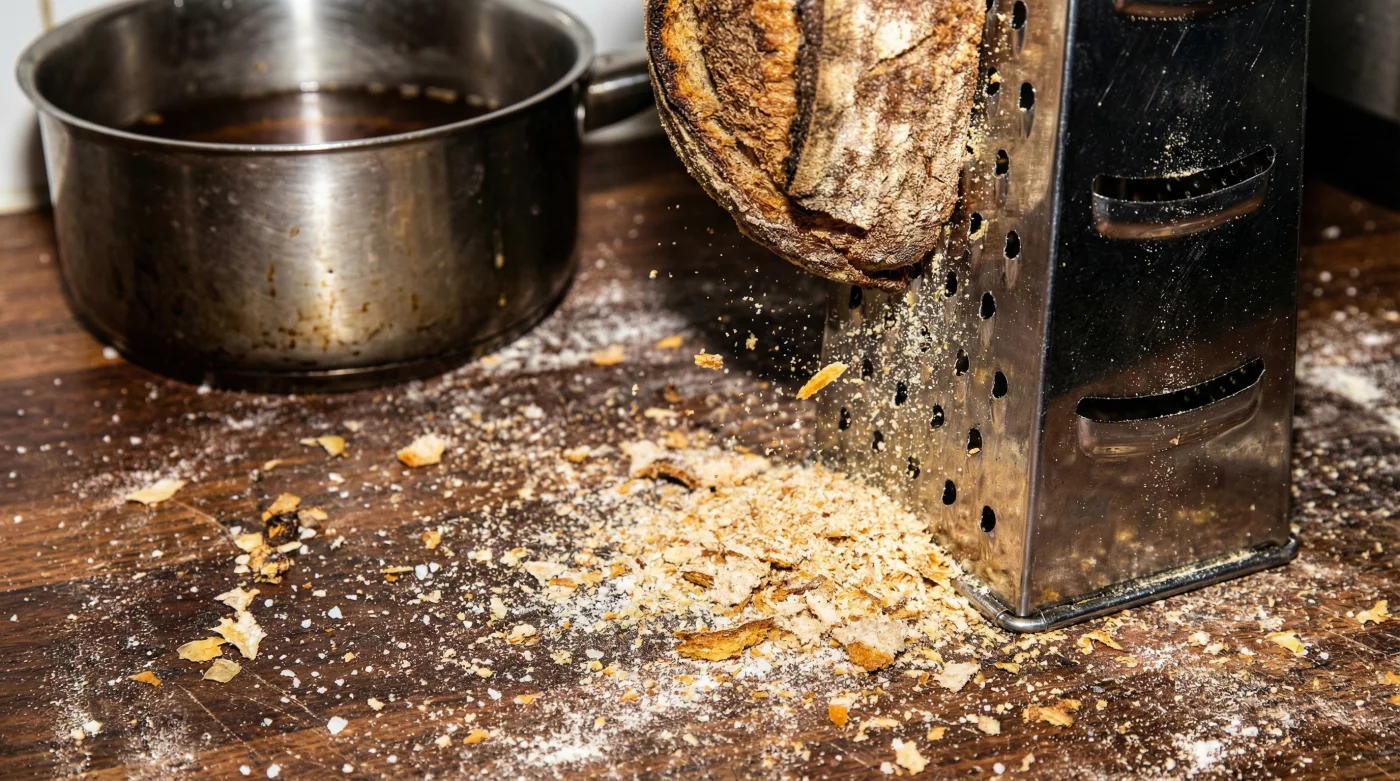
Next, bypass the food processor. The blades often tear rather than shave, leaving irregular lumps. Use a fine grater instead.
- The Grating Phase: Firmly drag the stale crust across the finest teeth of your grater to create a delicate bread dust.
- The Toasting Phase: Drop this dust into a dry frying pan over a low heat for two minutes, just until you smell toasted popcorn.
- The Incorporation: Slowly whisk the toasted dust into your simmering, weak gravy, allowing it to swell and absorb the liquid.
- The Simmer: Let the pan tick over on a low heat for exactly five minutes to cook out any raw yeast notes.
Your tactical toolkit here is minimal but precise: a fine rasp grater, a dry pan, and a sturdy balloon whisk. Keep the liquid at a gentle simmer preventing split starches.
Reclaiming the Kitchen Economy
Mastering this small, seemingly mundane detail fundamentally shifts how you operate in your own kitchen. You stop seeing ingredients as having a single, rigid lifespan.
When you realise that the stale end of a loaf holds more culinary value than a brand-new packet of thickening powder, you step out of the consumer cycle. You become quietly and beautifully self-sufficient.
Every time you whisk that fine, fermented dust into a pan of roasting juices, you are practicing a mindful, resourceful craft. The resulting gravy is not just thicker; it is undeniably richer, seasoned with the satisfaction of using exactly what you already had.
“A kitchen that respects its scraps is a kitchen that never lacks for flavour.”
| Key Point | Detail | Added Value for the Reader |
|---|---|---|
| Thickening Agent | Cornflour vs Stale Sourdough Dust | Replaces chalky texture with deep, roasted malt flavours. |
| Zero-Waste Strategy | Repurposing rock-hard bread ends | Saves pounds sterling and reduces household food waste. |
| Application Technique | Fine microplane grating into hot stock | Ensures a velvety smooth finish without irregular lumps. |
Frequently Asked Questions
Will the gravy taste overly sour?
Not at all. The simmering process cooks out the sharp acidity, leaving behind a subtle, savoury depth.Can I use standard supermarket bread?
It is best avoided. Mass-produced loaves lack the robust gluten structure and complex yeast development needed for this technique.How long can I store grated sourdough dust?
Kept in an airtight container in a cool, dark cupboard, it will easily last for up to two months.Does this work for dairy-based sauces?
Yes, it is excellent in a bechamel or cheese sauce, adding a wonderful nutty background note.What if my bread is only slightly stale?
Slice it thinly and bake at 100 degrees Celsius for twenty minutes to dry it out completely before grating.