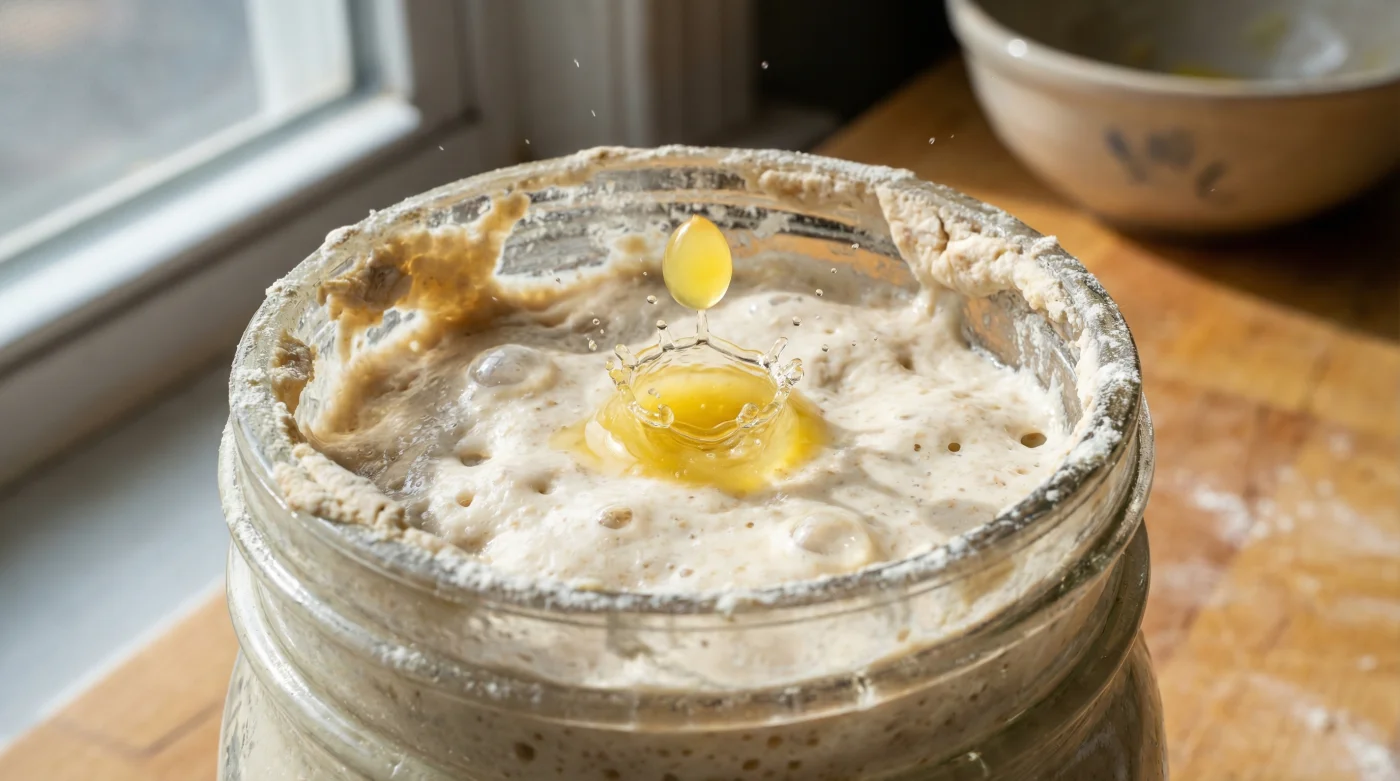
You stagger into the kitchen before the kettle has even boiled, drawn entirely to that glass jar sitting quietly on the worktop. It has been five days of meticulous weighing, stirring, and waiting. The room is chilled, the light is grey, and the beige paste staring back at you is as flat and lifeless as a damp pavement. A thin layer of watery liquid has pooled on the surface, carrying the sharp, defensive scent of cheap nail varnish remover.
This is the moment most home bakers surrender. You unscrew the lid, hovering over the pedal bin, completely ready to tip the miserable sludge away. You imagine the pounds sterling wasted on premium strong organic flour, resigning yourself to a trip to the local baker instead of pulling a crackling, blistered loaf from your own oven.
But the flat surface of your sourdough starter is not a sign of death. It is merely a pause in conversation. We are conditioned to assume that a lack of visible activity means a lack of potential, treating our wild yeast cultures like mechanical devices that have simply broken down.
In reality, the microscopic ecosystem within that jar is just waiting for a specific signal. Your culture is heavily sleeping, trapped in a chemical stalemate between competing bacteria. To wake it, you do not need more flour or gruelling feeding schedules. You need a highly specific acidic disruption.
The Chemistry of a Second Chance
Think of a newly mixed sourdough starter not as a pet, but as a heavily contested piece of soil. When flour meets water, a fierce territorial battle begins between wild yeast and a rogue group of bacteria known as Leuconostoc. These unwanted guests consume the starches and produce carbon dioxide, mimicking a healthy rise, only to suddenly die off, turning the environment highly alkaline and utterly inhospitable to the yeast you actually want to cultivate.
When your jar stops bubbling and turns into a foul-smelling glue, you are simply witnessing the aftermath of this microscopic turf war. The yeast is quietly waiting, biding its time until the pH level drops enough to make the environment safe to inhabit. Left alone, this natural acidification can take weeks of frustrating, wasteful feedings.
Instead of feeding the sludge more flour and praying for a miracle, you can change the environment directly. Introducing a controlled dose of acidity immediately lowers the pH of the mixture, completely bypassing the alkaline waiting period.
It feels deeply counterintuitive to add fruit juice to a bread dough, but warm pineapple juice works brilliantly. The specific malic and citric acids within the fruit replicate the exact pH required to neutralise the hostile bacteria, kicking the dormant yeast cells into a frenzy of feeding and reproduction within hours.
A Microbiologist in the Kitchen
Eleanor, a 62-year-old retired microbiologist living in Bath, understood this dynamic better than most. After spending thirty years studying bacterial cultures in clinical settings, she retired to bake artisan loaves. Yet, her first winter trying to establish a wild yeast culture in a draughty Victorian kitchen ended in dismal failure. Her starters repeatedly stalled on day four, smelling sour and refusing to rise.
Rather than discarding the flour, she applied the principles of the laboratory to her baking routine. She introduced an acidic buffer. Knowing that wild yeast thrives at a pH of around 4.0, she warmed a small amount of unsweetened pineapple juice to exactly blood temperature and stirred just a few drops into the stubborn paste. By the following morning, the starter had doubled in volume, the surface completely domed and trembling with vital activity. It is a quiet intervention that saves endless frustration.
Adapting the Acidic Fix to Your Routine
Not every stalled starter requires the same level of intervention. The way you apply this acidic life raft depends entirely on how you manage your baking schedule and the current state of your jar.
For the Desperate Rescuer
If your starter has completely separated, with dark liquid pooling on top and an intense acetone aroma, it is starving and stressed. Pour away the liquid entirely. Take just twenty grams of the remaining paste, place it in a fresh, clean glass jar, and feed it with equal parts flour and unsweetened pineapple juice gently warmed to 28°C. This aggressive pH drop acts as an immediate reset button, cutting through the bacterial stalemate overnight.
For the Chilled Weekend Baker
Perhaps you keep your culture in the fridge, pulling it out once a fortnight for a Sunday loaf. Cold suppresses acidic development. When you take it out to feed, substitute just a teaspoon of your feeding water with warm pineapple juice. This subtle adjustment gives the sleepy, cold-shocked yeast a slight environmental advantage, ensuring it reaches peak vitality in a cold British kitchen without needing three consecutive days of wasteful feeding.
For the Scrap-Saving Frugal Cook
If the thought of discarding half your starter every day makes you wince, this method is your absolute saviour. By using a highly acidic liquid to bypass the stalled phase of a new starter, you effectively cut the establishment time in half. You save hundreds of grams of expensive stoneground flour simply by making the environment hospitable from day one.
The Pineapple Protocol
Applying this fix requires restraint. The goal is to gently nudge the chemistry, not to drown your yeast in fruit sugar. Approach the process with quiet precision, focusing on temperature and cleanliness.
Your Tactical Toolkit:
- Unsweetened, pure pineapple juice (tinned or pressed, entirely free from artificial additives).
- A reliable digital cooking thermometer.
- A fresh, sterilised glass jar to leave the old bacteria behind.
Begin by warming exactly 25 millilitres of the pineapple juice until it reaches between 26°C and 28°C. It should feel barely lukewarm against the inside of your wrist. Temperature dictates yeast vitality, and anything too hot will simply scald the delicate cells you are trying to rescue.
Weigh exactly 25 grams of your sluggish starter into the clean jar. Add the warmed juice and stir vigorously with a wooden spoon until the mixture resembles a thin batter. Finally, fold in 25 grams of your usual flour, mixing until no dry pockets remain. Cover the jar loosely with a cloth and place it in the warmest, quietest corner of your kitchen.
Beyond the Bubbles
Rescuing a failing sourdough starter is about more than just saving a few pennies on flour or accelerating your weekend baking schedule. It fundamentally changes your relationship with the food you create. Instead of blindly following a rigid recipe and panicking when the results drift from the expected path, you begin to read the signals your ingredients are sending you.
When you learn to adjust the acidity rather than throwing everything in the bin, you step into true mastery. You stop being a passive instruction-follower and become an active participant in a living, breathing process. It brings a profound sense of peace to your kitchen routine.
There is immense satisfaction in watching a grey, lifeless paste suddenly surge back to life, swelling and stretching against the glass. It reminds us that nature is incredibly resilient, often requiring just a slight shift in conditions to thrive once again.
The art of wild yeast is not in the feeding, but in the listening. When the culture falls silent, change the environment, not just the food.
| Key Point | Detail | Added Value for the Reader |
|---|---|---|
| The Starter Myth | A flat, smelly starter is assumed to be dead. | Prevents you from binning weeks of hard work and expensive flour. |
| The Acidic Fix | Warm pineapple juice lowers the pH directly. | Bypasses the frustrating days of waiting for natural acidification. |
| Temperature Control | Juice must be warmed to exactly 28°C. | Ensures dormant yeast wakes gently without being scalded. |
Common Clarifications
Will my bread taste like pineapple?
Not at all. The sugars are completely consumed by the yeast, leaving only a robust, traditional sourdough flavour behind.Can I use orange or lemon juice instead?
It is not recommended. Lemon is far too acidic and can shock the yeast, while orange juice carries different acid profiles. Pineapple offers the exact pH balance required.Does the juice need to be fresh or from a tin?
Either works perfectly, provided it is 100% pure unsweetened juice without added preservatives that might hinder yeast growth.How long until I see bubbles again?
If kept in a warm spot, you should see clear signs of trembling and bubbling within 12 to 24 hours.Do I keep feeding it juice forever?
No. Once the starter is active and doming reliably, switch back to regular water for all your subsequent feeds.