Picture a quiet Saturday morning. The sourdough is resting patiently beside the toaster, the butter is softening to a perfect spreadable consistency, and the kettle has just clicked off. Yet, despite this peaceful scene, there is a familiar knot of tension forming in your stomach as you stand over a simmering pan of water. You are holding a cold egg, bracing yourself for the inevitable, messy battle ahead.
The kitchen smells distinctly of a local chip shop, thanks to the heavy glug of malt vinegar you felt compelled to pour into the water. You stir a violent vortex, hoping this spinning tornado will somehow force the egg white into a neat, café-style orb, just as the old cookbooks instructed.
Instead, you watch helplessly as white tentacles shoot outwards the moment the egg hits the water, wrapping around the edges of the pan like a deep-sea creature in distress. When you finally fish it out with a slotted spoon, you are left with a sad, ragged centrepiece sitting in a puddle of watery residue on your perfectly good toast, entirely ruining the crisp crust.
It does not have to end this way, and the secret to those immaculate, spherical café eggs has absolutely nothing to do with spinning water or harsh acids. It requires a mundane sieve, specifically a fine mesh strainer from your baking drawer, and the entire process takes precisely five minutes of quiet, deliberate prep.
The Anatomy of an Egg White
Let us rethink the physical structure of what you are actually dropping into the pan. We tend to view an egg white as a single, uniform substance, but it is remarkably complex. As an egg ages on the supermarket shelf, the protective protein bonds begin to slowly degrade and break down.
This creates two distinct layers within the shell: a thick, jelly-like inner white that clings tightly to the yolk, and a loose, highly liquid outer white. This watery outer layer is the sole culprit behind those ghostly, feather-like wisps that cloud your pan and ruin the final presentation.
The traditional advice—creating a frantic whirlpool and adding vinegar—is simply a blunt-force attempt to force that thin, watery liquid to coagulate rapidly before it has a chance to escape. But trying to tame that liquid in a pan of moving water is like trying to sweep water uphill; it is chaotic and largely ineffective.
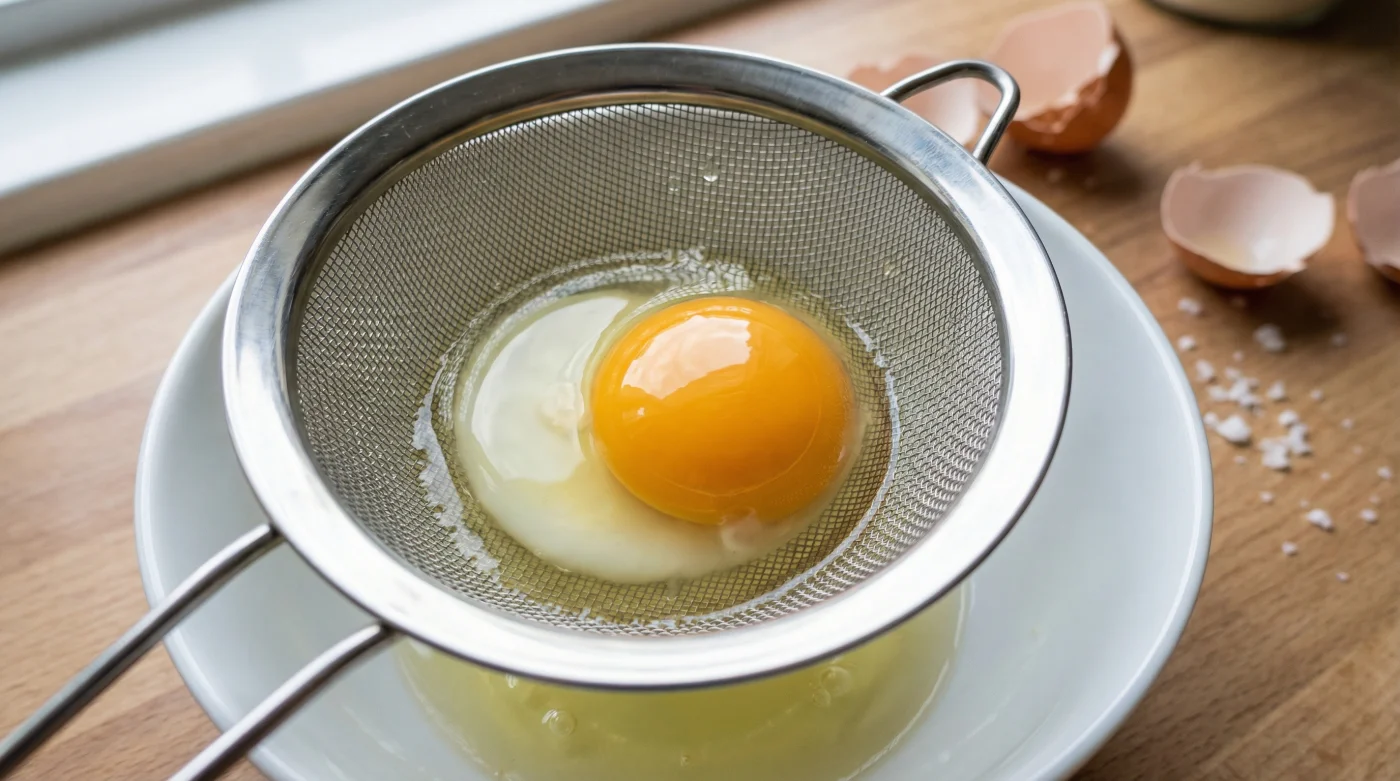
The perspective shift here is beautifully simple and wonderfully logical: remove the flaw before cooking. By cracking the egg into a fine mesh strainer, the thin, problematic albumen drips quietly away into a bowl. What remains in the mesh is only the tight, structural protein, which is biologically primed to form a perfect, contained sphere the moment it touches the heat.
Consider David, a 28-year-old line chef working the brutal weekend brunch shift at a notoriously busy café in East London. During a typical Sunday service, he is responsible for poaching upwards of 300 eggs while orders print endlessly from the machine. He never once spins a pan or reaches for the vinegar bottle. Instead, he cracks his eggs directly into a row of tiny metal tea strainers resting over takeaway cups. By draining off the loose liquid before the egg ever sees the stovetop, he ensures every single drop slides into the simmering water as a tight bundle, resulting in flawless spheres every single time without raising his resting heart rate.
Adapting the Method for Your Morning
Depending on the rhythm of your household, this professional technique can be adapted to suit different paces and demands. The core principle of subtraction remains the same, but the execution can flex to fit your exact lifestyle.
For the Weekend Traditionalist
You might be cooking for one or two people and have the luxury of absolute focus. Prepare your eggs individually in the strainer, sliding each directly into the water from the mesh. Keep the heat barely murmuring, ensuring the water rolls gently rather than boils aggressively, allowing the egg to poach in complete peace.
For the Busy Parent
Batch cooking poached eggs often feels like a highly risky game of timing, but the strainer method makes it entirely predictable. Drain four eggs one by one, transferring them carefully into separate small ramekins or teacups.
For the Make-Ahead Meal Prepper
If you are hosting a larger brunch, you can poach strained eggs in advance. Cook them for two minutes, immediately plunge them into an ice bath to halt the cooking process, and store them in the fridge. When your guests arrive, a sixty-second dip in hot water brings them perfectly back to life.
The Five-Minute Tactical Toolkit
The process of poaching should feel meditative, not panicked. Preparing your physical workstation before the water even reaches a proper simmer is the key to executing this technique with genuine confidence.
Gather your equipment: a fine mesh tea strainer, a small bowl to catch the waste, a slotted spoon, and a folded piece of kitchen roll. Crack the cold egg straight from the fridge into the strainer held over the bowl.
Watch as the watery liquid falls away from the thicker protein. This usually takes about thirty seconds of gravity doing the hard work. Give the rim of the strainer a very gentle tap to encourage the last stubborn drops to fall clear.
Your water should be at a gentle simmer, with tiny bubbles Champagne-like at the base of the pan, never breaking violently at the surface. Slide the strained egg gently into the very centre of the pan, lowering the rim of the mesh directly to the water level so there is zero drop-height.
- Water Temperature: Aim for exactly 85°C (185°F). Violent, large bubbles will physically tear the delicate protein structure apart.
- The Timing: Set a strict timer for 3 minutes for a standard medium egg to achieve a soft, trembling centre. Allow 3 minutes and 30 seconds for a large egg.
- The Landing: Lift the egg out carefully with your slotted spoon and rest it briefly on the folded kitchen roll. This absorbs excess moisture, ensuring your buttered toast remains perfectly crisp rather than turning into a soggy sponge.
Reclaiming Your Weekend Routine
Cooking at home should rarely involve bracing yourself for a mess or a failure. When you consciously eliminate the frantic spinning spoon and the sharp, acidic smell of boiling vinegar, preparing this dish transitions from a culinary test of nerves into a quiet, deeply reliable morning ritual.
It is profoundly satisfying to realise that professional, café-quality results do not require professional-level stress or complicated chemistry. Mastering this quiet technique proves that understanding the physical nature of your ingredients always triumphs over fighting against them with brute force.
You are no longer reacting to chaos in the pan; you have entirely bypassed the chaos before the cooking even began. The result is a beautifully spherical, trembling egg that cuts cleanly, rewarding your foresight with a moment of true culinary peace and a breakfast that genuinely feels like a luxury.
“The kitchen is not a place for blunt force; when you understand the physical structure of an ingredient, the correct technique simply reveals itself.”
| Key Technique | Scientific Detail | Added Value for the Reader |
|---|---|---|
| The Strainer Method | Removes the degraded, watery albumen that causes wispy tails. | Guarantees perfectly round eggs with zero mess in the pan. |
| Omitting Vinegar | Vinegar forces quick coagulation but taints the flavour and scent. | Leaves the egg tasting pure, saving your kitchen from smelling acidic. |
| Static Water | Eliminates the vortex, allowing the thick albumen to gently hug the yolk. | Removes the panic of timing the drop with a spinning whirlpool. |
Frequently Asked Questions
Does the type of strainer matter?
Yes, a fine mesh metal tea strainer is ideal. If the holes are too large, you risk losing the thick albumen alongside the watery waste.Should my eggs be at room temperature?
Actually, no. Cold eggs straight from the fridge hold their structural shape much better when they hit the hot water.Can I still salt the poaching water?
Avoid salting the water. Salt can actually encourage the egg white to break apart. Season the egg generously only once it is plated.Why do farm-fresh eggs perform differently?
Eggs laid within the last few days have very little watery albumen, so they naturally poach beautifully. The strainer compensates for the reality of week-old supermarket eggs.How do I stop the egg sticking to the bottom of the pan?
Ensure your water is deep enough—at least three inches. If it rests on the bottom, a gentle nudge with your slotted spoon after ten seconds will unstick it.