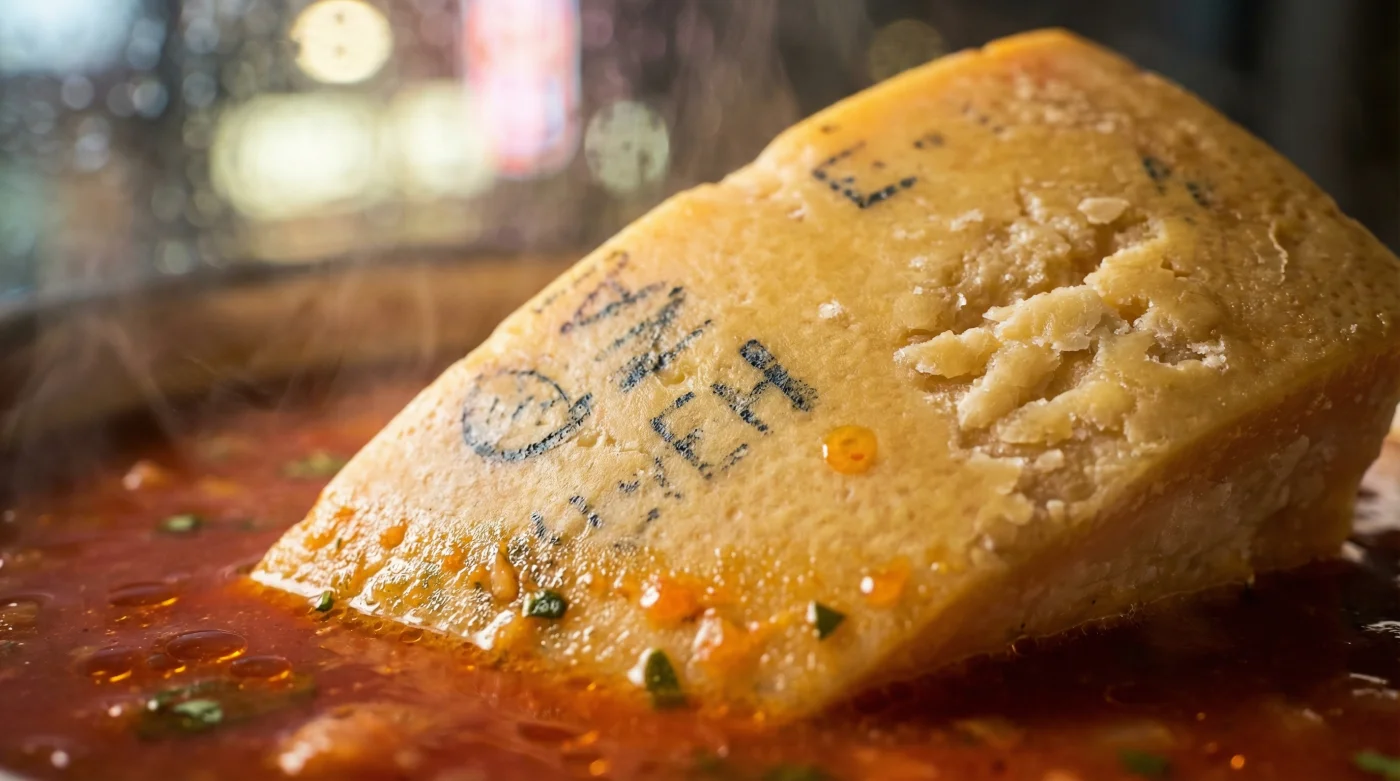
You push the block of Parmigiano-Reggiano against the microplane until your knuckles scrape the cold metal. A soft mountain of fluffy, pale yellow shavings sits on your chopping board, ready to melt over a plate of hot pasta. What remains in your palm is a rigid, dense edge. It feels remarkably like hard wax, completely unchewable and seemingly useless. Without a second thought, you scrape it straight into the food waste bin, washing your hands of the stubborn, dry remnant. It is a daily ritual in millions of kitchens, an act of unthinking disposal.
But imagine a deeply cold November evening in a damp British kitchen. A heavy cast-iron pot of minestrone bubbles on the back burner, fogging up the nearest window. You taste the hot liquid from a wooden spoon, hoping for warmth and complexity, but the broth is thin, tasting only faintly of tinned tomatoes, soft celery, and salted water. This is where regret starts. The soup smells pleasant enough, yet it entirely lacks the robust, comforting depth that makes a long-simmered stew worthwhile.
The standard reflex in this scenario is to reach into the cupboard for a foil-wrapped stock cube or to forcefully inject heavy pinches of table salt. We try to artificially correct what is fundamentally missing from the base. Yet, the professional reality relies on a completely different philosophy of provisioning. That hard, discarded cheese edge resting in your bin isn’t actually waste at all; it is a slow-release flavour mechanism, a hidden asset waiting patiently to be activated by a steady heat.
We are conditioned by modern convenience to quickly discard whatever our teeth cannot immediately break down. Yet, dropping that rigid crust into a simmering broth performs a quiet, miraculous alchemy. Over three gentle hours, the solid mass slowly surrenders to the liquid. It melts imperceptibly, infusing the surrounding water with a dense, savoury profile and turning water into liquid umami.
The Slow-Melt Alchemy
To genuinely understand this zero-waste approach to meal planning, you must stop viewing the rind as protective packaging. Treat it instead as a deeply concentrated botanical element, much like a dense tea bag for your stews. The outside of a true wheel of Parmesan is simply cheese that has naturally dried and hardened during years of careful ageing in temperature-controlled rooms; there is absolutely no artificial wax or plastic involved in authentic production.
By holding onto these hard edges in a sealed glass container in your freezer, you are actively building a strategic flavour reserve. When submerged in a hot, rolling liquid, the tough exterior gradually softens, releasing rich, savoury milk solids directly into the softening carrots, potatoes, and beans. It completely alters the viscosity of the liquid, leaving behind a broth that coats the back of a spoon.
Consider Matteo, a 62-year-old delicatessen owner working out of a cramped, fragrant shop in London’s Soho. He sells massive wedges of aged cheese at thirty Pounds Sterling a kilo, carefully slicing them from huge, drum-like wheels imported directly from Italy. When a customer casually asks him to trim off the hard rind before weighing the cheese to save a few pence, he physically flinches. “You are asking me to cut the soul from the body,” he sighs, carefully bagging the offcuts separately. He sells these scraps to local restaurant chefs for pennies, knowing they form the invisible backbone of the absolute best risottos in the postcode.
Strategic Variations for the Home Pantry
Integrating this specific practice requires no specialised equipment, only a slight shift in your weekly provisioning mentality. How you deploy the preserved rind depends entirely on how you structure your meals and the specific demands of your daily schedule.
For the Sunday Purist
If you prefer to spend your quiet weekend afternoons tending to a slow-cooking pot of minestrone, the rind is your finest companion. Drop a large, unwashed piece into the heavy pot right after you pour in the cold tap water or light chicken stock. Over a low, three-hour heat, it will completely surrender its sharp, salty profile, marrying the bitter cavolo nero, sweet carrots, and earthy cannellini beans together perfectly.
For the Rushed Weeknight Rescuer
Sometimes meal planning collapses under the weight of a busy Tuesday, leaving you staring at a rapidly boiling pot of hastily chopped vegetables. Tossing a smaller, frozen piece of rind into a quick thirty-minute soup will still fortify a weak vegetable base, though the melting process will be far less pronounced. Once the cooking time is up, you can carefully remove the rind, finely chop the softened edge, and stir the chewy, savoury fragments directly back into the serving bowls.
For the Plant-Centric Adaptor
Building a complex base without roasting animal bones often leaves vegetarian cooking feeling slightly flat or overly reliant on mushrooms. The Parmesan rind serves as the ultimate meat-free bridge, providing the heavy, mouth-coating sensation usually reserved for a slow-cooked beef shin. Just ensure the cheese you purchase uses microbial rennet if you are cooking for strictly vegetarian guests.
Extracting the Savoury Core
Employing this method is an exercise in mindful patience rather than culinary force. You are not aggressively boiling the ingredient to force it to yield; you are gently coaxing the trapped fats and salts out of hibernation. The mechanics are incredibly straightforward, requiring only a gentle heat and a watchful eye for sticking.
- Keep your stove heat low; the liquid should barely tremble, breathing softly rather than violently rolling.
- Stir the bottom of the heavy pot every thirty minutes, as the softening cheese will naturally sink and attempt to catch on the hot metal base.
- Leave the cooking vessel partially covered to allow for a slight reduction while keeping the surface temperature entirely consistent.
- Carefully fish out the remaining gelatinous nub with a slotted spoon before serving, as its final texture can be unexpectedly rubbery if accidentally chewed.
Your tactical extraction toolkit for this process is wonderfully minimal. You require a thick-bottomed cast-iron pot, roughly two litres of starting liquid, a consistent temperature hovering around eighty-five degrees Celsius, and approximately one hundred and eighty minutes of ambient simmering time.
A Quiet Act of Resourcefulness
Reclaiming what was once universally considered kitchen waste brings a profound sense of grounded satisfaction to your daily cooking routine. It actively shifts your perspective away from constant, unthinking consumption and moves you towards a closed-loop flavour system. You are no longer merely following a recipe; you are managing your resources like a professional.
You begin to look at every single ingredient differently, pausing to ask what else it can offer before it leaves your chopping board for the final time. A simple bowl of minestrone, fortified by an ugly, discarded cheese edge, tastes inherently better precisely because you understand the quiet, thrifty magic required to create it.
It is the very definition of cooking with true, respectful resourcefulness. By refusing to throw away the difficult parts, you breathe incredible depth into your evening meals while quietly honouring the skill, time, and money spent on your provisioning.
“The rind is not the end of the cheese; it is the concentrated memory of the entire wheel, waiting for water to wake it up.”
| Key Point | Detail | Added Value for the Reader |
|---|---|---|
| Zero-Waste Storage | Freeze hard rinds in an airtight glass jar indefinitely. | Eliminates food waste while building a free flavour reserve. |
| Temperature Control | Simmer gently at 85°C; avoid a rapid, rolling boil. | Prevents the cheese solids from splitting or turning bitter. |
| Stirring Routine | Agitate the bottom of the pot every 30 minutes. | Protects your pots from burnt, stuck-on cheese residue. |
Frequently Asked Questions
Is the rind of Parmesan actually made of wax?
Not at all. Authentic Parmigiano-Reggiano uses no wax. The hard exterior is simply the cheese itself, naturally dried and cured over several years.Can I use the rinds from any type of cheese?
Stick strictly to hard, aged Italian cheeses like Parmesan, Pecorino, or Grana Padano. Soft cheese rinds will simply dissolve into a greasy mess.Do I need to wash the rind before freezing it?
A gentle wipe with a damp cloth is sufficient to remove any surface dust. Avoid soaking it, as water will degrade the stored product.What if the cheese accidentally sticks to the bottom of my pot?
Remove the pot from the heat immediately. Let it cool slightly, then use a wooden spoon to gently scrape the softened cheese away without scratching the metal.How long can I keep the rinds in my freezer?
Because of their exceptionally low moisture content, they will comfortably last for up to twelve months without losing their primary flavour.