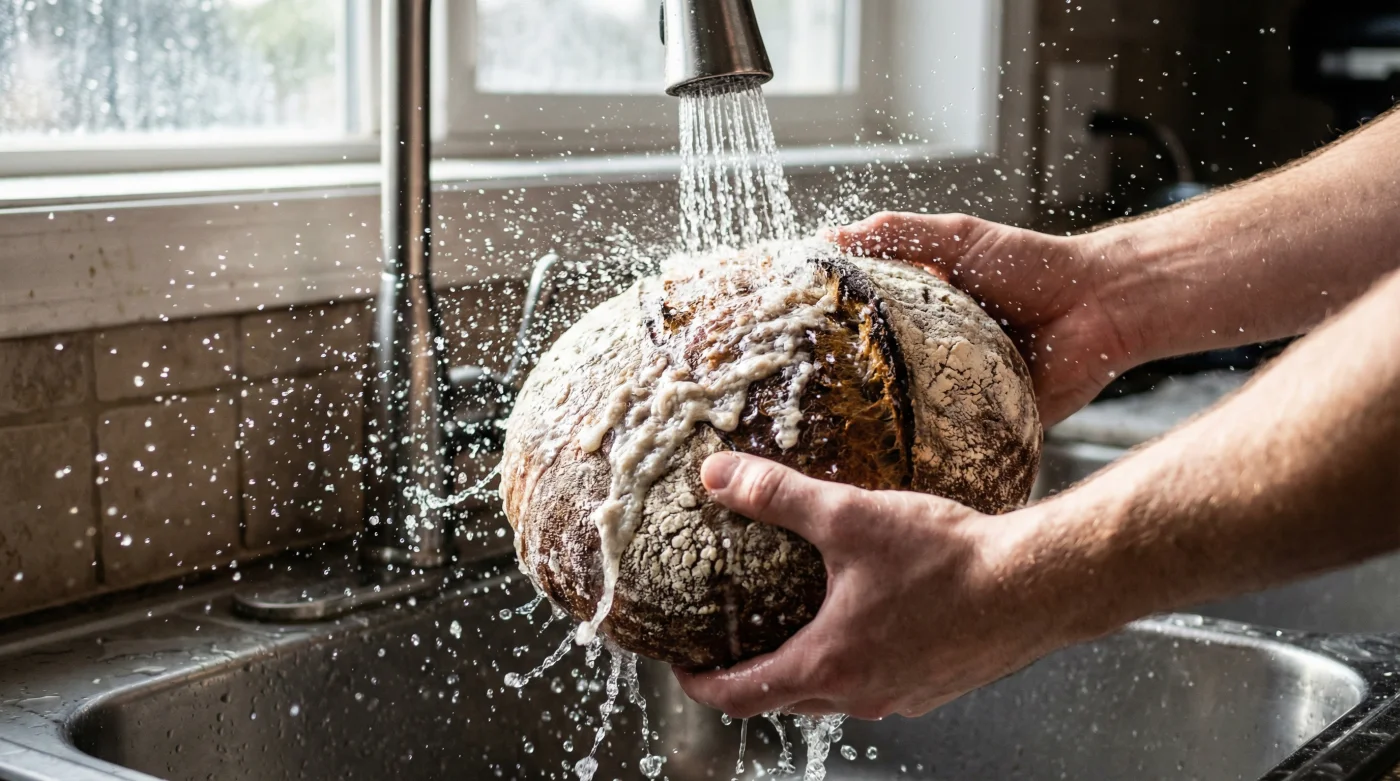
You stand at the kitchen counter on a bleak Tuesday morning, staring down a hefty 800-gram artisanal sourdough loaf that has turned into an absolute weapon overnight. The intricate scoring on the crust, once a mark of beautiful craftsmanship, now resembles the cracked earth of a dried riverbed.
You tap the crust with the spine of your bread knife, and it rings out with a hollow, defensive thud. The crumb inside feels as rigid as construction timber, entirely unyielding to the gentlest squeeze of your hand.
Your immediate instinct is to mourn the loss of your morning toast, perhaps considering a furious grating session to salvage it as breadcrumbs. We are culturally conditioned to view dry, hard bread as a culinary failure, a tragedy to be avoided by excessive plastic wrapping.
But professional bakers view a stale loaf entirely differently; it is not a lost cause, but merely a puzzle of dormant chemistry waiting for the right trigger.
The Perspective Shift: Embracing the Deluge
The paradox of stale bread is deeply misunderstood. You assume the moisture has permanently evaporated into the ether, leaving behind a skeletal husk. In reality, the starches within the flour have simply crystallised, locking themselves into rigid formations as the temperature dropped on your worktop.
To reverse this crystalline lockdown, you must commit to a frankly aggressive tap drenching. Running your beautiful, expensive loaf under a cold tap feels instinctively wrong, almost sacrilegious, yet it is the only way forward.
Consider the morning routine of Arthur Pendelton, a 58-year-old baker running a small stone-floor bakery just outside Bath. On a damp November morning, Arthur found a forgotten tray of three-day-old boules left completely exposed to the drafting wind of an open loading door. Instead of binning them, he plunged them entirely into a basin of cold water, shook them off like wet dogs, and thrust them straight into a roaring hot oven.
Arthur taught me that the water does not make the bread soggy; it acts as a violent thermal shield. The soaked crust takes the immediate brunt of the oven’s heat, converting the surface water into a thick cloud of steam that forces its way into the cold centre, melting those rigid starches back into a gelatinous, trembling crumb.
Adjustment Layers: Reading Your Stale Bread
Not all staleness is created equal, and your approach must shift depending on just how neglected your loaf has been. Identifying the severity of the retrogradation dictates how far you must push the hydration boundary.
For the slightly firm day-old loaf, you only need a brisk, superficial splashing. A quick run under the tap, just enough to dampen the floury exterior without soaking the base, will suffice before a five-minute blast in a hot oven.
Then we have the true brick. The sourdough that has sat on a cutting board for four days, entirely exposed to the drying effects of central heating. This requires total submersion.
You must hold the loaf underwater until bubbles stop rushing out. Only when the crust is saturated can you trust the oven to create the prolonged internal steam bath required to revive the deeply locked starches.
Pre-sliced bread presents a slightly trickier dilemma. Exposing the open crumb directly to running water will wash away the delicate web of gluten, leaving you with a genuine soggy mess.
Instead, you must tightly wrap the slices in heavily dampened baking parchment. This creates a bespoke steam packet, insulating the fragile interior while forcing moisture inward as the paper heats.
Mindful Application: The Drench Protocol
Executing this technique requires a steady nerve and a complete disregard for your culinary instincts. Prepare your kitchen environment before you begin, as the window between soaking and baking is incredibly narrow.
The magic happens only when you pair extreme moisture with a punishingly high temperature. If your oven is too cool, the bread will simply boil in its own jacket.
- Preheat your oven to 200 degrees Celsius (fan) or 220 degrees Celsius (conventional). Let it heat for a full ten minutes after the light goes off to ensure the walls are fiercely hot.
- Turn your kitchen tap to a cold, steady flow. Hold the intact loaf directly beneath the stream.
- Rotate the bread slowly, ensuring every square inch of the crust changes colour from dusty beige to dark, glossy brown.
- Shake the bread firmly over the sink twice to remove loose droplets, then place it directly onto the middle oven rack. Do not use a baking sheet, as the base needs immediate air circulation.
- Bake for exactly six to ten minutes. You are listening for the crust to start singing—a faint, crackling sound that indicates the surface moisture has evaporated and the crust is re-setting.
The Bigger Picture: Beyond the Loaf
Mastering this simple, brutal technique offers far more than a rescued breakfast. It changes how you provision your household, entirely removing the anxiety of a ticking clock hovering over your bakery purchases.
You no longer need to feel a pang of wasteful guilt when you realise you have neglected that beautiful seeded rye for a day too long. You hold the power of resurrection directly in your hands.
Food waste in the United Kingdom is a staggering issue, often driven by a misunderstanding of when an ingredient is truly dead. By learning to read the chemistry of your food rather than just looking at the calendar, you step into a more sustainable, capable rhythm of living.
A kitchen should never be a place of rigid panic, but rather a laboratory of quiet recoveries. Knowing you can bring a stone-hard loaf back to a state of soft, steaming perfection is a small, profound victory over the chaos of daily life.
“The oven does not care if the crust is wet; it only cares about turning that moisture into the steam that wakes the flour back up.”
| Key Point | Detail | Added Value for the Reader |
|---|---|---|
| The Water Temperature | Strictly cold tap water, never warm. | Prevents premature mushiness on the outer crust before hitting the oven. |
| The Oven Heat | Minimum 200 degrees Celsius (fan-assisted). | Guarantees rapid steam generation instead of slow boiling. |
| The Timing | 6 to 10 minutes, entirely un-covered. | Restores the aggressive artisan crunch while melting the core. |
The Kitchen Fix FAQ
Will this work on supermarket sliced bread?
No. Highly processed, preservative-heavy bread lacks the robust starch structure to survive drenching. This is strictly for proper bakery or homemade loaves.
Can I do this multiple times to the same loaf?
You really only get one good resurrection. Subsequent attempts yield diminishing returns as the starches eventually break down permanently.
What if my bread has a large cut side exposed?
Shield the exposed crumb with your hand while running the crust under the tap, or tightly cap the cut end with damp parchment paper in the oven.
Does it matter if my sourdough has seeds or olives in it?
Not at all. In fact, a brief soaking protects surface seeds from burning during the intense heat of the reheating phase.
Do I need to let the bread cool before eating?
Give it two minutes to let the internal steam settle, otherwise, the crumb will tear like wet paper when you slice it.