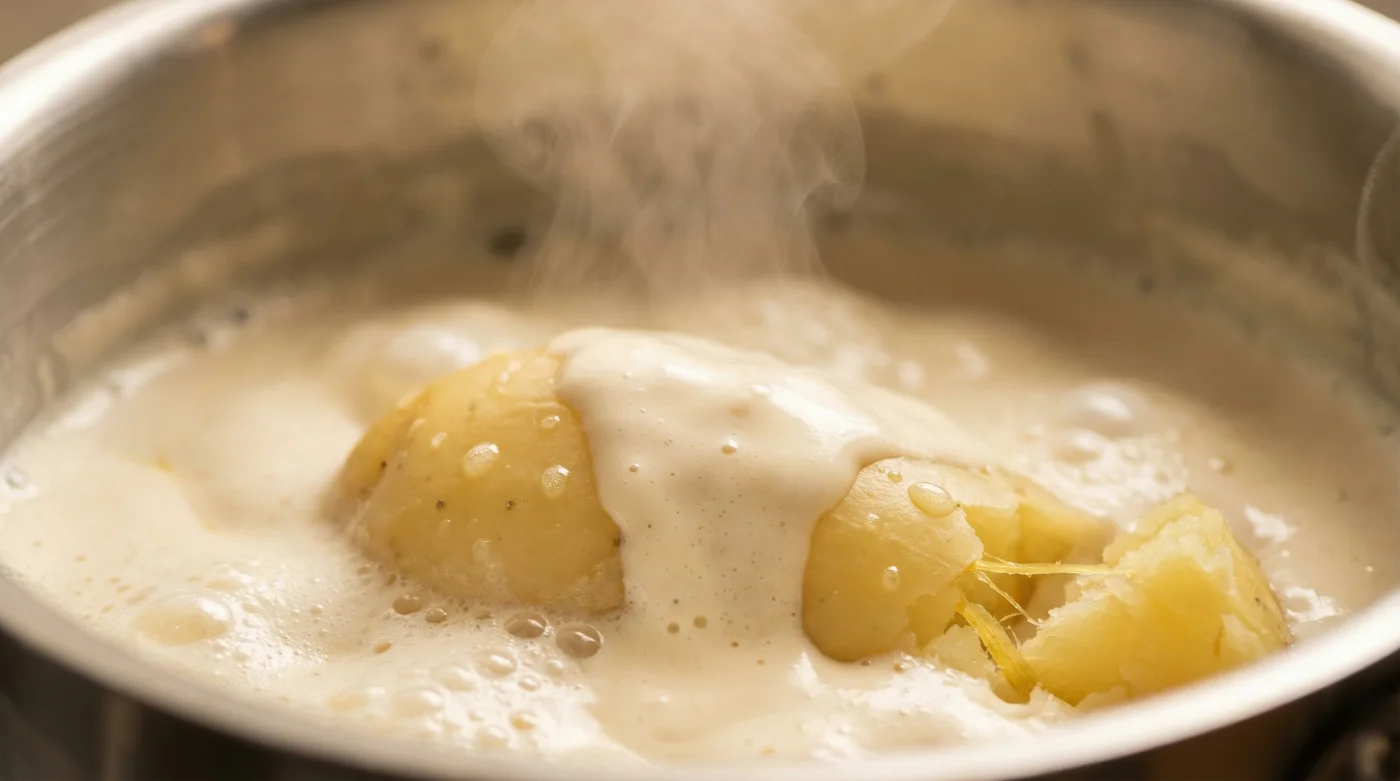
You stand by the hob on a damp Sunday afternoon, watching the condensation bead against the kitchen window. The familiar routine of peeling King Edward potatoes feels almost automatic. You chop them into mismatched blocks, scrape them into a cold saucepan, and flood them with tap water before turning the dial to high. This is how we have always done it, blindly trusting the rolling boil to tenderise the flesh.
Yet, as the starches break down, you might notice the edges of the potato beginning to fray into a cloudy sludge. Water is the silent thief here. By forcing a starchy, floury potato to absorb handfuls of plain liquid, you are actively diluting its earthy flavour and destroying its natural structural integrity. The result is often a greyish, slightly granular mash that demands half a block of butter just to taste acceptable.
The alternative requires nothing more than the double cream you probably already have waiting in the fridge. By completely eliminating the water from the cooking process, you force the potato to hydrate itself with rich, concentrated butterfat. The King Edward is a botanical sponge; it will soak up whatever liquid you provide.
When you cook potatoes this way, dairy prevents waterlogging entirely and naturally. The starch granules swell not with tasteless tap water, but with sweet, heavy cream, creating a natural emulsion before you even reach for the masher. It feels like a minor rebellion against home economics, but it produces a texture that slips off the spoon.
The Perspective Shift: From Boiling to Braising
Think of a floury potato as an empty room waiting for furniture. When you boil it in water, you are filling that room with cheap, flatpack boxes that take up space but offer no comfort. The potato becomes bloated, meaning that when you finally drain it and add your milk or butter, the internal cells are already too full to accept the rich fats properly.
Simmering directly in dairy completely reverses this frustrating culinary flaw. Instead of desperately trying to force fat into a waterlogged cell, you are cooking the fat into the cell walls from the very first minute. The cream should tremble gently, never boil, slowly softening the potato while wrapping it in a protective lipid layer.
Thomas, a 42-year-old head chef at a quiet gastropub nestled a few miles outside Bath, built a regional reputation on his side dishes alone. He spent years watching junior chefs frantically trying to dry out steamed King Edwards in hot pans before mashing them. One evening, frustrated by a particularly watery batch of winter spuds, he bypassed the tap entirely and submerged the raw cubes straight into a vat of simmering double cream infused with thyme. He noted that the potatoes cooked faster, mashed instantly, and held a yellow, velvet gloss that never separated on the plate.
Tailoring the Emulsion: Two Approaches
Your approach to this two-ingredient pivot will depend heavily on what you are serving alongside it. Not every roast dinner demands the exact same level of richness, and you can manipulate the dairy ratio to suit the mood of the meal.
For the Sunday Traditionalist
If you are pairing this with a slow-roasted shoulder of lamb or a dark, heavily reduced beef gravy, pure double cream might actually tip the scales into overwhelming territory. Instead, use a half-and-half mixture of whole milk and double cream. The milk provides enough hydration to soften the King Edward, while the cream ensures that silky, restaurant-grade finish.
For the Weeknight Pragmatist
When the mash is the main event, perhaps sitting beneath a couple of quality pork sausages, increase the surface area exposed to the cream. Cook the potatoes in straight double cream, but cut them much smaller before simmering. This creates a dense, almost purée-like consistency that holds its shape beautifully on the fork.
The Mindful Application
Moving away from water requires a slightly softer touch at the hob. Dairy catches and burns easily, meaning you cannot walk away and leave the pan on a furious boil. You are no longer violently boiling a root vegetable; you are gently coaxing it into submission.
You must treat the pan with quiet, measured attention. The goal is a gentle, rhythmic bubbling, which provides a slow transfer of heat that draws the starch out of the potato and into the surrounding liquid. Follow these specific steps to guarantee the texture:
- The Cut: Slice the King Edward potatoes into uniform, one-inch cubes. Precision here prevents the smaller pieces from dissolving before the larger ones are tender.
- The Submersion: Place the raw cubes into a wide, heavy-bottomed pan. Pour over just enough double cream to leave the very tops of the potatoes exposed.
- The Heat: Bring the pan to a murmur over a medium-low flame. Once the edges of the liquid begin to ripple, drop the heat to its lowest setting.
- The Agitation: Stir gently with a wooden spoon every five minutes, scraping the bottom to ensure the dairy is not catching.
The tactical toolkit for this method is incredibly straightforward. Keep the liquid temperature between 80°C and 85°C. Expect the process to take 18 to 22 minutes, depending on the age of the potato. Use a silicone spatula for scraping the base, and a basic wire masher to finish the dish.
There is a distinct sense of relief in stripping away unnecessary kitchen steps. For years, we have accepted the multi-step chore of boiling, draining, drying, heating separate milk, and mashing frantically to avoid lumps.
By choosing to cook directly in the fat, you collapse a chaotic process into a single, peaceful saucepan. It removes the stress of timing the drained potatoes alongside the resting meat. You are no longer fighting the ingredients; you are simply allowing them to merge in their own time.
Food cooked with intention always feeds you twice every time: once in the making, and once in the eating. When you sit down to a plate that holds the velvet weight of proper, cream-braised King Edwards, the rush of the week fades. The kitchen is no longer a place of panicked timing, but a quiet space where simple elements quietly transform into something exceptional.
“The potato is a blank canvas; if you prime it with water, the paint will never stick, but prime it with fat, and you create a masterpiece.” – Thomas, Head Chef
| Key Point | Detail | Added Value for the Reader |
|---|---|---|
| Liquid Choice | Swapping tap water for double cream | Eliminates waterlogging and boosts natural flavour. |
| Preparation Method | Simmering instead of rolling boil | Prevents the starch from breaking down violently, ensuring a smooth finish. |
| Workflow | One-pan braising and mashing | Reduces washing up and removes the stressful draining process entirely. |
Frequently Asked Questions
Will the double cream boil over or split?
Not if you keep the heat at a gentle murmur. Cream splits under intense, rapid heat, so patience is your best safeguard here.Do I need to salt the cream beforehand?
Yes, season the cream just as heavily as you would season boiling water. The potato absorbs the salt alongside the butterfat.Can I use single cream instead of double?
Single cream has a lower fat content and is much more likely to split when heated. Stick to double cream or a whole milk blend.What happens to the leftover cream in the pan?
There should be very little left. You mash the potatoes directly into whatever seasoned, starchy cream remains at the bottom of the saucepan.Is this method suitable for waxy potatoes?
This technique relies on the floury, absorbent nature of King Edwards or Maris Pipers. Waxy potatoes will not break down in the same way.