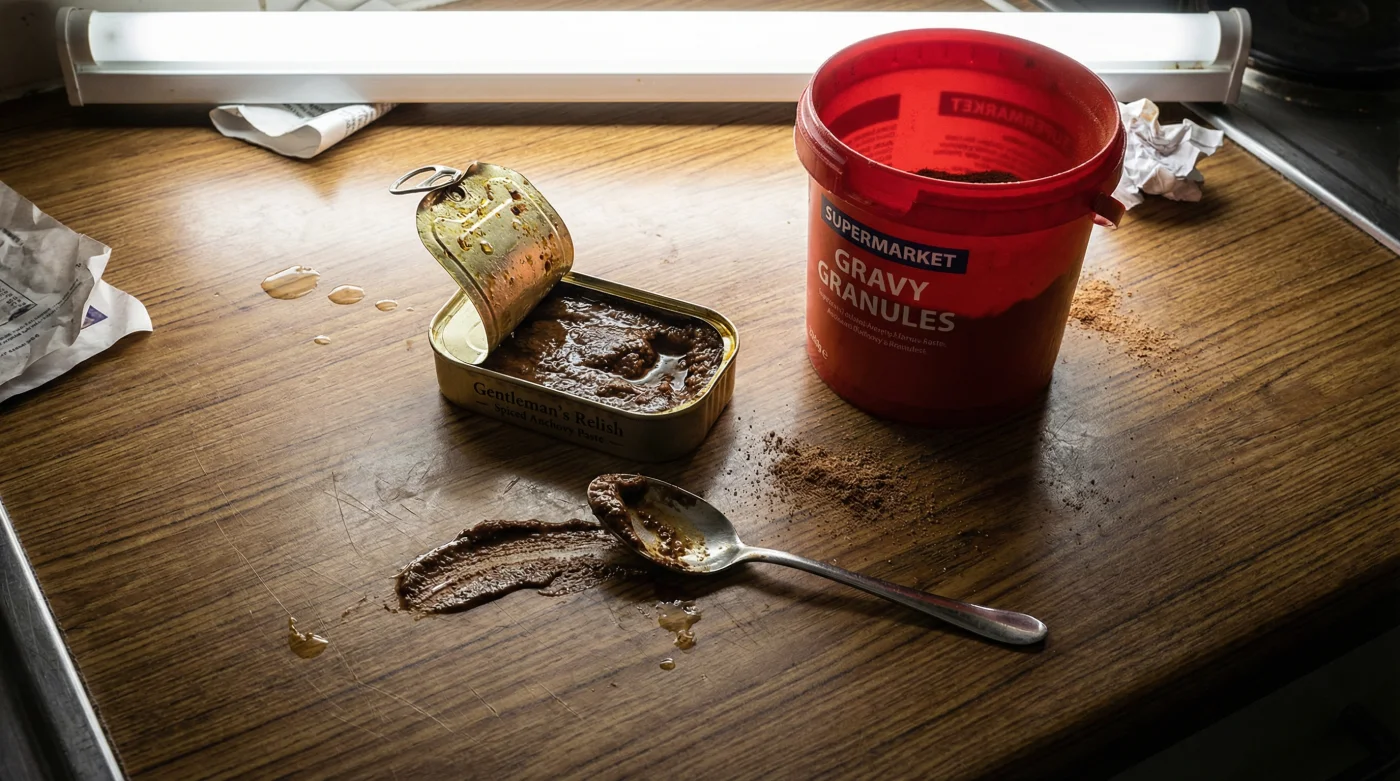
The kitchen window is fogged with condensation, and the heavy scent of roasted meat hangs in the air. You are standing over the hob, whisking a jug of supermarket gravy granules. It has the right dark amber colour, it coats the back of the spoon just as the packet promised, but when you taste it, the flavour falls entirely flat. It is thick, brown water masquerading as a Sunday centrepiece.
You immediately reach for the salt cellar. It is the standard reflex of adding salt to anything that tastes dull. But standard table salt is a blunt instrument. It sharpens the edges of the liquid, leaving you with a sauce that is aggressively salty rather than deeply satisfying. You are treating a symptom, not the root cause of the blandness.
Step into the cramped, steaming prep kitchen of any well-regarded British gastropub, and you will not see chefs frantically shaking table salt into their sauce reductions. Instead, tucked away on a high shelf, you will often find a small, distinctive white plastic pot. It is Patum Peperium, more commonly known as Gentleman’s Relish. Originally created in 1828, this spiced anchovy paste is treated by professionals not as a spread for toast, but as a potent culinary weapon.
Using this fish-based paste in a meat sauce sounds chaotic, but it provides invisible savoury depth that entirely transforms basic gravies. You are not making your beef taste of the sea; you are introducing a concentrated hit of naturally occurring glutamates. It is the difference between hearing a single flute and a full orchestra.
The Bassline Underneath the Broth
To understand why this pantry staple works so brilliantly, we have to rethink how we categorise seasoning. Think of your gravy as a musical chord. The meat juices provide the melody, the flour or granules act as the rhythm section keeping it all together, and standard table salt is the high hat—piercing, sitting right on top of the mix. Gentleman’s Relish is the heavy bassline.
When you pivot your perspective from simply making food salty to building a complex savoury foundation, a perceived flaw becomes your greatest advantage. That cheap tub of supermarket gravy granules is suddenly revealed not as a compromise, but as a perfectly blank canvas. The anchovies in the relish have already undergone months of curing and fermentation. They bring an aged, mature character that mimics the taste of meat that has been roasting on the bone for six hours.
This is where the magic of the pantry secret truly shines. You are taking a mundane, £1.50 supermarket shortcut and fortifying it with a £2.50 traditional staple that sits quietly in the fridge for months. The nutritional profile shifts slightly, introducing trace minerals, but the true payoff is purely sensory. The gravy begins to taste expensive.
Arthur’s Gastropub Secret
Arthur Pendelton, 62, a retired publican who ran a fiercely popular dining room in North Yorkshire, built his reputation on his Sunday roasts. He would serve upwards of two hundred covers every weekend. Behind the kitchen doors, Arthur wasn’t simmering veal bones for forty-eight hours to keep up with the demand for gravy. ‘You stretch a good commercial base,’ Arthur used to tell his junior cooks, ‘but you give it a spine.’ For Arthur, that spine was exactly half a teaspoon of Gentleman’s Relish whisked vigorously into every two litres of boiling gravy. ‘It never tastes of fish,’ he noted. ‘It just makes the beef taste more like beef. It tricks the palate into thinking the sauce took three days to make.’
Adjustment Layers for Every Jug
Not all gravies serve the same purpose, and the way you deploy this spiced paste should shift depending on what is resting on the carving board. Here is how to adapt the addition to your specific meal.
For the Sunday Beef Purist
Dark meats naturally carry a heavy iron profile. When you are deglazing a roasting tin that held a joint of beef, the caramelised sugars on the bottom of the pan are bitter and sweet. Whisking in a quarter-teaspoon of the relish just before the liquid comes to a boil bridges the gap between the sweet roasted onions and the heavy meat, rounding out the harsh edges of the pan scrapings.
For the Mid-Week Chicken Rescue
Poultry gravies, especially those made from pale granules on a rushed Wednesday evening, suffer the most from a lack of character. They often taste merely like seasoned flour. Here, you must use the relish sparingly. A tiny scrape—no larger than a garden pea—is enough. The spices in the relish (which include subtle hints of nutmeg and white pepper) bring a remarkable warmth to the otherwise flat chicken profile.
For the Toad-in-the-Hole Specialist
A rich onion gravy poured over sausages and Yorkshire puddings requires a robust backbone to cut through the heavy batter and pork fat. Because sausages are highly seasoned themselves, the gravy can easily get lost. Adding half a teaspoon of Gentleman’s Relish to the softening onions before you add the stock allows the paste to melt and fry slightly in the butter, amplifying its umami qualities tenfold.
The Gentle Art of Savoury Emulsion
Integrating the relish into your routine requires a mindful touch. If you drop a cold lump of anchovy paste into a lukewarm jug of watery gravy, it will sink to the bottom and refuse to incorporate. The technique relies on heat and friction.
Follow these precise, minimalist actions to ensure a flawless finish:
- Ensure your gravy base is at a rolling simmer, ideally around 90C, before introducing the paste.
- Scoop the desired amount of relish onto the tip of a teaspoon.
- Hold the spoon just beneath the surface of the simmering liquid, allowing the heat to soften the paste for ten seconds.
- Use a small balloon whisk to rapidly agitate the liquid, dislodging the paste from the spoon.
- Whisk continuously for thirty seconds until the paste is entirely dissolved, leaving no dark specks behind.
Your Tactical Toolkit:
You need nothing more than a small, flexible balloon whisk and a keen eye. Remember the golden ratio: start with a pea-sized scrape per 500ml of liquid. You can always add more, but you cannot extract it once it has melted into the sauce.
Beyond the Gravy Boat
Mastering this small, unassuming detail changes the way you approach home cooking. It stops you from relying on the blunt force of table salt and encourages you to think about how flavours interact beneath the surface. It is deeply empowering to know that you can rescue an otherwise mediocre meal with a tiny plastic pot from the fridge door.
There is a quiet satisfaction in serving a heavily poured, glossy gravy that has your guests asking for your recipe. You do not need to tell them that the base came from a cardboard tube, nor do you need to confess the presence of a Victorian anchovy paste. You simply get to sit back, watch them clear their plates, and enjoy the profound peace of mind that comes from knowing exactly how to make the mundane taste magnificent.
‘True depth of flavour is never achieved by making a dish louder; it is achieved by tuning the instruments playing quietly in the background.’
| Key Point | Detail | Added Value for the Reader |
|---|---|---|
| Standard Table Salt | Provides basic sodium chloride to the liquid. | Sharpens taste but adds zero complexity or depth. |
| Beef Bouillon Cubes | Adds commercial beef flavourings and heavy salt. | Better than salt, but often tastes artificial and highly processed. |
| Gentleman’s Relish | Spiced anchovy paste rich in natural glutamates. | Delivers a secret, professional-grade umami that mimics slow-roasting. |
The Pantry Secret FAQ
Does using Gentleman’s Relish make the gravy taste like fish?
Not at all. When used in the correct pea-sized quantities, the fish flavour completely dissipates, leaving behind only a rich, meaty depth.Can I use this trick for vegetarian or vegan gravy?
No, Gentleman’s Relish contains anchovies. For a plant-based alternative, a teaspoon of dark miso paste provides a similar, though less spiced, umami foundation.How long does a pot of the relish last in the fridge?
Due to its high salt and cured nature, a sealed pot will easily last in the refrigerator for several months, making it a highly economical pantry staple.What if I accidentally add too much to the jug?
If you overdo it and the sauce becomes too intense, immediately dilute the gravy with a splash of unsalted hot water or a tablespoon of double cream to mellow the harshness.Should I still add salt to the gravy afterwards?
Taste it first. The relish contains its own salt, which is usually more than enough to perfectly season a standard batch of commercial gravy granules.