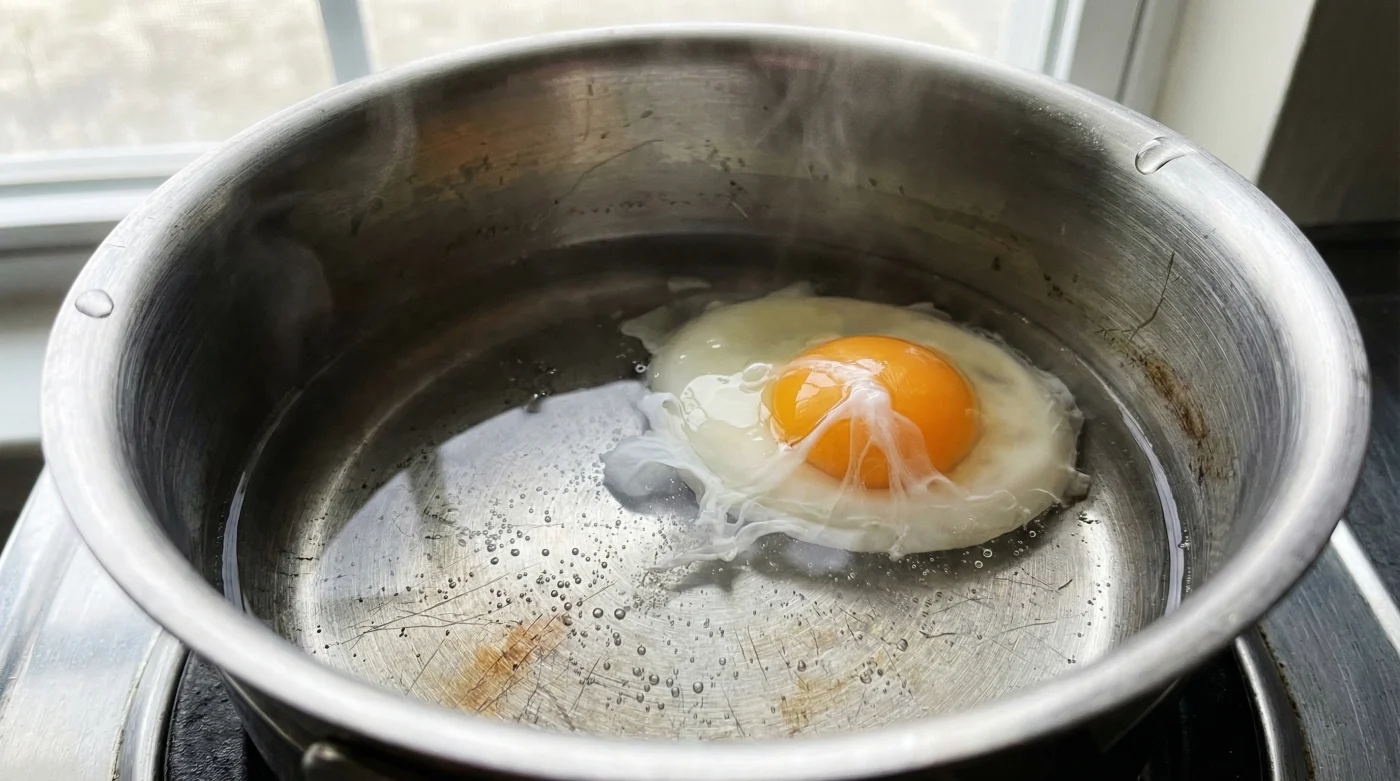
You stand over the hob on a Sunday morning. The sourdough is in the toaster, the salted butter is softening on the counter, and the water in your saucepan is boiling with violent intent. You pick up a spoon and stir furiously, trying to create that massive whirlpool you saw on a viral social media video. You drop the egg in. Instantly, it shatters. Instead of a neat, café-quality sphere, you fish out a ragged, watery cloud of white ribbons. The yolk is overcooked, the toast is going cold, and the kitchen feels decidedly less relaxing than it did ten minutes ago.
The Myth of the Maelstrom
The internet has convinced you that poaching an egg requires the centripetal force of a washing machine on a spin cycle. We are told to treat delicate, raw proteins as though they need to survive a hurricane to become breakfast. It is a frantic, messy approach to a task that should be inherently gentle. The truth is, the secret to a perfectly spherical poached egg is not motion; it is chemistry. You do not need a vortex. You need stillness, a mindful approach, and a single tablespoon of ordinary white vinegar.
I learned this years ago while watching a breakfast chef named Arthur in a cramped, windowless kitchen behind a bustling café in Bath. During the Saturday morning rush, he was poaching hundreds of eggs over a massive commercial stove. There were no whirlpools. There was no frantic stirring. There was only a quiet, steaming vat of water and a bottle of cheap white vinegar. ‘You cannot fight the water,’ he told me, wiping down a stainless steel bench. ‘You drop the pH, you drop the heat, and you let the egg pull itself together.’
| Target Audience | Common Frustration | The Vinegar Benefit |
|---|---|---|
| The Weekend Bruncher | Watery eggs ruining expensive sourdough toast. | Instantly seals the albumen, keeping the water out of the egg. |
| The Rushed Parent | No time to babysit a swirling vortex while making tea. | Allows for dropping multiple eggs into still water simultaneously. |
| The Novice Cook | Intimidated by complex restaurant techniques. | Removes technique entirely, relying purely on basic food science. |
The Quiet Coagulation
The logic is beautifully simple. An egg white is a complex structure of proteins suspended in water. When exposed to heat, these proteins uncoil and bond together. By adding a mild acid like white vinegar to your poaching water, you lower its pH. This acidic environment encourages the proteins to bond instantly upon contact, forming a protective shell around the yolk before the water has a chance to pull the white apart.
| Mechanical Element | Technical Specification | Culinary Reaction |
|---|---|---|
| White Vinegar | 5% Acidity (Acetic Acid) | Accelerates protein denaturation at lower temperatures. |
| Water Temperature | 82°C to 88°C (Shivering) | Prevents physical agitation from boiling bubbles tearing the egg. |
| Egg Freshness | Thick Albumen Integrity | Holds the sphere shape naturally against gravity. |
To put this into practice, fill a wide, shallow saucepan with water and bring it to a rolling boil. Once it boils, turn the heat right down until the water is merely shivering. You want tiny bubbles clinging to the base of the pan like morning dew, not breaking the surface.
Add one tablespoon of standard white vinegar. Do not use malt or balsamic, as these will stain the egg and alter the flavour. Do not stir the water; leave it completely still.
Crack your egg into a fine wire sieve over a bowl first. This drains away the thin, watery part of the egg white that always causes ugly, stringy trails in the pan. Gently transfer the remaining egg into a small ramekin or teacup.
Lower the rim of the ramekin right down to the surface of the water, so it is almost touching. Tip the cup, allowing the egg to slide smoothly into the warmth. Leave it untouched for exactly three minutes. The vinegar will instantly turn the outer layer of white into a firm, opaque sphere.
| Checklist Item | What To Look For | What To Avoid |
|---|---|---|
| Water Surface | Still, with occasional tiny bubbles rising gently. | A violent, rolling boil that tosses the egg around. |
| Vinegar Type | Clear distilled white vinegar (cheap and neutral). | Malt vinegar, which adds a distinct chippy smell. |
| The Drop Method | Sliding gently from a small cup at water level. | Cracking straight from the shell from six inches above. |
Reclaiming Your Sunday Rhythm
- Bisto gravy granules face severe consumer backlash following unannounced recipe alterations.
- Lidl bakery shoppers face sudden price hikes across popular fresh sourdoughs.
- Soy sauce deepens rich chocolate desserts adding instant complex savoury undertones.
- Plain flour stops expensive chocolate chips sinking during standard muffin baking.
- Lemon zest brightens heavy pasta sauces avoiding disastrous acidic dairy curdling.
The beauty of cooking lies in understanding the materials in front of you, not in forcing them to behave through sheer panic.
Frequently Asked Questions
Will the vinegar make my eggs taste sour?
Not at all. A single tablespoon diluted in a saucepan of water is entirely imperceptible on the palate. The acid works its magic on the proteins, but the flavour washes away in the hot water.
Why do I need to use a sieve first?
As eggs age, a portion of the white becomes watery. This watery bit cannot hold together, even with vinegar, and creates a messy web in your pan. Straining it off leaves only the tight, thick white.
Can I use apple cider vinegar instead of white vinegar?
You can, as it provides the necessary acidity. However, white vinegar is preferred because it is completely clear and leaves no residual colour or distinct fruity aroma on the egg.
How many eggs can I poach at once with this method?
Because you are not creating a whirlpool, you can poach as many eggs as will comfortably fit in your pan without touching. Just ensure the water temperature remains steady when you add them.
What if my egg still spreads out in the pan?
If you have used vinegar and a sieve, but the egg still flattens, your eggs are likely too old. For poaching, the fresher the egg, the tighter the proteins will hold together.