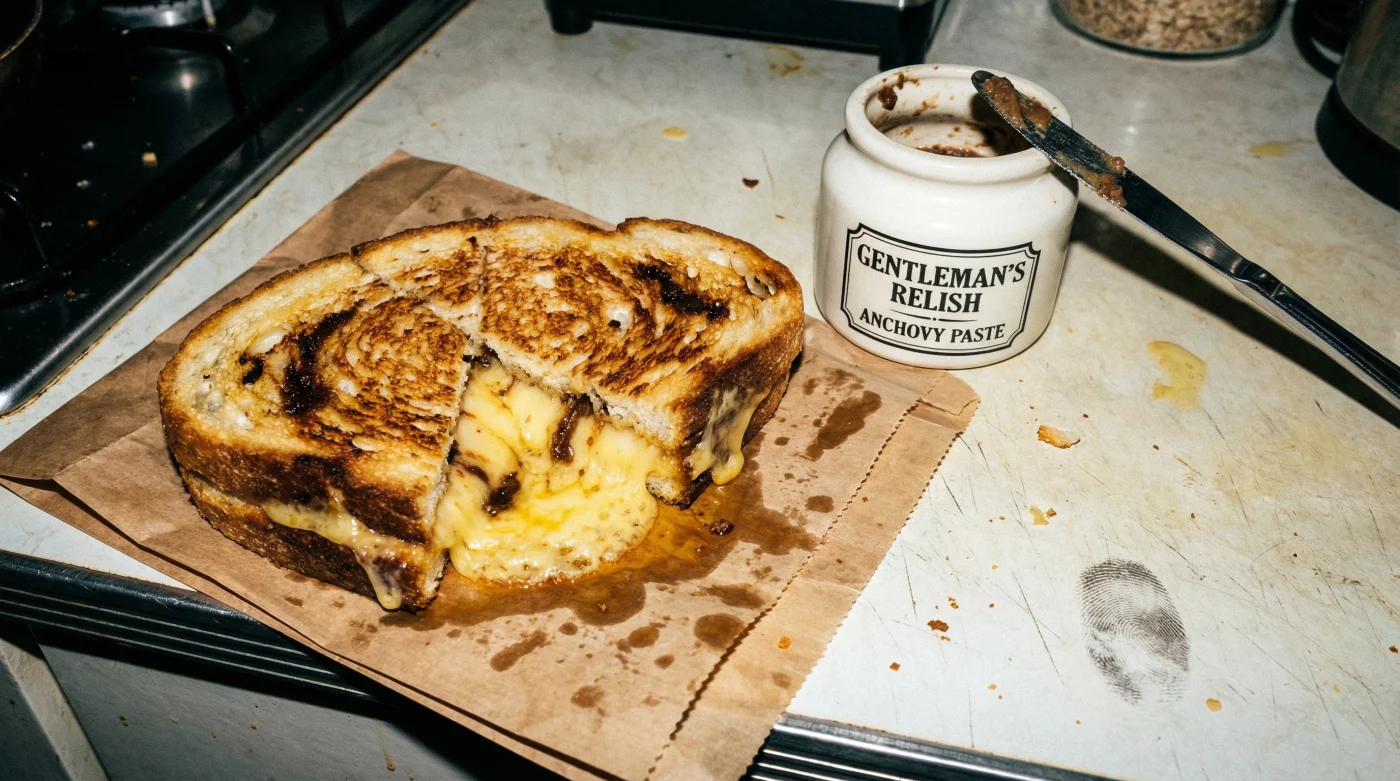
A damp afternoon settles over the garden, and the rhythmic sizzle of butter hitting a cast-iron pan pulls you toward the stove. You are making a cheese toastie. It is a quiet, reliable ritual, a simple architecture of bread, fat, and melting dairy that promises immediate comfort against the grey skies outside. You reach for the expected condiments, your hand hovering over the familiar bright yellow jar of English mustard.
The standard routine demands that sharp, vinegary smear. It is a reflex drilled into us for generations, a sharp acidic punch intended to cut through the rich, heavy blanket of melted cheese. But in reality, **mustard bullies the dairy fat**, forcing the subtle notes of a good cheddar into submission rather than supporting its complex character.
Look past those prominent jars to the very back of your cupboard. There, often forgotten, sits a tiny, flat white pot adorned with ornate Victorian lettering. Patum Peperium, better known as Gentleman’s Relish. Inside this unassuming plastic container lies a dense, heavily spiced anchovy paste that turns a hastily assembled afternoon snack into a profound, almost luxurious culinary revelation.
This is the pantry secret hiding in plain sight. Swapping the aggressive heat of mustard for this historic spread does more than adjust a flavour profile; it **alters the very chemistry** of the meal. You are suddenly cooking with an awareness of how ingredients speak to one another, bypassing brute force for a sophisticated, deeply satisfying synergy.
The Umami Equation: Why Sharpness Fails Us
Treating aged dairy with sharp condiments is akin to treating a complex mechanical lock with a hammer. You will certainly break it open, but you destroy the delicate mechanisms inside. Mustard blows the doors off your palate, leaving a singular, ringing note of heat. Gentleman’s Relish, however, is the act of patiently finding the combination code.
Aged cheddar is naturally dense with glutamates, the crystalline structures that give old cheese its slight crunch and deep, mouth-watering pull. Anchovies, the primary ingredient in the relish alongside butter and secret spices, are packed with a different compound called inosinates. When glutamates meet inosinates on your tongue, they do not just add up; they multiply. This chemical reaction **creates an exponential savoury resonance**, amplifying the hidden, earthy notes of the cheese that mustard would ordinarily obliterate.
Eleanor Vance, a 48-year-old cheesemonger running a tiny, damp-cellared shop in Bath, watches customers buy heavy, expensive wedges of Montgomery cheddar only to casually mention drowning it in sweet pickle and aggressive mustards. She often stops them at the till, sliding a pot of Gentleman’s Relish across the counter. ‘You need the ocean to wake up the pasture,’ she tells them, explaining how a mere whisper of the spiced anchovy paste bridges the gap between the rich fat and the sharp saltiness the palate craves.
Adjusting the Savoury Dial
Because the paste is aggressively concentrated, it requires a light hand. Treat it not as a spread, but as a seasoning. How you apply it depends entirely on the sort of comfort you are seeking from your pan.
For the Purist: You are using a thick-cut sourdough and an unpasteurised, cloth-bound vintage cheddar. Here, you want the relish to act as a phantom ingredient. Dot a half-pea-sized amount onto the interior of the bread and scrape it furiously until it is nothing more than a brown smudge. **Less is infinitely more** when dealing with vintage dairy.
For the Late-Night Grazer: You are working with standard, pre-sliced white bread and a block of everyday mature supermarket cheddar. This is where the relish performs miracles. The bread acts as a soft, yielding pillow, and the cheese lacks complex depth. You can afford a slightly thicker scrape of the paste. The umami kick tricks your palate into believing you are eating a cheese aged for years rather than weeks.
For the Modernist: You want texture. You are incorporating finely sliced leeks or pickled red onions into the melt. The Gentleman’s Relish should be folded directly into a small knob of softened butter before being applied to the inside of the bread. This **disperses the spiced salinity** evenly, ensuring the sweet crunch of the onion does not clash with a sudden pocket of pure anchovy.
Constructing the Perfect Melt
To master this, you must approach the pan with intention. A toastie is not merely heated; it is constructed and coaxed. The bread should crackle, the cheese should tremble, and the interior should remain molten without turning into a greasy collapse.
Ensure your bread is buttered on the outside, edge to edge. The butter must be room temperature. Cold butter tears the crumb and creates uneven browning in the pan. The interior receives your precise application of the relish.
- Grate your cheddar rather than slicing it. Grated cheese melts at a uniform rate, preventing the bread from burning while you wait for the centre to yield.
- Apply the Gentleman’s Relish to only one interior slice. Two sides create an overwhelming, metallic saltiness.
- Place the sandwich into a cold cast-iron pan, then turn the heat to medium-low. Starting cold renders the butter slowly, creating a deeply golden, shatteringly crisp crust.
- Cover the pan with a lid for the first three minutes. The trapped steam **encourages an aggressive, even melt** without requiring high, destructive heat.
The Tactical Toolkit: Target pan temperature: 160 degrees Celsius. Total cooking time: 7 to 9 minutes. Essential tool: A heavy fish slice or spatula to gently press the sandwich once, firmly, just after flipping to marry the melted cheese to the spiced bread.
Reclaiming the Forgotten Pantry
Reconnecting with a staple from 1828 is not an act of culinary nostalgia; it is a profoundly practical upgrade to your daily routine. We often rush through these solitary meals, standing over the sink, eating purely for fuel. Taking an extra twenty seconds to properly season the inside of a sandwich forces you to slow down.
It reminds you that exceptional flavour does not require expensive restaurant reservations or complex, hours-long preparations. The items sitting quietly in the dark corners of your cupboards hold immense potential. When you understand the mechanics of taste—how sea-salt, spice, and aged fat dance together—you stop merely following recipes and begin trusting your own palate.
The next time the rain starts and the pan comes out, leave the bright yellow jars alone. Reach for the tiny white pot. **Transform the mundane into magic**, and allow a simple British classic to finally reach its full, savoury potential.
True culinary authority lies not in adding more ingredients, but in understanding exactly which single element will force the others to speak.
| Key Point | Detail | Added Value for the Reader |
|---|---|---|
| The Chemical Reaction | Inosinates in anchovy meet glutamates in aged cheddar. | Multiplies savoury flavour, allowing you to use less cheese while getting a richer taste. |
| Application Technique | Scraped thinly as a seasoning, not thickly as a spread. | Prevents the overpowering saltiness that often ruins first attempts with Gentleman’s Relish. |
| Temperature Control | Starting the toastie in a cold pan over medium-low heat. | Ensures a shatteringly crisp exterior crust while the dense cheese melts completely. |
Frequently Asked Questions
Can I use standard anchovy fillets if I do not have the relish?
Yes, but you must mash a single fillet into a paste with a little butter and a pinch of black pepper and nutmeg to replicate the spiced profile of the original relish.Will the sandwich taste strongly of fish?
No. When used sparingly against heavy dairy fat, the fishiness vanishes completely, leaving only a deep, meaty, savoury richness.Does this work with cheeses other than cheddar?
It pairs beautifully with hard, aged cheeses like Gruyere or aged Gouda, but clashes violently with soft, delicate cheeses like Brie or mild mozzarella.How long does a pot of Gentleman’s Relish last once opened?
Due to its high salt and fat content, it will happily keep in the refrigerator for several months. Always use a clean knife to prevent contamination.Why shouldn’t I just mix the relish and mustard together?
The aggressive acetic acid in the mustard will strip away the delicate warming spices (cinnamon, pepper, nutmeg) present in the relish, leaving a muddled, overly sharp mess.