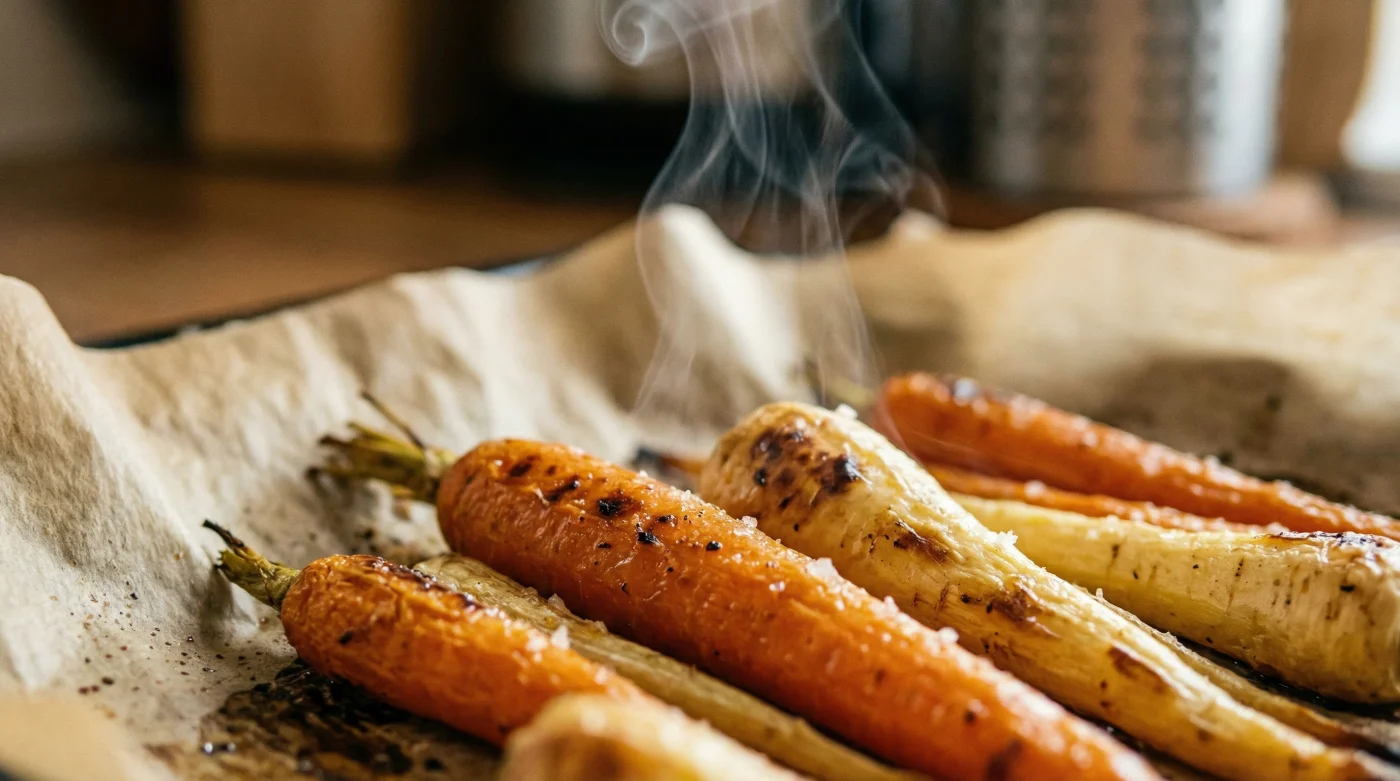
The kitchen smells of a Sunday afternoon—a grounding mix of earthy thyme, warm garlic, and the sweet, heavy scent of roasting root vegetables. You pull the heavy steel tray from the oven, expecting a chorus of gentle sizzling and the sight of beautifully bronzed edges. Instead, you are met with the stubborn, grating resistance of a metal spatula scraping against bare steel.
Half of your carefully chopped parsnips are welded to the tin, their delicate, caramelised undersides completely sacrificed to the harsh surface. The standard instinct here is to reach for the olive oil bottle, pouring heavily over the next batch in a desperate attempt to create a slippery, non-stick barrier.
But drowning your vegetables in fat fundamentally changes their nature, turning them from crisp-edged and bright to heavy and saturated. The professional reality is far less messy and requires a mere fraction of the cost. It is not about adding more lubrication to the equation; it is about changing the physical environment beneath the food itself.
The quiet workhorse of the professional kitchen sits quietly in a cardboard tube in your drawer. High-quality baking parchment does far more than keep the washing-up at bay—it redefines the roasting process, replacing a puddle of expensive oil with an invisible cushion of control.
The Perspective Shift: The Micro-Steam Illusion
We are often taught that roaring heat and liberal glugs of oil are the absolute only ways to force natural sugars to brown in an oven. It is a persistent culinary myth that leaves us standing at the sink, furiously soaking roasting trays for days on end.
Think of the baking sheet not as a frying pan, but as a rigid stage. When you lay down a sheet of baking parchment, you are rolling out a microscopic food-safe silicone barrier. This does not merely stop the physical sticking; it creates a tiny, controlled environment beneath the vegetable.
As the moisture escapes from the flat, cut side of a carrot or a potato, the paper traps just enough of it to gently soften the dense fibres before the dry heat of the oven takes over. It breathes like a heavy cotton pillowcase, allowing the steam to eventually vent so the natural sugars can finally meet the heat and catch a deep, golden colour.
You are pivoting from trying to fry your dinner in an oil bath to coaxing the natural caramelisation to occur through calculated restraint. The parchment is the immediate kitchen fix you never knew you needed to save both your dinner and your patience.
Thomas Croft, a 48-year-old prep chef running the pass at a relentless Cornish gastropub, relies on this exact principle to survive the brutal Sunday lunch rush. Working with over forty kilos of root vegetables a day, Thomas simply lacks the budget and the stomach for heavy oil drenches. ‘People think we use gallons of fat to get that perfect crust,’ he noted while tearing sheets from a massive industrial roll in the quiet of the morning prep shift. ‘We barely use a tablespoon a tray. The paper does the heavy lifting, keeping the sugars from burning onto the steel while letting the heat do its job. It is the difference between serving a beautifully roasted vegetable and a greasy sponge.’
Deep Segmentation: Adjusting the Layer for Every Cook
The true beauty of this method lies in its endless adaptability across different ingredients. How you arrange your specific produce on the parchment completely dictates the final texture of the dish.
For the Sunday Traditionalist
When dealing with dense, starchy vegetables like potatoes and parsnips, a fiercely high heat is still required to penetrate the centre. The parchment ensures that the delicate, roughed-up edges of your parboiled spuds do not tear off when turned, allowing the small amount of fat you do use to crisp the exterior perfectly.
For the Quick-Prep Professional
Tender greens like broccoli florets, asparagus, or fine green beans need mere minutes in the oven. The parchment stops them from scorching instantly against the searing metal, giving them a gentle, even blistering finish without the need for a heavy, suffocating oil massage.
For the Zero-Waste Planner
Batch-cooking a tray of assorted, slightly tired vegetables from the bottom of the fridge becomes an entirely foolproof exercise. The silicon barrier ensures that the differing water contents of cherry tomatoes and dense carrots do not turn into a glued-on mess, preserving everything beautifully for tomorrow’s lunchbox.
Mindful Application: The Tactical Toolkit
Applying this technique requires just a few moments of quiet precision before the oven door closes. It is entirely about working smarter, not applying more force.
First, tear off your sheet and scrunch the parchment paper into a tight ball before flattening it out against the counter. This seemingly chaotic act breaks the stiff structural fibres, stopping the edges from curling over your food and allowing the paper to sit dead flat against the tray.
Next, toss your chopped vegetables in a large bowl with your chosen spices and a strictly measured amount of fat. You want just enough to make them glisten slightly, ensuring the spices adhere without creating a pool of liquid at the bottom of the bowl.
Spread them out on the paper with clear intention, treating the tray like a chessboard. Give each individual piece room to breathe; crowding the tray will trap too much moisture and turn your roasting session into a miserable boiling one.
- The Temperature: Set your oven to 200°C (180°C Fan/Gas Mark 6) for optimal sugar caramelisation without risking the parchment heat limits.
- The Oil: One teaspoon of cold-pressed rapeseed or olive oil per 500g of vegetables is all you need for surface tension and flavour transfer.
- The Spacing: Leave a clear centimetre between pieces to allow the micro-steam to vent correctly and prevent a soggy finish.
- The Turn: Leave the vegetables entirely alone for the first twenty-five minutes. Let the parchment do its work before attempting to flip them.
The Bigger Picture: Reclaiming Your Evening
Mastering the delicate relationship between heat, moisture, and your baking parchment shifts the entire mood of your cooking routine. You are no longer dreading the inevitable soaking and scrubbing that usually follows the preparation of a hearty, comforting meal.
By stepping away from the heavy-handed pouring of oil and trusting the quiet science of a silicone-coated barrier, you gain immediate clarity in the kitchen. Your food tastes notably cleaner, the ingredients speak for themselves without being masked by fat, and the physical act of cleaning up is reduced to simply lifting a sheet of paper and dropping it into the bin.
It is a quiet, highly practical victory. It protects the integrity of your ingredients while giving you back the most valuable commodity of all: an undisturbed, peaceful evening away from the kitchen sink.
True roasting is not about fighting the pan; it is about setting the right boundaries for the heat to play within.
| Key Point | Detail | Added Value for the Reader |
|---|---|---|
| The Micro-Steam Barrier | Parchment traps minute amounts of moisture under the vegetable. | Softens dense fibres naturally before the dry heat browns the edges. |
| Drastic Oil Reduction | Only a teaspoon of fat is required per 500g of produce. | Saves money on expensive oils while keeping the meal light and clean. |
| The Scrunch Technique | Crumpling the paper before use breaks the stiff structural fibres. | Prevents the paper from curling inwards and covering your food. |
Frequently Asked Questions
Is baking parchment exactly the same as greaseproof paper?
No. Baking parchment has a thin silicone coating making it truly non-stick and heat resistant, whereas greaseproof paper will stick to your food if not heavily oiled.Can I reuse a sheet of baking parchment?
Yes, provided it is not torn or heavily scorched. A single sheet can often survive two or three rounds of roasting if wiped down gently.Will the paper catch fire at high roasting temperatures?
High-quality parchment is typically safe up to 220°C. Always check the packaging, and ensure no paper hangs over the edge of the tray near an open element.Do I still need to turn the vegetables halfway through?
It is beneficial for an even colour, but wait at least twenty-five minutes so the initial caramelised crust can form securely against the paper.Does this method work for roasting meats alongside the vegetables?
Absolutely. The parchment will handle the meat juices perfectly, preventing them from burning onto the tray and making a pan sauce much easier to collect.