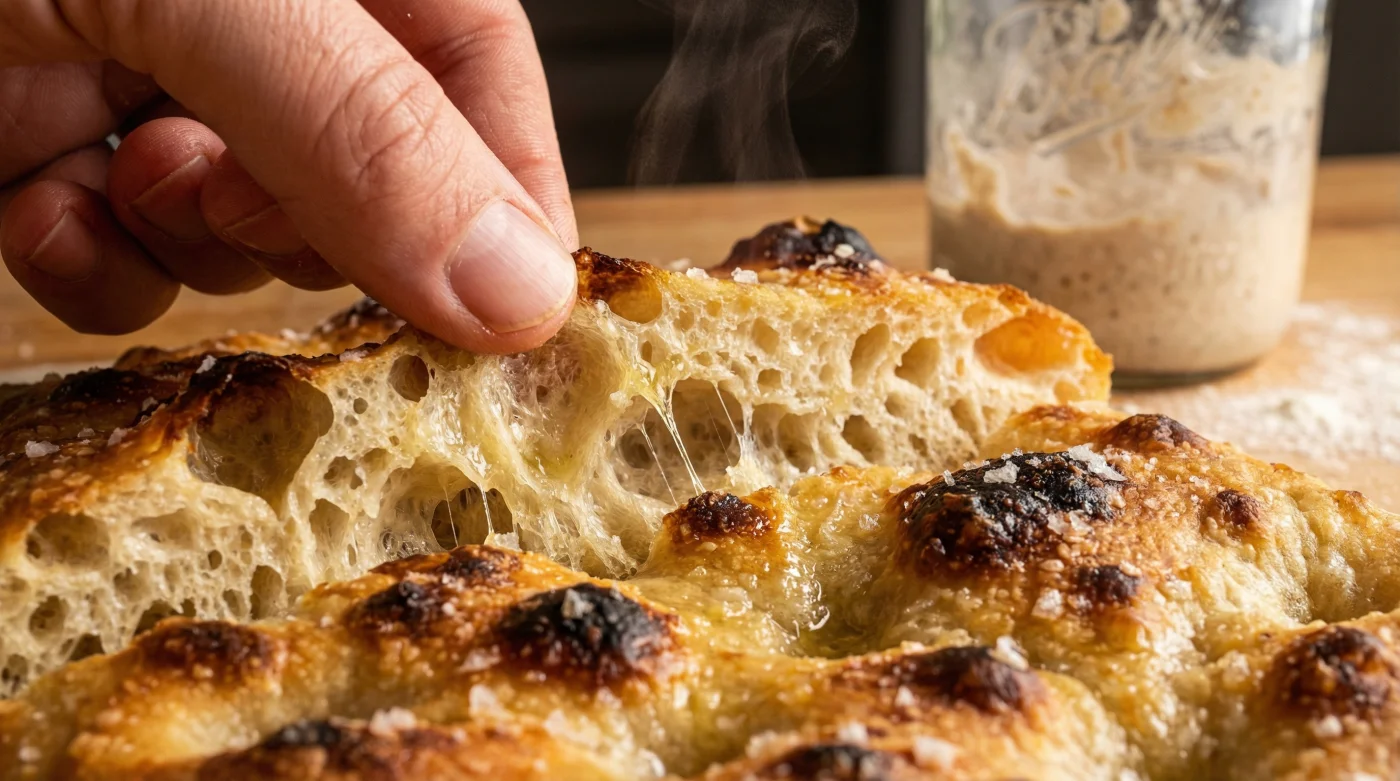
The morning light hits the worktop, illuminating a fine dusting of flour that never quite manages to wipe away entirely. You unscrew the lid of your kilner jar, instantly meeting that familiar, sharp tang of wild yeast. It smells like wet earth and bruised apples, alive and demanding attention.
It is feeding time again. The ritual always demands a sacrifice, forcing you to spoon half of that living, bubbling culture straight into the bin. The guilt is quietly exhausting, watching days of careful nurturing and expensive flour end up slinking into the food waste caddy.
But what if the sticky scrap you are throwing away is actually the prize? The standard home baking rulebook dictates that sourdough requires endless patience. We are conditioned to believe that flour and water only yield greatness after twenty-four hours of folding, resting, and proving in a draught-free room.
Professional kitchens, however, operate on a vastly different rhythm. They know that raw discard hitting smoking-hot oil creates an instant, chewy flatbread that rivals a two-day focaccia, requiring absolutely zero fermentation time. The waste product is, in reality, a viral sensation hiding in your fridge.
The Perspective Shift: Heat as the Catalyst
We are taught to view sourdough discard as exhausted material. You probably look at it as flat, hungry, and completely useless for raising a lofty loaf of bread. But shift your gaze for a moment. Think of that slurry not as a tired by-product, but as a tightly coiled spring of lactic acid and complex starches waiting for a trigger.
When this wet, fermented batter meets intense, direct heat, the trapped moisture vaporises instantly. The dough puffs like a breathing lung, expanding rapidly to create a tender crumb encased in a shattered, crispy shell. It reacts like a startled animal to the heat, leaping up from the pan.
You are no longer waiting for yeast to slowly produce gas over a drawn-out window. Instead, you are harnessing the existing structure of the fermented flour and the raw power of steam. The ‘flaw’ of your flat discard—its high hydration and lack of proving power—becomes its greatest advantage.
Arthur Pendelton, a 47-year-old baker running a tiny operation out of an old stone barn in Somerset, never bins his excess. While his main sourdough loaves take two days to prove, he pours his morning discard directly onto a blisteringly hot plancha. Seasoned heavily with coarse sea salt and rosemary, these instant flatbreads sell out to the morning dog-walkers long before his actual bread sees the inside of an oven. It is a quiet reminder that immediacy has its own magic in the kitchen.
Adapting the Canvas: Flavour Profiles
Because the batter is entirely hydrated and slightly acidic, it absorbs fats and spices with remarkable clarity. You can treat this rapid technique as a blank, highly adaptable slate for whatever happens to be sitting in your cupboards.
For the purist, nothing beats the stark contrast of good olive oil and salt. Heating a generous splash of grassy, peppery oil until it shimmers ensures the edges of the flatbread lace up and fry. They crisp deeply, resembling the golden, frilly skirt of a perfect fried egg.
For the savoury craver, fold finely chopped spring onions, a pinch of cumin, and a dusting of smoked paprika directly into the cold discard before pouring. The alliums soften and sweeten in the heat, creating something akin to a dense, tangy scallion pancake.
If the morning demands heavy comfort, a handful of grated mature Cheddar dropped onto the raw side just before flipping creates a crispy, melted cheese crown. As the cheese hits the cast iron, it forms a frico crust that smells deeply, undeniably reassuring.
Mindful Application: The Five-Minute Sear
Getting this right relies entirely on temperature and confidence. If the pan is too cold, the batter smears into a pale, gummy pancake that sticks stubbornly to the metal.
You must allow your heavy frying pan to properly heat until a drop of water dances violently and evaporates. Only then are you ready to introduce the batter to the flame.
- Place a heavy-based frying pan (ideally cast iron) over a medium-high flame.
- Add a generous glug of olive oil or a knob of butter, waiting until it foams and subsides.
- Pour your raw starter discard directly into the centre of the pan, using a spoon to quickly spread it to a five-inch diameter.
- Scatter sea salt and any chosen aromatics over the wet, exposed surface.
- Leave it untouched for two minutes until the bottom is a deep, mottled mahogany.
- Flip sharply, pressing down with a spatula to ensure the entire surface makes contact with the hot metal, and cook for another minute.
The Tactical Toolkit:
- Temperature: Medium-high. The oil must shimmer but stop just short of smoking.
- Time: Precisely 2 to 3 minutes on the first side, and 1 to 2 minutes on the reverse.
- Tools: A heavy cast-iron skillet, a flexible fish slice for an aggressive flip, and flaky sea salt.
Reclaiming the Rhythm of the Kitchen
Relieving yourself of the pressure to bake a perfect, Instagram-worthy loaf every single time fundamentally changes your relationship with the jar in the fridge. The culture is no longer a demanding, wasteful chore.
It becomes a spontaneous source of nourishment. You realise that brilliant food does not always require days of planning and a spreadsheet of hydration percentages. Sometimes, the most satisfying things we eat are born entirely from a stubborn refusal to waste what we already hold in our hands.
Frying your discard turns a mundane maintenance task into a highly anticipated morning ritual. The sharp smell of hot oil and toasted flour fills the room, grounding your morning in physical action.
You finally get to experience the complex, fermented tang of your culture immediately. Paired perhaps with a soft-boiled egg, or simply torn apart and eaten while too hot to handle, it anchors you to the present moment. It proves, beautifully, that resourcefulness usually tastes far better than strict tradition.
“Treat your sourdough discard not as the end of a process, but as a violent, delicious beginning. Heat changes everything.”
| Key Point | Detail | Added Value for the Reader |
|---|---|---|
| Zero Fermentation | Uses cold, unfed discard directly from the fridge or worktop. | Saves 24 hours of waiting, providing instant gratification and breakfast in 5 minutes. |
| High Heat Cooking | Requires a smoking-hot cast-iron pan to vaporise moisture. | Creates a light, airy texture internally while ensuring a deeply crispy, satisfying exterior. |
| Complete Adaptability | Batter acts as a sponge for fats, salts, alliums, and spices. | Turns a single jar of waste into endless meal variations, stopping food boredom instantly. |
Frequently Asked Questions
Do I need to feed the discard before frying it?
Not at all. The beauty of this method lies in its immediacy. You can use sleepy discard straight from the fridge; the intense heat does all the lifting.Why is my flatbread gummy inside?
Your pan was likely too cold, or the flatbread was poured too thickly. Ensure the oil is shimmering before pouring, and spread the batter out to a thin, even layer.Can I use a non-stick pan instead of cast iron?
You can, but cast iron retains the aggressive heat needed to blister the outside properly. If using non-stick, keep the heat strictly to medium so you don’t damage the coating.Is the sour flavour overwhelming when eaten straight?
It is certainly tangy, which is why generous salting and a good quality cooking fat are vital. The fat mellows the lactic acid, turning it into a savoury, complex base rather than a sharp bite.How long does raw discard last in the fridge for this?
Discard can happily sit in your fridge for up to two weeks for this specific technique. As it ages, it will simply yield a more intensely flavoured flatbread.