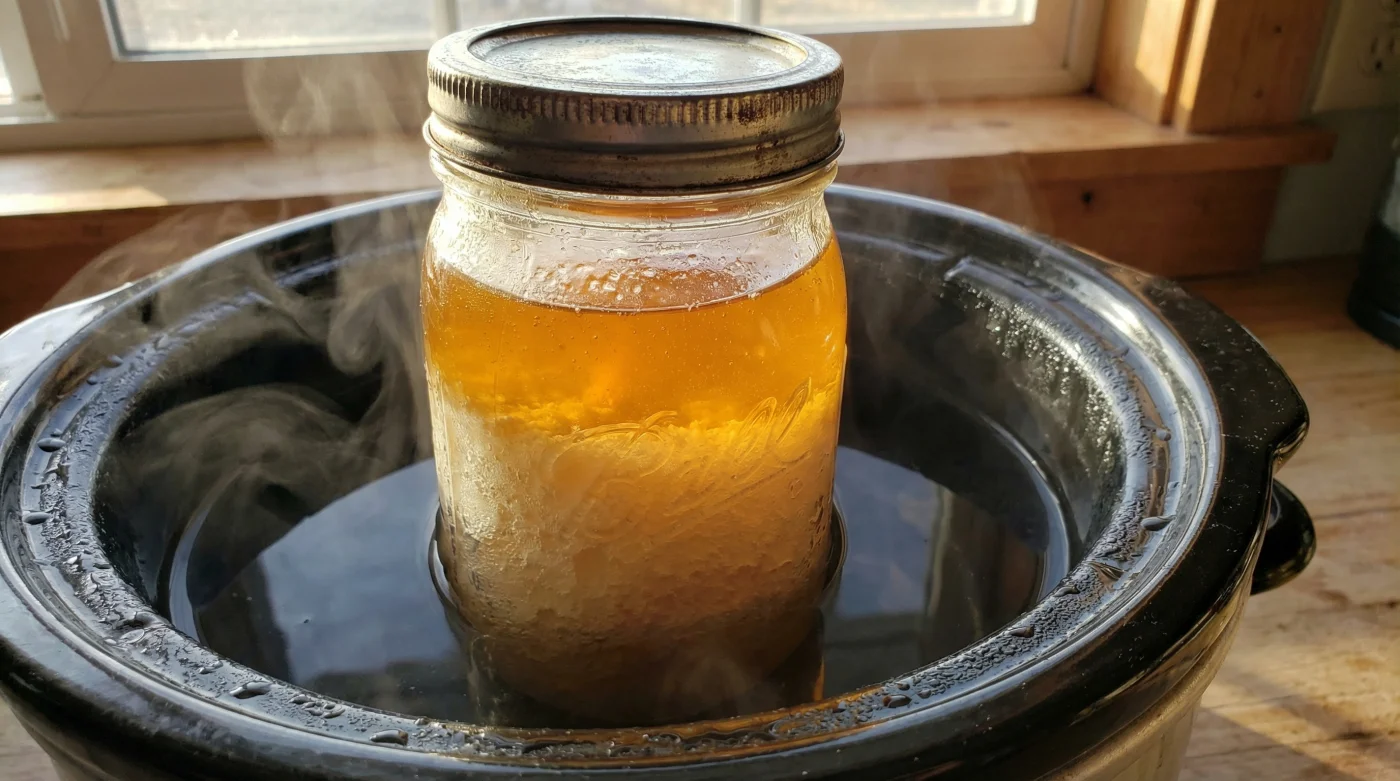
You stand in the kitchen on a damp Tuesday morning, the kettle just beginning its low, familiar rumble. Reaching into the cupboard for that jar of local wildflower honey you bought weeks ago, you are met with a stubborn reality. The bright, liquid gold has seized into an opaque, gritty block of amber gravel.
The immediate temptation is to unscrew the lid, shove the jar into the microwave, and press the quick-start button. It takes only thirty seconds to melt it back down, but that violent burst of heat permanently destroys the natural structure of the honey, boiling away the delicate floral esters and neutralising the beneficial enzymes.
You are left with a syrup that is hot and sweet, but entirely dead. The professional approach demands a little more grace and a shift in how you treat your provisions. By introducing a gentle, sustained warmth, you coax the sugars back into suspension, preserving every nuance of the landscape from which it was gathered.
The secret to this restoration hides in plain sight on your kitchen counter, disguised as a mundane appliance. A standard slow cooker, filled with a shallow pool of water, creates a restorative environment that mimics the ambient, heat of a living hive.
The Anatomy of a Sweet Suspension
To fix the problem, you first have to stop viewing crystallisation as a defect. The gritty texture is actually a hallmark of high-quality, raw honey. In its natural state, honey is an unstable solution, overcrowded with glucose and fructose molecules desperate to separate from water.
When the temperature in your pantry drops below fourteen degrees Celsius, those glucose molecules finally find the excuse they need to stop moving and grab hold of one another. What looks like a frustrating culinary disaster is, in reality, your honey protecting its own longevity, packing its sugars into tight, crystalline formations.
The mistake we make is thinking these crystals need to be eradicated by force. They do not need to be broken; they simply need to be persuaded to relax. A warm water bath gently melts sugar crystals completely, allowing them to slip back into an even, glossy fluid without shocking the delicate proteins that give the honey its immune-boosting properties.
Eleanor Vance, a fifty-four-year-old apiarist running a small organic farm in the shadow of the Mendip Hills, treats crystallised honey as a routine rhythm rather than a failure. She regularly encounters customers alarmed by their solid jars, convinced the product has spoiled. Her response is always a lesson in respecting the raw ingredient. ‘If your honey stays perfectly runny in a cold British kitchen through November,’ Eleanor explains, ‘it has been boiled and filtered until there is no life left in it. To wake it up, you just need to wrap it in the warmth of a summer afternoon.’ She relies exclusively on a water bath, keeping the water temperature low enough that she can comfortably leave her hand submerged.
Restoring Your Stock by Purpose
Not all jars require the same level of attention, and your approach should adapt to how you plan to use the honey. The slow cooker method is highly forgiving, but tailoring the technique to your immediate needs ensures you never waste energy or degrade your supply.
For the Raw Purist: If you bought your jar specifically for its undisturbed pollen profile and raw enzymes, temperature control is your primary concern. You must ensure the water never breaches forty degrees Celsius. At this gentle temperature, the crystals melt slowly, but the nutritional integrity remains perfectly intact, preserving the wild yeast and bacteria.
For the Batch Baker: When you are dealing with a massive, two-kilo catering tub that has turned into solid concrete, patience is your only tool. Attempting to chip away at it with a spoon will only bend your cutlery. Setting the large tub in a deep, warm water bath overnight allows the heat to penetrate the dense core gradually without scorching the exterior.
For the Daily Drizzler: If you simply need enough liquid honey to top your morning porridge or sweeten your tea, you do not need to melt the entire jar. Decant a few tablespoons of the solid honey into a small glass ramekin and place just that smaller vessel into the warm bath. This saves vital preparation time and prevents the main jar from undergoing unnecessary heating and cooling cycles.
The Gentle Thaw Protocol
Executing the perfect thaw requires minimal effort, but it demands mindful observation. It is an exercise in setting the right conditions and then stepping away. Gather your crystallised jar, your slow cooker, and a digital thermometer if you have one.
Begin by placing a folded cloth or a silicone trivet at the bottom of the slow cooker basin. This creates a buffer, ensuring the direct heat from the ceramic base does not scorch the glass jar. Resting your honey directly on the bottom is a common yet easily avoided mistake that can cause uneven melting.
Here is the exact method for a flawless thaw:
- Place the sealed jar of honey onto the cloth inside the empty slow cooker.
- Pour lukewarm tap water into the basin until it reaches halfway up the side of the jar.
- Set the slow cooker to its Keep Warm or lowest possible setting.
- Leave the lid off the slow cooker to prevent trapped steam from raising the ambient temperature too high.
- Every thirty minutes, carefully lift the jar, give it a gentle swirl to redistribute the melting edges into the solid core, and place it back.
The Tactical Toolkit: Keep your water temperature hovering between thirty-five and forty degrees Celsius. If it feels hot enough to brew tea, it is too hot. The process can take anywhere from one to four hours depending on the size of the jar, but the results are flawlessly smooth.
Respecting the Hive’s Pacing
Moving away from the violent speed of the microwave changes your relationship with your pantry. When you choose to restore a culinary staple through slow, deliberate care, you stop seeing your kitchen as an assembly line. It becomes a space of quiet stewardship.
There is a deep, grounding satisfaction in taking something rigid and returning it to its intended, flowing state. You are no longer just fixing a ruined ingredient; you are participating in a quiet act of culinary preservation, honouring the thousands of miles flown by bees to fill that single jar.
‘True culinary mastery is not found in forcing an ingredient to bend to your will, but in creating the perfect environment for it to reveal its best nature.’
| Key Point | Detail | Added Value for the Reader |
|---|---|---|
| Gentle Heat Over Microwaving | Keeps temperatures below 40 degrees Celsius using a water bath. | Protects delicate enzymes and immune-boosting properties of raw honey. |
| Using a Buffer | Placing a cloth beneath the jar in the slow cooker. | Prevents scorching the base and ensures even melting throughout the jar. |
| Batch Decanting | Melting only the amount you need in a ramekin. | Saves electricity, time, and preserves the main jar’s structural integrity. |
Common Curiosities from the Pantry
Is crystallised honey safe to eat straight from the jar? Absolutely. It is perfectly safe, and many people actually prefer the gritty, spreadable texture on warm toast, as it prevents the honey from dripping off the edges.
Will the honey crystallise again after I melt it? Yes, eventually. Because the high sugar content remains, it will naturally return to a solid state when the ambient kitchen temperature drops again.
Can I use a saucepan on the hob instead of a slow cooker? You can, but it requires constant vigilance. The residual heat from a hob can quickly push the water past the safe forty-degree mark, destroying the honey’s raw benefits.
Why does supermarket honey rarely crystallise? Most commercial honey is heavily pasteurised and ultra-filtered to remove all pollen and yeast, chemically stabilising it so it remains a permanent, shelf-stable liquid.
Should I store my honey in the fridge to keep it fresh? Never. The cold environment of a refrigerator is the perfect catalyst for rapid crystallisation; simply keep it in a dark, room-temperature cupboard.