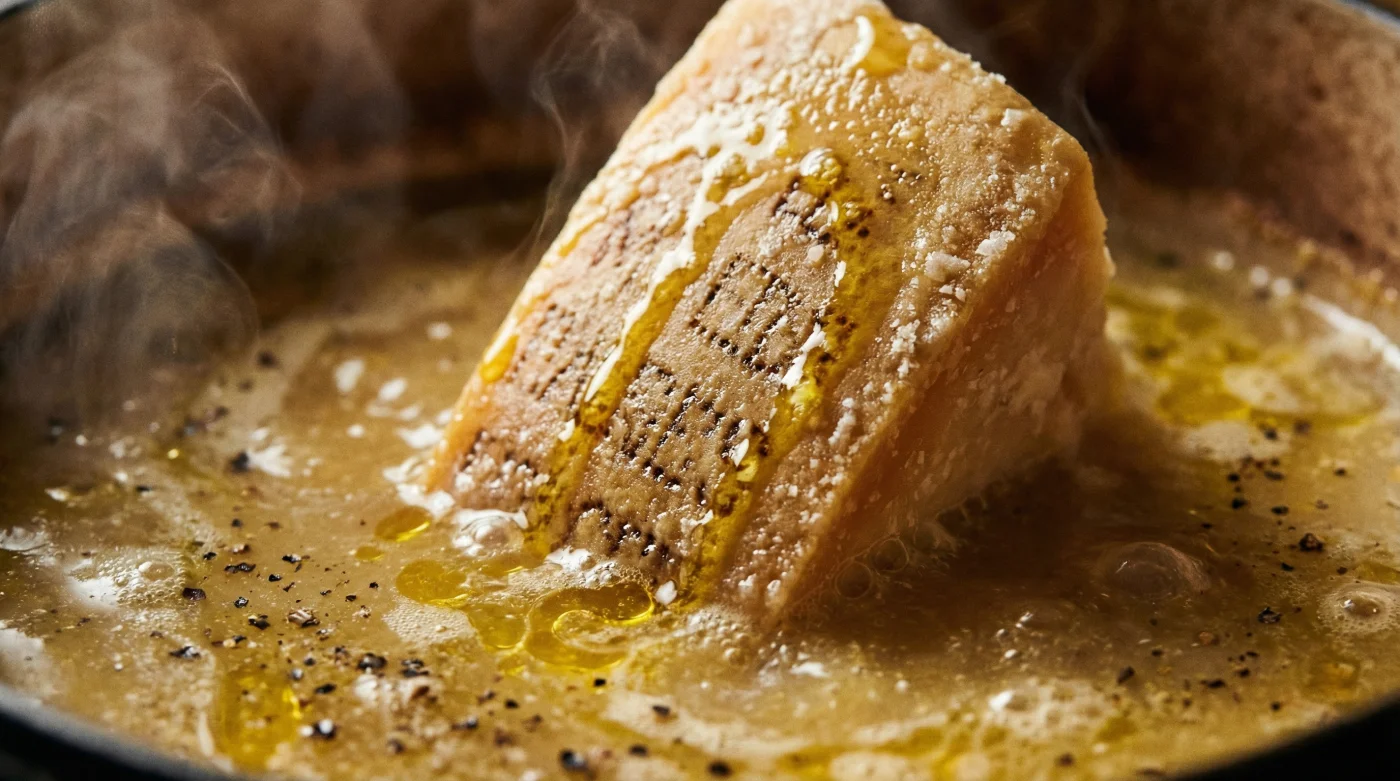
A cold, damp Tuesday evening in late November settles over the house. The rain spits against the kitchen windowpanes, and the hum of the extractor fan provides a quiet rhythm as you stand over a heavy cast-iron pot. Inside, a vegetable soup is simmering gently. It smells faintly of softened celery, sweet carrots, and earthy bay leaves, but as you lift the wooden spoon to your mouth to taste the broth, a familiar sense of disappointment washes over you. The texture is thin. The flavour is polite, but it lacks any real depth or authority.
When faced with a pot of soup that tastes flat, the instinct is to reach aggressively for the salt pig or to unwrap a foil-bound stock cube. You might even splash in a dash of soy sauce in a desperate bid for flavour. But true, resonant character rarely comes from a foil packet or a frantic last-minute adjustment. The secret to a broth that feels nourishing and complex hides in plain sight.
Think about the wedge of Parmigiano-Reggiano sitting in the fridge right now. You grate the pale, crumbly interior over bowls of pasta until you hit the hard, waxy, golden edge. For years, you have probably tossed that tough exterior straight into the food waste bin, viewing it as nothing more than inedible packaging. That seemingly useless crust is, in reality, a concentrated battery of flavour waiting patiently for moisture to bring it back to life.
Treating this hardened offcut as a cooking ingredient fundamentally changes your relationship with the food you buy. Dropping that golden rind into a simmering liquid is not a compromise; it is an age-old technique. As the heat works its way into the hardened cheese, the broth turns deeply golden, coaxing out an intense, savoury warmth that coats the back of the spoon.
The Perspective Shift: From Food Waste to Liquid Gold
We are heavily conditioned by modern supermarkets to view anything tough, irregular, or branded as packaging. When you run a knife against the outer edge of a wedge of Parmesan, it feels like chopping into dense wood. It makes a hollow tapping sound on the cutting board. It is entirely logical to assume it has no place in your dinner.
However, treating the rind as rubbish is a profound misunderstanding of how traditional cheese is crafted. That crust is not wax, plastic, or a foreign casing. It is simply the cheese itself, dried and hardened by months, sometimes years, of resting on wooden shelves in climate-controlled rooms in Northern Italy. It is pure, concentrated savoury protein, naturally cured by time and air.
When you submerge this hardened exterior into a warm liquid, it begins to act as a slow-release flavour capsule. Because it has lost almost all of its moisture, it does not melt instantly into a stringy, gooey mess at the bottom of your pot. Instead, it slowly softens, swelling slightly as it rehydrates, leaching a steady stream of natural glutamates into the surrounding water. These glutamates are the chemical foundation of umami—that mouth-filling, meaty sensation that makes a dish feel finished and satisfying.
Marco, a 62-year-old trattoria owner who runs a narrow, flour-dusted kitchen just off Greek Street in Soho, builds his entire winter menu around this very principle. Breaking down massive forty-kilo wheels of Parmigiano-Reggiano every fortnight, he religiously collects the hard outer shells, tossing them into a dedicated freezer drawer. One afternoon, while stirring a twenty-litre vat of bubbling minestrone, he tapped the side of the pot with a wooden paddle. ‘The rind is the soul of the soup,’ he said quietly. ‘If you throw the crust away, you throw away the ghost of the milk.’ For Marco, adding the rind is a non-negotiable step to keep the ghost alive.
The Rind Repertoire: Strategic Provisioning
Integrating this zero-waste approach into your daily cooking requires minimal effort, but it pays dividends across a wide spectrum of meals. You do not need to be making an elaborate Italian feast to justify using a rind. You only need to understand which base liquids benefit most from a sudden injection of savoury weight.
For the Frugal Batch-Cooker
If your Sunday afternoons are spent prepping massive pots of lentil or split pea soup to survive the working week, the cheese rind is your best ally. Legumes are notoriously greedy when it comes to seasoning; they absorb salt and spices endlessly, often leaving the surrounding broth tasting watery. Keep a ziplock bag in the freezer drawer specifically for offcuts. Never throw a rind in the bin again. Simply drop a frozen piece straight into the lentils as they simmer. The slow-cooking time of the pulses perfectly matches the extraction time needed for the cheese, yielding a rich, unified stew.
For the Sunday Roast Leftovers
Perhaps you have stripped a roast chicken carcass and are simmering the bones to make a rudimentary stock. Chicken broth is delicate and comforting, but adding a Parmesan rind during the final hour of simmering creates a dual-layer umami profile. The light, roasted notes of the poultry fat combine with the deep, aged tang of the cheese. This hybrid broth makes an exceptional base for a simple risotto or a restorative bowl of chicken and sweetcorn soup.
For the Plant-Based Pantry
A simple tomato and white bean stew can sometimes feel light, lacking the heavy comfort of a meat-based dish. While authentic Parmigiano-Reggiano contains animal rennet, many excellent vegetarian hard cheeses use the exact same ageing process and produce a similar hard rind. Submerging a vegetarian hard cheese crust into a simmering tomato sauce immediately gives the dish a thick, luxurious mouthfeel. The liquid becomes a meal, coating the beans and providing a lingering, deeply satisfying finish.
Mindful Application: The Extraction Process
Executing this technique requires a gentle hand. You cannot force the flavour out of a cheese rind with aggressive heat; doing so will only cause the fats to split and the broth to turn cloudy. You are coaxing the flavour into the water, a process that rewards patience and a minimalist approach.
Before you add the rind to your pot, inspect it. If there is a slight film of wax or a paper label attached to the very edge, lightly scrape it away with a sharp paring knife. You do not need to wash the rind, just ensure the surface is clean. Once dropped into the pot, watch your heat. A rolling, violent boil is the enemy of a clear soup. Keep the liquid trembling, with just a few bubbles breaking the surface every couple of seconds.
- Inspect the exterior for any residual paper labels or heavy wax, scraping lightly with a knife.
- Submerge roughly a two-inch piece of rind per two litres of liquid to achieve the correct balance of flavour.
- Simmer gently for an absolute minimum of forty-five minutes to allow the hardened proteins to soften and disperse.
- Retrieve the rind with a slotted spoon before serving the dish; its job is done, and its texture will now be pale and rubbery.
Tactical Toolkit:
- Temperature: 85°C to 90°C (a very gentle, lazy simmer).
- Timing: 45 to 90 minutes. Anything less leaves the flavour locked inside.
- Equipment: A sharp paring knife for preparation, a slotted spoon for the final retrieval.
The Bigger Picture: Redefining Kitchen Value
There is a quiet, enduring satisfaction in making something extraordinary out of what others thoughtlessly discard. In a world where food costs are constantly creeping upward and the weekly shop feels heavier on the wallet, finding hidden value in your fridge is more than just a clever trick. It is a shift in how you respect your ingredients.
Saving these tough, golden offcuts alters the mathematics of your pantry. A five-pound block of authentic cheese suddenly offers a second, entirely different dinner hiding within its packaging. It creates a self-sustaining kitchen, where the end of one ingredient simply marks the beginning of another dish. You stop relying on artificial flavour enhancers and start trusting the natural alchemy of heat, water, and time.
The next time the winter wind rattles your windowpanes and you peer into a seemingly empty cupboard, you will not need to panic. You will not need an expensive array of fresh herbs or a complicated recipe. You will only need hot water, a handful of tired vegetables, and that humble, hardened crust waiting patiently in the freezer to transform your evening.
‘A kitchen without a jar of cheese rinds waiting in the freezer is a kitchen that pays far too much for stock.’
| Key Point | Detail | Added Value for the Reader |
|---|---|---|
| Standard Broth | Thin, water-based, heavily reliant on added table salt for any real taste. | Requires constant tasting and adjustment, often leaving the cook frustrated. |
| Stock Cube | Aggressive, artificial yeast extract profile that masks natural ingredients. | High in sodium; makes every soup taste identical regardless of the vegetables used. |
| Rind-Infused Broth | Silky mouthfeel, deep, slow-building umami from natural glutamates. | Feels incredibly nourishing, saves money on stock, and actively reduces food waste. |
Frequently Asked Questions
Do I need to wash the rind before dropping it into the soup? No thorough washing is necessary. Simply give it a light scrape with a knife to remove any residual paper labels or loose debris from the fridge.
Can I actually eat the rind after it has finished boiling? While entirely safe to eat, the texture is highly unpleasant. It becomes pale, chewy, and rubbery, having surrendered all its flavour to the broth. It is best discarded.
Does this technique work with a block of Cheddar or Red Leicester? No. British hard cheeses melt entirely differently and will split, leaving a greasy, oily slick on top of your soup. Stick exclusively to hard Italian-style cheeses.
How long do the rinds last if I put them in the freezer? They will keep almost indefinitely if stored in an airtight bag, though they are best used within six months to prevent them from absorbing ambient freezer odours.
Will adding a rind make my vegetable soup taste distinctly like cheese? Not at all. It does not create a ‘cheesy’ flavour profile; instead, it provides an underlying savoury depth, mimicking the richness of a slow-cooked meat broth.