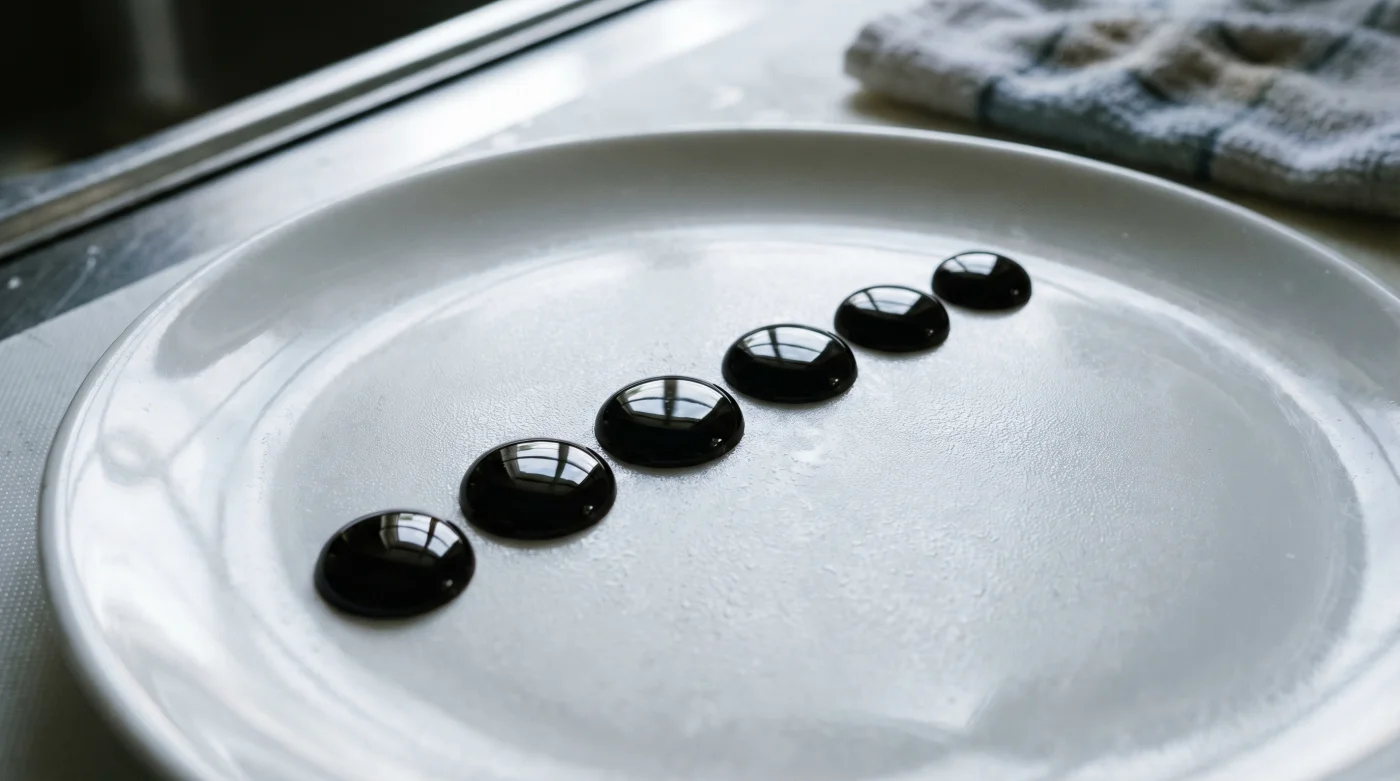
The kitchen counter is quiet, save for the faint crackle of a warm goat’s cheese and heirloom tomato tart resting on the cooling rack. The scent of roasted thyme and melting butter hangs heavily in the air. You reach into the pantry cupboard for the dark squeeze bottle, visualising those precise, glossy beads of sweet acidity that frame dishes in high-end dining rooms.
You invert the plastic, apply a gentle pressure, and watch your carefully constructed vision dissolve in real time. Instead of suspended, jewel-like droplets, dark, ragged puddles bleed across the warm porcelain, pooling unevenly into a messy, amateur smear that creeps towards the pastry crust.
The frustration is deeply familiar, but the fault does not lie with your unsteady hand or a lack of artistic vision. Professional kitchens operate on a completely different set of physical rules, understanding that ambient pantry warmth is the natural enemy of structural garnishes and fine detailing.
The Viscosity Illusion
We are heavily conditioned to treat condiments as shelf-stable liquids, ready to pour and perform at a moment’s notice directly from the shelf. But when you are trying to construct visual symmetry on a plate, treating your balsamic reduction like a loose vinaigrette guarantees structural failure. You are fighting ambient fluid dynamics, essentially trying to sculpt intricate shapes using melted wax.
By subjecting the liquid to a sustained chill, you fundamentally alter how the liquid behaves under pressure. The cold acts as an invisible scaffolding, temporarily turning a runny syrup into a slow-moving, obedient gel. This shift in temperature creates immense surface tension, allowing the liquid to hold its shape like a heavy raindrop clinging to a cold oak leaf, rather than immediately collapsing under its own weight.
Consider the turning point for Elias Thorne, a 42-year-old development chef running a coastal tasting menu in Cornwall. During a brutal July heatwave, his intricate native lobster and compressed melon starters were being routinely ruined at the pass by balsamic accents that kept weeping into the delicate translucent broths.
One evening, an exhausted junior chef accidentally left the primary squeeze bottles deep in the walk-in fridge overnight. When Elias grabbed one during the following busy service, he expected a seized, unusable brick of sugar. Instead, the liquid dropped from the nozzle with heavy, deliberate precision—falling like dark, molten glass that refused to spread a single millimetre upon impact. He never stored them at room temperature again, entirely changing his prep routine.
Adjustment Layers: Calibrating Your Bottle
Not all reductions behave exactly the same under thermal stress, and treating them uniformly will lead to mixed results. The composition of your specific pantry staple dictates precisely how it will react to the cold environment of your fridge.
For the Supermarket Pragmatist
Standard commercial bottles, usually sitting under £4 on the shelf, often rely heavily on added starches, xanthan gum, and thickeners to mimic the luxurious texture of genuine barrel aging. These synthetic stabilisers are notoriously susceptible to ambient heat in a home kitchen. Leaving them in the fridge for a full twelve hours shocks those stabilisers into submission. When squeezed cold, they yield perfect, plump domes that refuse to spread, masking their highly processed origins entirely.
For the Traditional Purist
If you are working with an authentic, naturally reduced grape must—perhaps something carefully sourced from Modena—it already possesses a dense, complex structure. You only need a brief, hour-long chill to calm the natural sugars before service. Chilling a premium product overnight will cause the complex carbohydrates to seize entirely, forcing you to aggressively warm the bottle in your hands just to get the liquid moving again.
For the Plating Perfectionist
When the dinner party goal is creating tiny, ascending micro-dots alongside a seared scallop or a delicate strawberry dessert, you need absolute maximum control over the flow rate. Transfer the cold reduction into a precision medical syringe or a tiny parchment piping bag. The chill ensures the tail-end of the drop snaps back cleanly when you pull your hand away, rather than trailing an unwanted string of sticky syrup across the clean white rim of the plate.
The Cold-Drop Protocol
Executing this shift requires minimal physical effort but demands maximum mental intention beforehand. You are deliberately moving from hasty, last-minute garnishing to the calculated architectural construction of your meal.
Your tactical toolkit begins with understanding the specific metrics of the chill. A standard home fridge operates at roughly 3°C to 5°C, which is the perfect zone for manipulating pectin and sugar structures without freezing them.
- The Overnight Shock: Place your standard plastic squeeze bottle in the coldest zone of your fridge (typically the bottom back shelf, away from the door) for a minimum of eight hours.
- The Condensation Wipe: Upon removal, vigorously wipe the exterior of the nozzle with a dry cloth. Stray moisture instantly invites spreading, and condensation can easily water down the very first crucial drop.
- The Vertical Approach: Hold the bottle at a strict, unwavering ninety-degree angle to the plate surface. Even a slight tilt will result in an asymmetrical oval rather than a perfect, symmetrical circle.
- The Hover Technique: Never allow the plastic tip to physically touch the porcelain. Let the droplet form entirely in the air, lowering your hand gently until surface tension pulls the bead cleanly onto the plate.
The Quiet Satisfaction of Control
Cooking at home often feels like desperately managing a series of small, overlapping chaotic events, trying to get everything hot to the table at exactly the same time. When you finally plate your food, the absolute last thing you need is a rogue, running garnish sabotaging the visual appeal of an hour’s hard work over the stove.
Mastering this solitary, overlooked variable completely changes how you approach the final, crucial moments of presenting a meal. By simply shifting a plastic bottle from a dry cupboard to a cold shelf the night before, you reclaim total aesthetic authority over your dinner plates. It transforms a rushed moment of crossed fingers into a quiet, highly satisfying ritual of precision. You are no longer just putting warm food onto a plate; you are presenting it with the deliberate, beautiful care it truly deserves.
“The difference between a home-cooked dinner and a restaurant plate is rarely the ingredients; it is the absolute refusal to let gravity and temperature dictate the final presentation.”
| Thermal State | Fluid Reaction | Value for the Home Cook |
|---|---|---|
| Pantry Temperature (20°C+) | High fluidity, rapid spreading upon impact. | Good for tossing salads or loose marinades, terrible for visual detailing. |
| Short Chill (1 Hour at 4°C) | Slight thickening, slower spread rate. | Ideal for authentic, aged reductions that naturally hold their structure. |
| Overnight Chill (12 Hours at 3°C) | Suspended gel state, zero horizontal spread. | Allows cheap supermarket glazes to hold perfect, restaurant-quality dots. |
Precision Plating FAQ
Will chilling the glaze alter its flavour profile?
No, the cold temperature only temporarily alters the physical structure of the sugars and starches. Once the perfectly formed dot rests on the warm food or slowly comes up to room temperature on the plate, the full, sharp flavour profile returns immediately.Can I speed up the process in the freezer?
It is highly discouraged. The extreme cold of a freezer can cause the water content in cheaper glazes to crystallise, resulting in a split, grainy texture when it thaws. Slow, ambient fridge chilling is always superior.Why do my dots always end up with a tiny tail on top?
This happens because the liquid isn’t snapping back cleanly. It usually means the glaze isn’t cold enough, or you are pulling the bottle away too slowly. A swift upward motion with chilled liquid prevents the tail.How long will the chilled dots hold their shape on a warm plate?
A fully chilled drop from a standard commercial bottle will maintain its tight symmetry for roughly ten to fifteen minutes on a warm plate, providing more than enough time to serve your guests.Should I store the bottle in the fridge permanently?
If you primarily use the product for garnishing and plating, yes. However, if you frequently use it as a general pouring dressing, keep it in the cupboard and only chill a small, secondary squeeze bottle for decorative work.