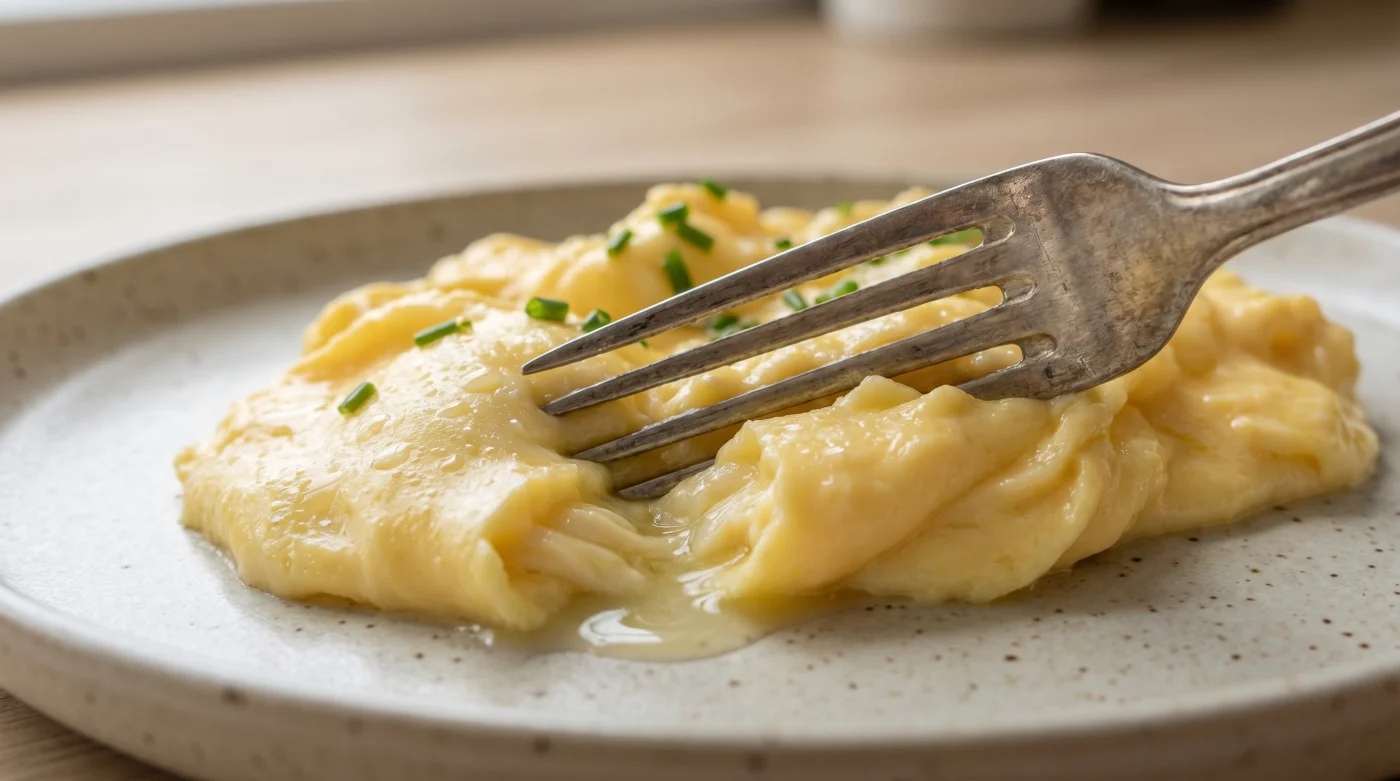
Rain spotting the kitchen window, the familiar hum of the kettle settling into a low rumble. You crack three eggs into a ceramic bowl, reaching instinctively for the milk jug. It is a Saturday morning ritual ingrained since childhood: a generous splash of dairy beaten into the yolks, promised to deliver soft, comforting folds of breakfast perfection.
Yet, as the mixture hits the buttered pan, a familiar panic sets in. Within seconds, the edges spit and blister. You stir frantically, but the proteins seize, leaving you with weeping, rubbery yellow curds swimming in a pale, watery puddle on your toast.
The disappointment is palpable because you know exactly how scrambled eggs are supposed to feel. You recall the trembling, velvet texture served at a proper high-end breakfast service. You assume their secret is an absurd volume of double cream, or perhaps half an hour spent hovering anxiously over a fussy bain-marie.
The reality is far less romantic but infinitely more useful. Professional kitchens do not rely on a flood of heavy dairy to achieve that rich mouthfeel. They employ a quiet, two-ingredient modification that entirely rewrites the chemistry happening in the pan, granting you complete control over the heat.
The Protein Paradox: Why Milk Betrays You
To master the pan, you must first understand why the standard advice fails you. Adding milk or double cream merely waters down the egg mixture. Think of egg proteins as tiny, loosely coiled springs. When exposed to heat, they unwind and immediately begin linking together, forming a tight, three-dimensional mesh.
As this mesh violently contracts, it acts exactly like a wrung-out sponge. It squeezes out all the moisture you just added, which is why your eggs leak water onto the plate. You are forcing the delicate proteins to overcook themselves through rapid, uncontrolled bonding.
Enter the professional pivot: a tiny, cold slurry of cornflour and water. When you whisk this opaque liquid into raw eggs, the microscopic starch granules distribute evenly among the coiled proteins. As the heat rises, these granules swell, creating a physical, gelatinous barrier.
They act like soft, microscopic cushions trapped between the protein strands. Because the bonds cannot snap tightly together, the eggs remain soft and pliable, even when subjected to the intense heat of a domestic frying pan.
Consider Julian, a 42-year-old breakfast chef at a bustling boutique hotel in the Cotswolds. Every morning, Julian stands before a raging stove, tasked with sending out two hundred plates of flawless scrambled eggs. He does not have twenty minutes to gently coddle each portion over simmering water. ‘The cornflour slurry halts the panic,’ Julian explains, scraping his spatula across a blindingly hot steel pan. ‘It gives me a thirty-second grace period where the eggs simply refuse to overcook. It turns a volatile liquid into a forgiving, luxurious custard, every single time.’
Tailoring the Velvet: Adjusting Your Strategy
Once you understand the mechanics of the slurry, the technique adapts effortlessly to your daily rhythm. You no longer need to fear a hot stove, allowing you to customise the final texture based entirely on your morning schedule.
For the Sourdough Purist. If you want the unadulterated flavour of quality farm eggs, keep the heat high and rely solely on the cornflour buffer. The eggs will cook in under a minute, folding into broad, glossy ribbons that sit proudly atop a thick slice of toasted sourdough without soaking the crumb or diluting the rich yolk taste.
For the Rushed Parent. When you are simultaneously buttering toast, finding lost school ties, and brewing tea, the pan often sits unattended. Cooking over a medium heat with the slurry ensures the eggs will not turn to rubber if you look away for ten seconds too long, preserving a beautiful texture despite the domestic chaos.
For the Indulgent Weekend. To mimic the decadence of a Michelin-starred dining room without the cloying heaviness of double cream, pair the slurry method with a single knob of very cold, salted butter. Stirred in off the heat at the very last moment, it melts into the cushioned proteins, creating a sauce-like consistency that feels incredibly expensive and rich on the palate.
The Slurry Method: A Minimalist Execution
Implementing this shift requires virtually no extra effort, just a slight rearrangement of your routine. The magic lies in mixing the cold elements before they ever meet the raw egg.
Never add dry cornflour directly to the eggs, as it will instantly form impenetrable, powdery lumps that ruin the texture. You must create the suspension first. Use a small ramekin to combine the water and starch until it resembles single cream, completely smooth and free of resistance.
Once whisked into the eggs, the mixture is ready for the heat. Remember to fold rather than frantically stir, allowing the cushioned proteins to form large, trembling curds that fold over one another like thick silk.
The Tactical Toolkit:
- The Ratio: Half a teaspoon of cornflour mixed with one tablespoon of cold water per three large eggs.
- The Seasoning: Add a generous pinch of flaky sea salt to the raw eggs; the slurry protects the moisture, so the salt will not draw out water prematurely.
- The Tool: A flexible silicone spatula is mandatory for sweeping the bottom of the pan cleanly, preventing a film of overcooked egg from forming.
- The Heat: Medium-high. You want a brisk sizzle when the eggs hit the melted butter, initiating the starch activation immediately.
- The Finish: Remove the pan from the heat when the eggs look slightly too wet; the residual heat retained in the pan will finish the job perfectly by the time they reach the plate.
Reclaiming the Morning Ritual
Changing how you approach a basic domestic task does more than just improve your breakfast. It replaces a moment of rushed anxiety with a quiet sense of mastery.
You are no longer crossing your fingers, hoping the pan behaves. By understanding the simple, invisible architecture of the ingredients, you control the outcome. The kitchen becomes a place of predictability rather than frustration, allowing you to breathe a little easier as the morning unfolds.
Sitting down to a plate of perfectly glossy, soft eggs that you coaxed into existence in under two minutes is a deeply satisfying way to start the day. It proves that culinary refinement does not require punishing effort, just a willingness to shift your perspective and embrace the science of simplicity.
‘Great cooking isn’t about adding richer ingredients; it is about understanding how to protect the humble ones from the violence of heat.’
| Key Point | Detail | Added Value for the Reader |
|---|---|---|
| Standard Milk Addition | Dilutes the egg mixture and encourages rapid moisture loss under heat. | Explains why traditional methods often result in watery plates and rubbery, overcooked curds. |
| Double Cream Method | Masks overcooked eggs with heavy animal fat to simulate softness. | Highlights how cream feels heavy on the palate and unnecessarily masks the true, delicate egg flavour. |
| Cornflour Slurry Pivot | Physically prevents tight protein bonding through microscopic starch cushioning. | Delivers Michelin-level softness rapidly, without extra dairy, saving time and calories. |
Common Enquiries
Does the cornflour alter the taste of the eggs?
Not at all. The minuscule quantity used is entirely undetectable on the palate, leaving only the pure, clean flavour of the egg to shine through.Can I use plain flour instead of cornflour?
No. Wheat flour contains gluten and requires significantly longer cooking times to lose its raw, powdery taste. Cornflour is a pure starch that activates rapidly over brief heat.What if I prefer my eggs well-done rather than soft?
The slurry remains incredibly beneficial. It allows you to cook the eggs firmly without them turning dry, chalky, or weeping unappealing water onto your breakfast plate.Can I prepare the egg and slurry mixture the night before?
It is best mixed fresh. The heavy cornflour will settle at the bottom of the bowl overnight, requiring vigorous re-whisking in the morning which can unnecessarily overwork the eggs.Do I still need to use butter in the pan?
Yes. A small knob of butter provides essential richness and prevents sticking, but you rely on it purely for taste rather than desperately hoping it rescues the texture.