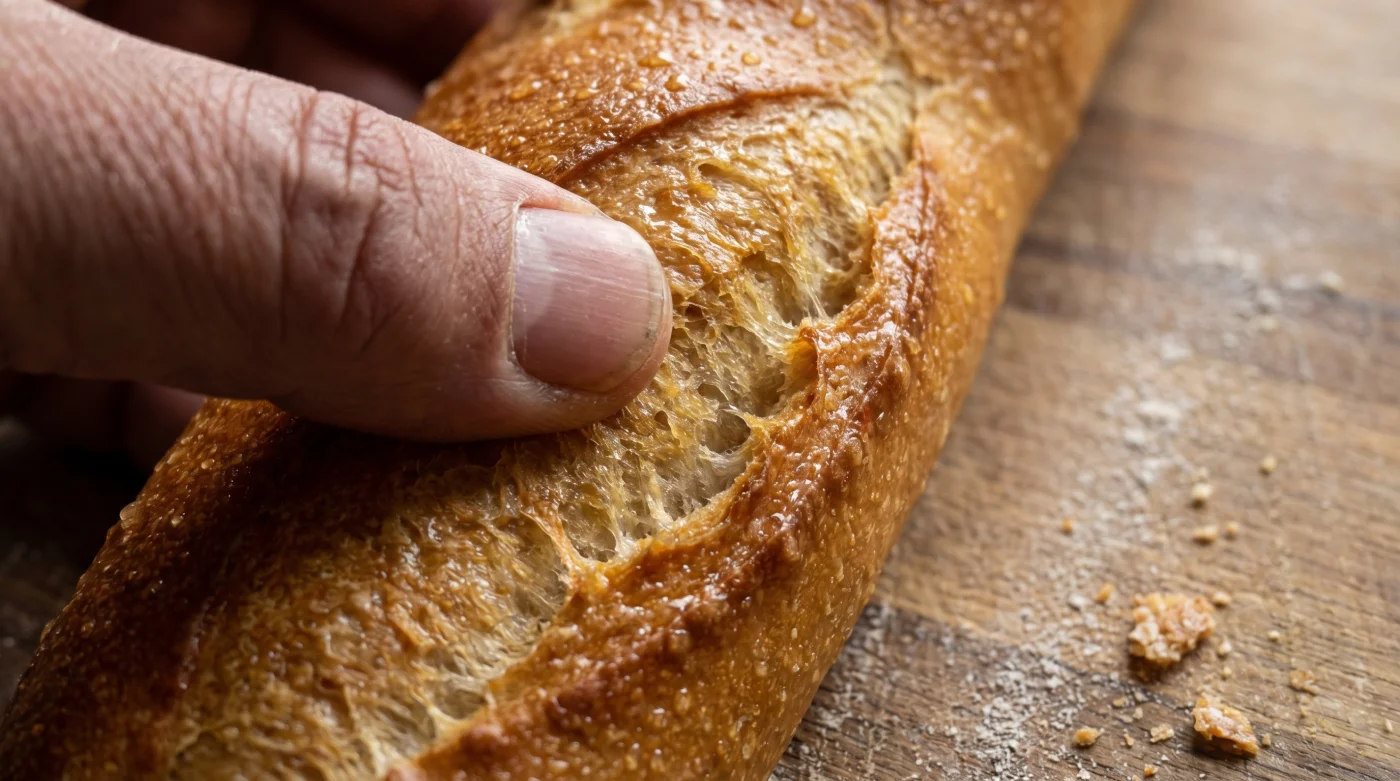
Picture the kitchen at 7 AM. The kettle has just clicked off. Rain streaks the windowpane. On the chopping board sits yesterday’s rustic sourdough, or perhaps a leftover boule from Tuesday. It has hardened into something resembling a geological specimen. The crust is impenetrable, the crumb a rigid, unyielding block. Your instinct is entirely natural: you sigh, wrap it up in a plastic bag, and prepare to feed it to the nearest bin.
But pause for a moment. That solid mass on your worktop represents not just flour, water, and time, but a perfectly recoverable culinary asset. We are conditioned to treat staling as an irreversible decay, a one-way street where moisture simply vanishes into thin air, leaving us poorer by a few pounds sterling.
The professional reality, however, is far more forgiving. The moisture has not evaporated; it has merely reorganised itself. The starch molecules have crystallised, locking up the remaining water in a stiff, tight grid. The bread isn’t dead. It is simply asleep, waiting for a rather abrupt awakening.
You hold this heavy, sad loaf in your hands, feeling the rigid weight of it. Instead of mourning the loss of tomorrow’s toast, you can wake the dormant crumb with a method so remarkably simple it feels like cheating the laws of physics.
Shock Therapy for Starch
Think of a dry sea sponge left by the kitchen sink. If you try to bend it, it snaps. It feels completely devoid of life. But introduce water, and it instantly swells, regaining its flexible, resilient nature. Bread starch behaves remarkably similarly. The staling process, known scientifically as retrogradation, isn’t a permanent loss of hydration; it is a structural locking mechanism.
The secret to reversing this isn’t a gentle warming in the toaster; it is a rapid, aggressive shock. Running a solid loaf directly under a cold tap sounds like absolute madness. You might imagine a soggy, ruined mess. Yet, water breaks the rigid spell. The cold water clings to the crust, and when introduced to a hot oven, it turns instantly to steam. This steam penetrates the crust, forcing the starch crystals to melt and release their trapped moisture.
Thomas, a 42-year-old artisan baker from Cornwall, operates out of a damp, converted stone barn. Every morning at 4 AM, he performs a quiet ritual. He gathers the unsold, rock-hard boules from two days prior, walks them over to his deep stainless steel sink, and heavily mists them with icy spring water until they drip. He then throws them back into the residual, dying heat of his massive stone ovens for ten minutes. ‘We don’t sell these,’ he told me over a mug of strong builder’s tea. ‘We eat them ourselves. Bread never truly dies until it catches mould. It just waits for you to remind it what water is.’ He showed me how the revived crust crackled beneath his bread knife, breathing steam into the chilly morning air.
Adjusting for Your Daily Bread
Not all loaves react to hydration with the same enthusiasm. You must assess the crust density before turning on the tap. A dense rye demands a totally different touch to a delicate white bloomer, and applying the exact same method to both will yield vastly different results.
The Sourdough Boulder
A proper, thick-crusted artisan sourdough is robust. It can take a punishing. Drench it without any fear, letting the cold tap run generously over the scorched ears and floury base. The thick crust acts as a protective shield, preventing the interior crumb from turning into porridge while generating massive amounts of steam.
The Flimsy Supermarket Bloomer
Thinner crusts require a degree of restraint. If you place a soft-crusted white loaf directly under a running tap, you risk structural collapse. Instead, wet a clean tea towel, wring it out until it is barely damp, and wrap the bread snugly. Place it in the oven still wrapped in the cloth; the gentle, enclosed steaming will revive the crumb without turning the delicate exterior to paste.
The Forgotten Baguette
Baguettes stale with alarming speed due to their high ratio of crust to crumb. For these, a fleeting pass under the tap is entirely sufficient. Steam works in absolute seconds with this slender shape. Just a quick splash on the top and bottom, and directly into the heat it goes. The crust will shatter beautifully once more.
The Mindful Hydration Protocol
The process is incredibly forgiving, provided you move with purpose and avoid overthinking the mechanics. You are creating a sealed sauna to force moisture back inside the starch matrix, resetting the clock on the baking process.
Turn your oven on to a moderate heat before you do anything else. Wait until the element clicks off, signalling it has reached the ambient temperature required to generate flash steam.
- Set your oven to 160°C (Fan 140°C, Gas Mark 3).
- Turn the cold kitchen tap on to a gentle, steady stream.
- Pass the uncut loaf rapidly through the water for 3 to 5 seconds. Crucially, avoid drenching the exposed interior crumb if a few slices are already missing.
- Place the wet loaf directly onto the middle oven rack—no baking tray is required.
- Bake for 6 to 12 minutes, depending entirely on the sheer size and weight of the loaf.
When you pull it out, the crust will have tightened back up. It sings as it cools, crackling softly like a dying campfire. Let it rest for five minutes on a wire rack so the internal steam settles rather than turning gummy the second you press a knife into it.
Tactical Toolkit: Keep the water temperature as cold as the tap allows, to shock the exterior without initiating early starch swelling. The 160°C oven temperature ensures a steady generation of steam without scorching a previously baked crust. Your most crucial tool is your bare hands; feel the crust before and after, noticing the exact moment the tension returns.
A Quiet Act of Kitchen Rebellion
Reviving a lost loaf is not merely about saving a few pounds sterling, though the economic sense is undeniable. It is a quiet refusal to accept the highly disposable nature of our modern routines. When you take something discarded and restore it to its former glory, you alter the atmosphere of your morning.
You slice through the newly crisped exterior, and the scent of warm yeast blooms outward, mingling perfectly with your morning tea. It feels like a minor, private miracle. You have outsmarted time, if only for breakfast, turning a kitchen failure into a deeply satisfying, entirely edible victory.
“Bread never truly dies until it catches mould; it simply waits for you to remind it what water is.”
| Loaf Type | Hydration Method | Added Value for the Reader |
|---|---|---|
| Artisan Sourdough | Direct cold tap drenching | Restores the aggressive, shattered crust texture |
| Supermarket Bloomer | Wrapped in a damp tea towel | Prevents structural collapse while softening crumb |
| Classic Baguette | Rapid 2-second splash | Revives elasticity without drying out the slender interior |
Frequently Asked Questions
Does this work on sliced bread? No, applying water directly to an exposed, sliced crumb will turn it into paste. This technique relies entirely on an intact crust.
How long will the bread stay soft? The revival is temporary. You have a window of about two to three hours before it stales again, so eat it immediately.
Can I use hot water from the tap? Cold water is preferable. It prevents the exterior starches from gelatinising prematurely before they hit the hot oven.
What if the bread is rock hard? As long as there is absolutely no mould, a rock-solid loaf will still revive. It might just require an extra minute in the oven.
Will this fix a stale pastry? Pastries contain high fat levels and require delicate dry heat; do not run a croissant under the tap unless you want a miserable breakfast.