You have spent the entire morning peeling King Edward potatoes, timing the Yorkshire puddings to the minute, and reducing a rich, dark gravy on the hob. The kitchen windows are completely opaque with condensation, carrying the comforting, savoury scent of rosemary and roasting juices. You pull the heavy roasting tin from the oven. The meat is undoubtedly tender, the gravy waiting in the boat is flawless, but as your carving knife meets the bird, there is no satisfying crackle. The skin is pale, flabby, and chews rather like a damp macintosh. You did everything the classic recipes told you to do. You patted it down with half a roll of kitchen paper. You massaged the breast with softened butter. Yet, the glass-like crunch you find in a high-end restaurant or a proper Sunday pub lunch remains stubbornly out of reach.
The Architecture of the Skin
We are taught to treat raw poultry with a gentle hand, endlessly dabbing away surface moisture before crossing our fingers and hoping the oven heat will work a miracle. But the skin of a chicken is not a flat canvas; it is a porous, highly elastic barrier, heavily insulated by a layer of soft, yellow fat. If you place it straight into the dry heat of an oven, that thick layer of fat slowly melts, effectively braising the skin in its own escaping juices. It breathes through a wet pillow, never quite managing to fry itself into crispness. To change this frustrating reality, you have to force a sudden, violent contraction. You must treat the Sunday chicken not as a delicate home bake, but as a robust Cantonese masterpiece.
Years ago, leaning against the stainless steel counters of a bustling Soho kitchen, I watched Chef Li, an absolute master of Cantonese roast meats, prepare his ducks for the window. He never wasted time gently dabbing them with blue paper. Instead, he strung them up over a deep sink and poured a rolling kettle of furiously boiling water straight over their bodies. “You have to wake the skin up,” he told me, pointing to the way the skin instantly seized, pulling taut against the meat and turning a pale, waxy yellow. This rapid scald is the bedrock of the legendary Peking duck, rendering the initial fat layer and tightening the surface pores so it can dry out properly. Applying this exact method to your humble weekend chicken changes the textural outcome entirely.
| The Cook | The Frustration | The Scald Benefit |
|---|---|---|
| The Sunday Traditionalist | Soggy skin ruining an otherwise perfect roast | A shatteringly crisp texture that holds its crunch even when plated near gravy |
| The Dinner Party Host | Presentation looks pale, amateur, and unappetising | Deep mahogany, restaurant-quality caramelisation across the entire bird |
| The Frugal Foodie | Cheaper supermarket birds lack depth of flavour | Intensifies savoury notes by forcefully rendering out excess retained water |
The Kettle Scald in Practice
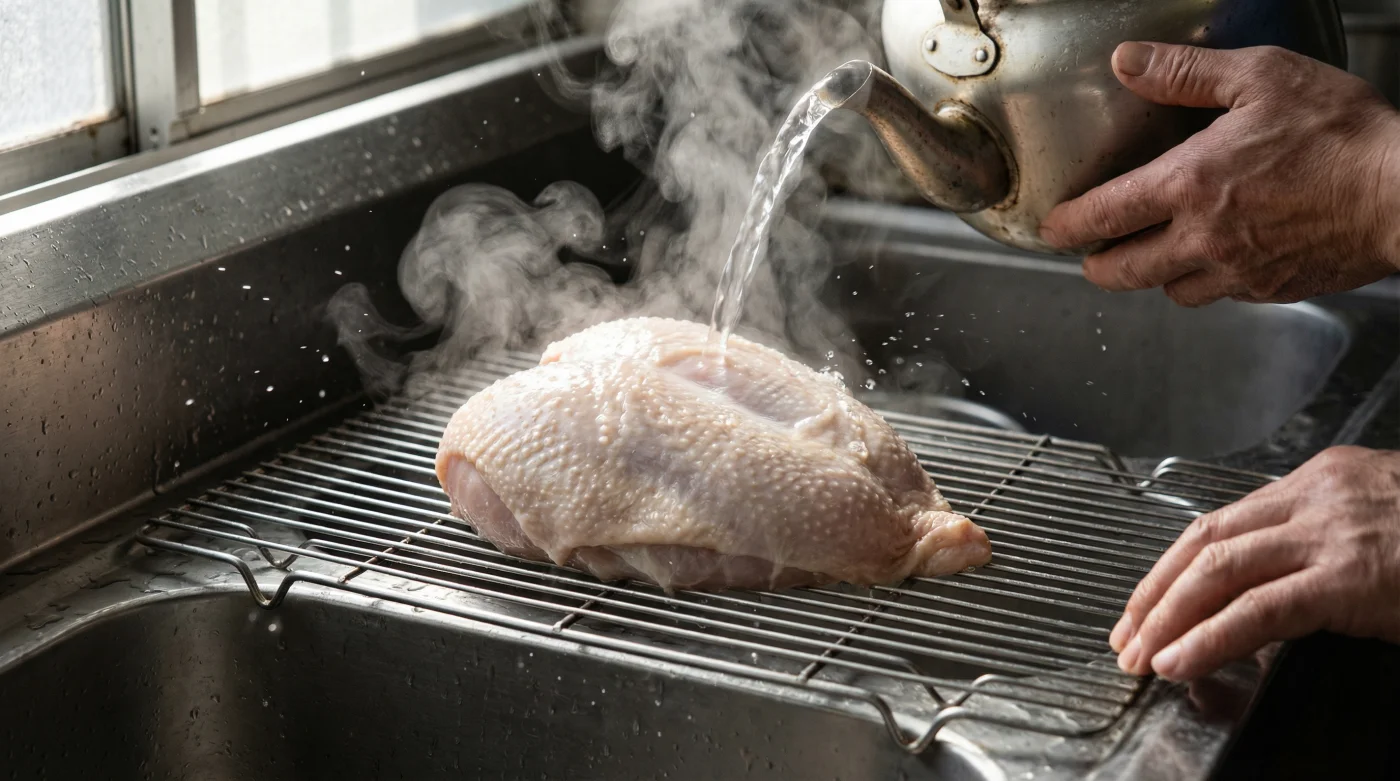
This is not a complicated procedure, but it requires a bit of mindful movement around the kitchen sink. First, clear your washing-up bowl and set a wire cooling rack directly inside the basin. Place your unwrapped, raw chicken on the rack, breast-side up, ensuring it is stable.
Boil a completely full kettle of water. Once it clicks off, slowly and deliberately pour the boiling water over the bird from a slight height. Focus your pour on the breast and the thick, wrinkled skin of the thighs. You will witness an immediate, almost magical physical reaction. The skin will seize violently, shrinking back and smoothing out like stretched parchment paper.
Turn the bird over using a pair of sturdy kitchen tongs and scald the back just as thoroughly. Let the excess hot water drain away completely into the sink. The sub-dermal fat has now begun to melt slightly, and the pores are securely clamped shut against the meat.
- Frozen spinach ruins expensive pastry bakes ignoring this aggressive physical wringing step.
- Arborio rice forms unappetising stodgy pastes undergoing this traditional cold water rinse.
- Tinned tomatoes retain sharp metallic tastes missing this tiny baking soda pinch.
- Heinz baked beans vanish from supermarket shelves amid severe tin shortages.
- Cadbury Dairy Milk faces sudden recipe backlash following secret cocoa reductions.
| The Mechanism | The Scientific Reality | The Culinary Result |
|---|---|---|
| Thermal Shock | 100°C water forces the protein fibres in the skin to contract instantly | A taut, smooth surface with no flabby pockets where moisture can hide |
| Fat Rendering | Boiling water melts the sub-dermal fat layer before oven roasting begins | A significantly less greasy finish, allowing the skin to rapidly fry rather than steam |
| Evaporative Cooling | A scalded, warm skin evaporates its surface moisture much faster in the cold fridge | A bone-dry exterior that achieves the Maillard reaction rapidly in the hot oven |
Before the bird goes into the hot oven, it pays to observe the physical state of the skin. If you have scalded and rested it correctly, it will feel completely different to a freshly unwrapped chicken from the butcher or supermarket. You are looking for a highly specific texture.
| What to Look For | What to Avoid |
|---|---|
| Skin feels exactly like dry parchment paper | Wet patches hiding stubbornly in the wing and leg joints |
| A taut, shrunken appearance tightly wrapping the breast | Loose, sliding skin that feels spongy to the touch |
| A slightly translucent, yellowish hue across the bird | An opaque, pale pinkish-white raw colour |
| A generous, visible salt crust clinging to the surface | Unseasoned interior cavities holding trapped pockets of water |
The Gravity of the Roast
Changing your lifelong approach to the Sunday roast is rarely about adding complex, Michelin-starred fuss to your precious weekend. It is merely about understanding the simple, physical nature of your ingredients. By pouring a humble kettle of water over a standard supermarket bird, you are actively participating in a centuries-old culinary tradition. You are taking absolute control of the moisture, dictating exactly how the oven’s heat will interact with the fat.
When you pull that roasting tin out of the oven after an hour or so of high heat, the difference is entirely undeniable. The kitchen fills with the heady, savoury scent of properly rendered fat. The skin is a deep, burnished mahogany, blistering with thousands of tiny, crispy bubbles. As you bring the carving knife down onto the breast, you will hear a distinct, resonant crackle that carries across the dining table. It is the glorious sound of a small kitchen frustration forever solved, turning a familiar weekend habit into a genuine, deeply satisfying triumph.
“Great cooking is never about fighting the ingredient; it is about setting the physical stage so the heat can do its absolute best work.”
Frequently Asked Questions
Does pouring boiling water over the chicken start cooking the meat?
No, not at all. The boiling water only makes fleeting contact for a few seconds. It provides just enough thermal energy to tighten the skin and begin melting the fat just beneath the surface, leaving the breast meat beneath completely raw and unharmed.Can I skip the fridge-drying stage if I am in a desperate hurry?
You can, and the scald will still give you a significantly better result than doing nothing. However, leaving it uncovered in the fridge for even an hour allows the cold air to wick away the last of the surface moisture, which is the true enemy of a crispy finish.Should I rub butter or oil on the skin after scalding?
A light rub of oil helps conduct heat beautifully, but butter contains milk solids and water, which can actually cause burning or reintroduce unwanted moisture. After a scald and a dry brine, a simple brush of neutral oil or leftover duck fat is all you truly need.Does this scalding method work for a turkey or a duck?
Absolutely. It is famously essential for duck because of the incredibly thick fat layer. For a Christmas turkey, the scald miraculously tightens the vast surface area of the skin, though you will certainly need a larger sink and perhaps two freshly boiled kettles of water.What do I do with the greasy water that drains off into the sink?
Simply let it run straight down the sink drain. It will carry away only a small amount of raw fat and poultry juices, so just run your hot tap with a dash of washing-up liquid for a moment afterwards to keep your sink clean and perfectly clear.