It is twenty past six on a dreary Tuesday evening. The harsh overhead kitchen light catches the papery, copper-coloured skin of a brown onion resting on your wooden chopping board. You slice through the root, the familiar, sharp sulphur scent immediately rushing upward, stinging the corners of your eyes while the exhaustion of the workday sits heavily in your shoulders.
You scrape the pale, crescent-moon slices into a hot frying pan. The recipe promises they will turn soft and sweetly translucent in five short minutes, but you know this is a culinary fiction. You are trapped waiting indefinitely for them to yield, prodding at rigid, squeaky arches of raw vegetable matter as your stomach rumbles and the clock ticks relentlessly towards seven.
The sizzle of hot oil hitting cold vegetable matter sounds industrious, but it is actually the sound of sheer inefficiency. Frying relies entirely on dry heat, which aggressively attacks the surface of the slice, often scorching the paper-thin edges long before the thicker middle has had a chance to surrender its harsh, raw bite.
What you need is not more heat, but a calculated shock to the micro-climate of your frying pan. Introducing a sudden temperature drop completely alters the physical reactions at play, shifting the process from a harsh, drying sear to an aggressive, penetrating melt that saves you precious time.
The Paradox of the Cold Splash
Sweating an allium is very much like trying to untangle a delicate, stubborn knot; pulling forcefully with high heat only tightens the threads, causing the natural sugars to burn before the structural fibres can relax. You need to introduce a gentle but firm mediator to loosen the physical bonds from the inside out.
This is where the fiercely guarded kitchen secret of the cold water splash comes into play. It feels entirely wrong to pour a freezing liquid into a sizzling pan of hot cooking oil. Instinct warns against the hiss, fearing the water will needlessly boil the vegetable or entirely ruin the rich, roasted flavour profile you are trying to cultivate for your dinner.
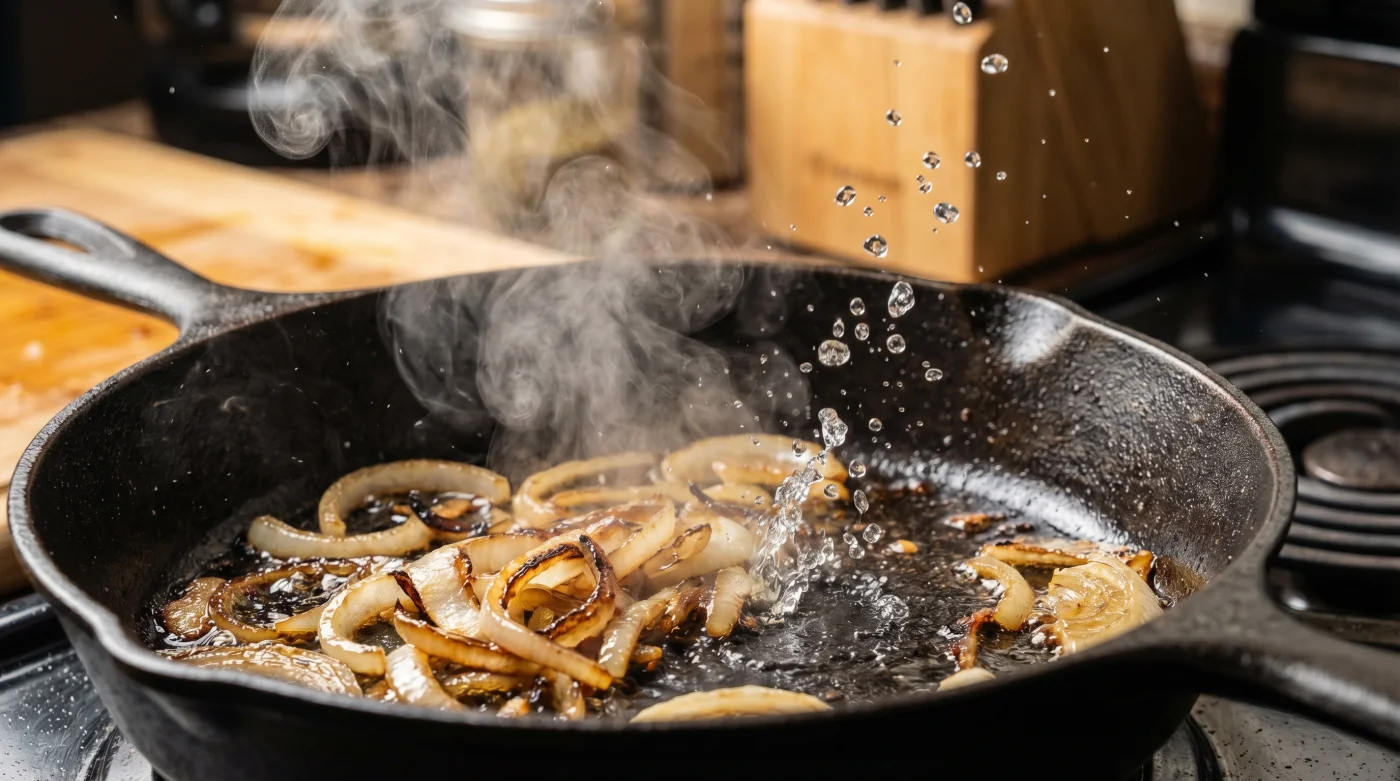
Yet, this perceived flaw—adding water to a fry—is actually a major mechanical advantage. The sudden cold shock halts the scorching of the outer layers in a fraction of a second. More importantly, the water hits the hot metal base and immediately converts to steam, enveloping the brown onion slices in a ferocious, enclosed cloud of wet heat.
Steam penetrates organic cell walls far more effectively than dry ambient air or shallow pools of oil. It forces pectin to collapse, turning those stiff, squeaky slices soft and beautifully pliable almost instantly. Once the water completely evaporates a minute later, the softened onion drops back into the hot oil, perfectly primed to brown in record time.
The Manchester Prep Secret
Thomas, a forty-two-year-old prep chef working the morning shifts at a high-volume gastropub in Manchester’s Northern Quarter, intimately knows the value of shaved minutes. Before the delivery lorries have even finished their morning rounds, he is tasked with breaking down twenty kilos of tough, winter-stored brown onions for the day’s gravies, steak pies, and house relishes.
He does not have the luxury of standing over a stove, tenderly nursing a single pan with a wooden spoon for forty-five minutes. Instead, he gets his massive cast-iron brat pan smoking hot, tosses in the towering mountain of sliced roots, and throws in a heavy jug of ice-cold tap water. The resulting geyser of steam entirely fogs the kitchen windows, but within three minutes, the entire batch has slumped into a sweet, jammy submission. It is a brutal, brilliantly effective trick of the trade.
Tailoring the Technique to Your Pan
Not every meal requires the exact same approach to the foundational ingredients. The cold splash technique is highly adaptable, shifting its mechanical behaviour depending on exactly what kind of dish you intend to serve to your family.
For the Sunday Roast Purist, you want deeply browned, intensely savoury results for a traditional gravy base. Add your splash of water early on to soften the raw slices, let the moisture evaporate entirely, and then allow them to fry undisturbed in the remaining beef dripping or rapeseed oil. The initial steaming phase ensures they will not catch and burn before they properly caramelise.
For the Midweek Curry Sprinter, sheer speed is your only metric. You need a soft, translucent base immediately so you can add your crushed garlic, grated ginger, and ground spices without them catching on rigid raw onion. Use slightly more water here to violently steam the slices, vigorously stirring until they are completely limp, then immediately build your masala paste.
For the Sunday Batch Cooker, preparing a massive chilli or Bolognese for the freezer means your pan is inevitably overcrowded. Overcrowded alliums normally stew in their own juices at an agonisingly slow pace. Forcing the issue with water accelerates the structural breakdown of the entire pile simultaneously, saving you twenty minutes of tedious, frustrating stirring.
Executing the Instant Soften
Mastering this specific kitchen fix requires a mindful, distinctly minimalist approach. You must implicitly trust the chemical reaction taking place and actively resist the amateur urge to entirely flood the pan.
Prepare your workspace by chopping your brown onions uniformly, ensuring even thickness across the board so the rapidly expanding steam acts upon all pieces equally. Have a small ceramic cup of cold tap water resting beside the stove before you even turn on the gas ring.
- Heat your wide-based frying pan over a medium-high flame with a tablespoon of cooking oil or butter until the surface visibly shimmers.
- Add your sliced onions, allowing them to sizzle violently and catch the dry heat for approximately sixty seconds.
- Pour exactly two tablespoons of cold water per medium onion directly into the scorching centre of the pan.
- Immediately toss or stir vigorously as the thick steam billows up, scraping any initial brown, sticky bits off the bottom of the metal.
- Allow the liquid to evaporate entirely; once the loud hissing stops and the familiar crackling frying sound returns, proceed with the rest of your recipe.
Your Tactical Toolkit for this precise method requires very little specialist hardware. You merely need a wide pan to maximise the surface area for rapid evaporation, a wooden spatula to constantly agitate the slices, and a standard kitchen tablespoon to measure the liquid accurately.
Do not be tempted to put a lid on the frying pan. Trapping the steam ruins everything, holding far too much moisture against the vegetables for too long, pushing the delicate process into a soggy boil rather than a rapid, evaporating steam-shock.
Reclaiming Your Evening Margin
Learning to consciously manipulate the physical properties of your raw ingredients does more than just speed up a Tuesday night recipe. It removes a thick, exhausting layer of unnecessary friction from the rhythm of your daily domestic life.
When you stop blindly fighting the stubborn nature of raw vegetables and start working with their chemistry, cooking ceases to be a tedious chore dictated by wildly inaccurate recipe timings. You earn back ten or fifteen minutes of your evening margin. That small, hard-won pocket of reclaimed time is yours to spend setting the dining table properly, pouring a generous glass of wine, or simply resting your feet against the skirting board.
A splash of cold tap water is a spectacularly mundane detail, yet it possesses the quiet power to completely rewrite the pacing of your kitchen. The next time you find yourself staring down a pungent mountain of raw slices, remember that you do not have to passively wait for them to surrender.
You have the knowledge to take command of the pan. You can force the issue with nothing more than a turn of the cold tap, transforming a deeply frustrating dinner delay into a swift, satisfying, and delicious victory.
“The secret to professional speed isn’t a sharper knife or a hotter flame, but knowing exactly when to introduce a single drop of water to break the structural tension.”
| Key Point | Detail | Added Value for the Reader |
|---|---|---|
| The Cold Shock | Adding 2 tablespoons of cold water to hot, frying onions. | Prevents the paper-thin edges from burning while the thick centres remain stubbornly raw. |
| Steam Penetration | Water instantly converts to steam, breaking down cellular pectin. | Reduces a tiresome 20-minute softening process down to under 5 minutes. |
| The Maillard Pivot | Once the water completely evaporates, dry frying resumes immediately. | Allows for rapid, even caramelisation without leaving a boiled or mushy texture behind. |
Frequently Asked Questions
Will this make my brown onions taste boiled?
Not at all. Because you use a very small, measured amount of water in a blisteringly hot pan, it evaporates almost immediately. The onions steam for just a few seconds, drop their rigid structure, and then go right back to frying in the residual hot oil.Does this trick work with red or white varieties?
Yes, the cellular biology is incredibly similar across the entire allium family. However, red ones hold slightly less moisture naturally, so the cold splash is exceptionally effective at preventing them from turning tough and leathery before they soften.Should I use chilled ice water or just cold tap water?
Cold tap water is perfectly fine for this method. The goal is simply to introduce a liquid that is significantly colder than the cooking oil to create a rapid, shocking burst of steam without dropping the pan’s core temperature for too long.Can I add salt at the exact same time as the water?
Adding a generous pinch of sea salt when you add the cold splash is highly recommended. Salt actively draws out the onion’s internal moisture, working in perfect tandem with the external steam to collapse the rigid cell walls even faster.What if my pan loses all its heat when I add the liquid?
If your pan goes completely quiet and stays silent for more than ten seconds, you either added far too much liquid or your starting heat was much too low. Ensure you only add a small splash to a properly heated, shimmering pan to maintain momentum.