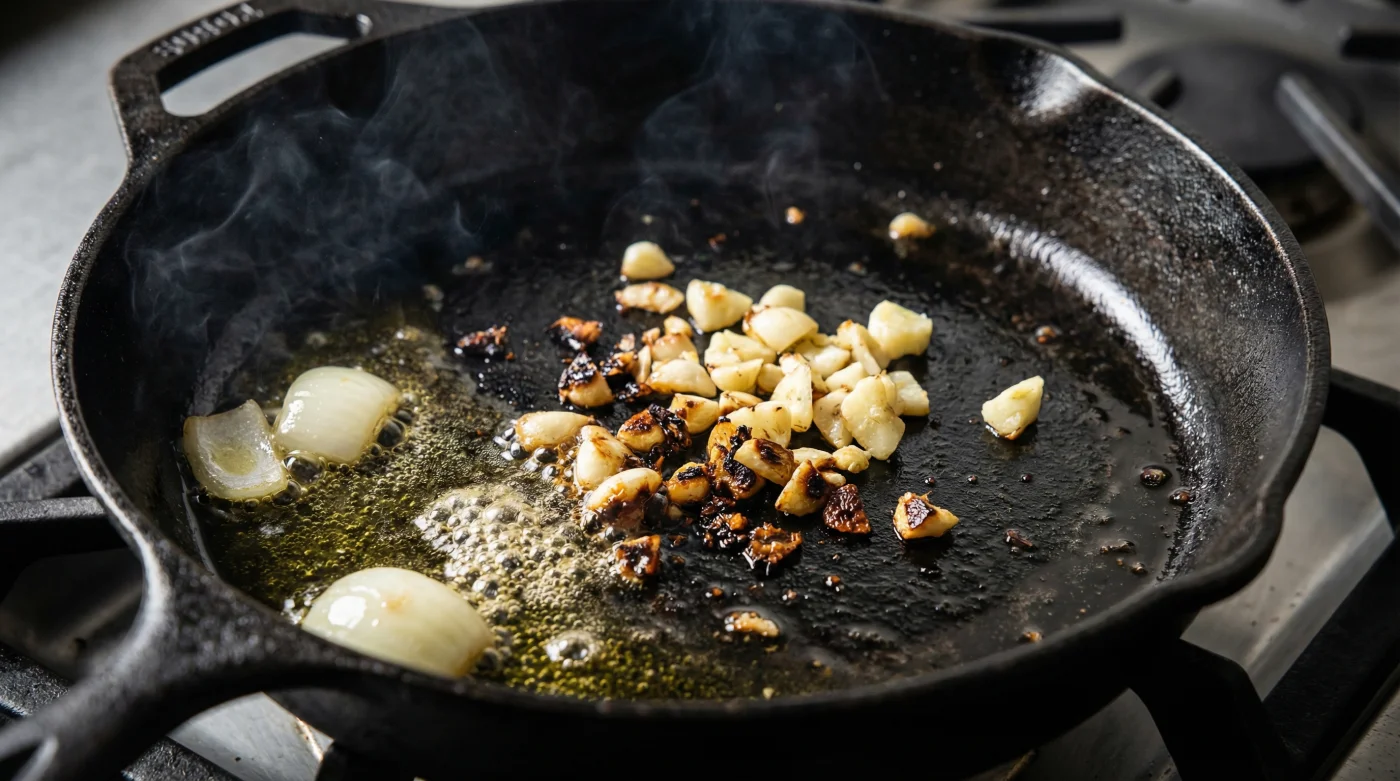
You know the sound. The comforting, enthusiastic hiss of hot oil meeting freshly chopped vegetables. You stand by the hob, wooden spoon in hand, anticipating the foundational aromas of your evening meal. You tip the entire chopping board—a snowy pile of diced onions mixed with finely crushed garlic—straight into the pan. For a moment, it smells divine. But within ninety seconds, a sharp, acrid scent begins to catch in your throat. Those delicate, pale yellow garlic fragments have turned a harsh, ashen brown. Your base is burnt, and the subtle sweetness of your dish is entirely lost to an overwhelming, metallic bitterness.
We are all taught to start recipes this way. “Fry the onions and garlic until soft,” the cookbooks lazily instruct. It is perhaps the most widespread culinary lie we blindly accept, quietly ruining everything from a humble Tuesday night ragù to a complex weekend curry.
The Footrace in the Frying Pan
Think of your sauté pan as a running track. If you place a heavily layered, water-dense onion at the same starting line as a tiny, sugar-rich fragment of crushed garlic, the race is fundamentally unfair. The onion needs time, heat, and patience to break down its tough cellular structure and release its moisture. The garlic, almost entirely devoid of water and packed with fragile, volatile oils, sprints to the finish line instantly. By the time your onion has even thought about turning translucent, your garlic has slammed into a brick wall, scorching beyond rescue.
This is where the frustration stems from. You follow the instructions, yet end up eating a dish that tastes faintly of burnt toast. The secret lies not in changing your ingredients, but in changing your timing. You must treat garlic not as a companion to the onion, but as a finishing touch to the sautéing process.
| Cook Profile | Specific Benefit of the 30-Second Rule |
|---|---|
| The Rushed Weekday Cook | Eliminates the need to start a ruined dish from scratch, saving both time and frustration. |
| The Batch-Cooking Prepper | Prevents bitter compounds from multiplying and spoiling the flavour of meals stored in the fridge. |
| The Weekend Entertainer | Ensures expensive meats or delicate sauces aren’t overpowered by the harsh taste of scorched alliums. |
I recall standing in the sweltering kitchen of a busy Soho brasserie years ago. I was tasked with preparing the base for a massive batch of marinara. I scraped my mountain of garlic and onions into a vast cast-iron pot. The head chef, a terrifyingly calm veteran of the London food scene, reached over and physically lifted the pan off the flame.
“You are suffocating the garlic,” he said, tapping the rim with his tongs. “The onion is a sponge; the garlic is a spark. Cook your onions until they surrender. Only when they are soft, golden, and ready to welcome the tomatoes, do you add the garlic. Thirty seconds. Just enough time for it to bloom, never enough time for it to burn.”
The Thermal Reality of Alliums
There is a harsh mechanical logic to how food behaves under heat. When you crush a clove, you rupture its cell walls, mixing an enzyme called alliinase with an amino acid to create allicin. This is the compound that gives the ingredient its unmistakable punch. However, allicin is highly unstable and deeply sensitive to high temperatures.
| Ingredient | Water Content | Sugar Content (Per 100g) | Burn Threshold |
|---|---|---|---|
| Standard Brown Onion | 89% | 4.2g | High (Requires prolonged heat to caramelise) |
| Crushed Garlic | 59% | 1.0g (but highly concentrated due to low water) | Extremely Low (Scorches within 45 seconds at high heat) |
Because crushed pieces are so small, their surface area is vast relative to their volume. When dropped into oil that is sitting at 180 degrees Celsius, the minimal water content evaporates in a blink. The sugars remain, and sugar in hot oil turns rapidly from caramel to carbon. That carbon is the exact source of the metallic bitterness that coats your tongue.
Mastering the Thirty-Second Window
Correcting this widespread kitchen error requires nothing more than a mindful shift in your physical routine. You do not need new equipment; you simply need to split your preparation.
Begin by finely dicing your onions. Place them in your pan over a medium-low heat with a slick of oil or a knob of butter. Add a generous pinch of sea salt immediately. The salt acts as a microscopic abrasive, breaking down the onion’s cell walls and drawing out the moisture. This water acts as a buffer, regulating the temperature of the pan and preventing browning before the softening occurs.
While the onions gently sweat, take your garlic. Peel it, crush it, or mince it finely. Keep it entirely separate on your board. Do not let it touch the heat yet.
Watch the onions. You are waiting for them to turn translucent, losing their rigid white opacity. Once they reach that sweet, yielding stage, push them slightly to the edges of the pan to create a small clearing in the centre. Drop your garlic into this space.
- Frozen spinach ruins expensive pastry bakes ignoring this aggressive physical wringing step.
- Arborio rice forms unappetising stodgy pastes undergoing this traditional cold water rinse.
- Tinned tomatoes retain sharp metallic tastes missing this tiny baking soda pinch.
- Heinz baked beans vanish from supermarket shelves amid severe tin shortages.
- Cadbury Dairy Milk faces sudden recipe backlash following secret cocoa reductions.
| Visual State | What to Look For (Quality Indicator) | What to Avoid (Warning Sign) |
|---|---|---|
| Raw | Firm, pale ivory, pungent smell. | Green shoots in the centre (remove them, they are bitter). |
| Perfectly Sautéed | Softened, slightly translucent, intensely fragrant. | Sticky clumping in the pan. |
| Overcooked | Golden brown edges (acceptable only for specific Asian stir-fries). | Dark brown or black fragments. Discard and start again. |
A Calmer Rhythm at the Hob
Adopting this simple thirty-second rule changes the entire atmosphere of your cooking. Instead of frantically chasing a burning ingredient around a fiercely hot pan, you are dictating the pace. You are treating each vegetable with the specific respect its physical structure demands.
There is a quiet satisfaction in taking a deeply ingrained habit, dismantling it, and replacing it with something better. By separating the onion from the garlic, you rescue your palate from bitterness. You ensure that the pounds sterling you spent on good meat, fresh vegetables, and quality spices are elevated by a sweet, aromatic base, rather than masked by the sharp taste of an avoidable mistake.
The next time you stand before the hob, resist the urge to scrape the entire board into the oil at once. Hold the garlic back. Let the onions take their time. Your evening meal will thank you for the restraint.
“A dish is only as strong as its foundation; scorch your base, and you spend the rest of the evening apologising for the bitterness.”
Frequently Asked Questions
Does this apply to slow cookers as well?
Yes. Slow cookers do not reach the fierce temperatures of a frying pan, but adding garlic at the very end of a slow cook preserves its bright, aromatic notes rather than muddying them over eight hours.
What if a recipe demands I fry them together?
Ignore it. Unless you are cooking the onions for less than a minute in a blazing hot wok, standard recipes are simply writing in shorthand. Always sweat the onions first.
Is sliced garlic more forgiving than crushed?
Absolutely. Sliced pieces have less surface area exposed to the hot oil and will cook slightly slower, but they still require a watchful eye and should generally follow the onions.
How do I fix a dish if the garlic has already burnt?
Truthfully, you cannot. The bitter compounds are entirely oil-soluble and will permeate the whole pan. It is better to throw away a 10p onion and start again than to ruin a £15 piece of beef.
Should I use oil or butter for the initial frying?
A mixture of olive oil and a small knob of butter works beautifully. The oil prevents the butter from burning too quickly, while the butter helps to softly sweat the onions.