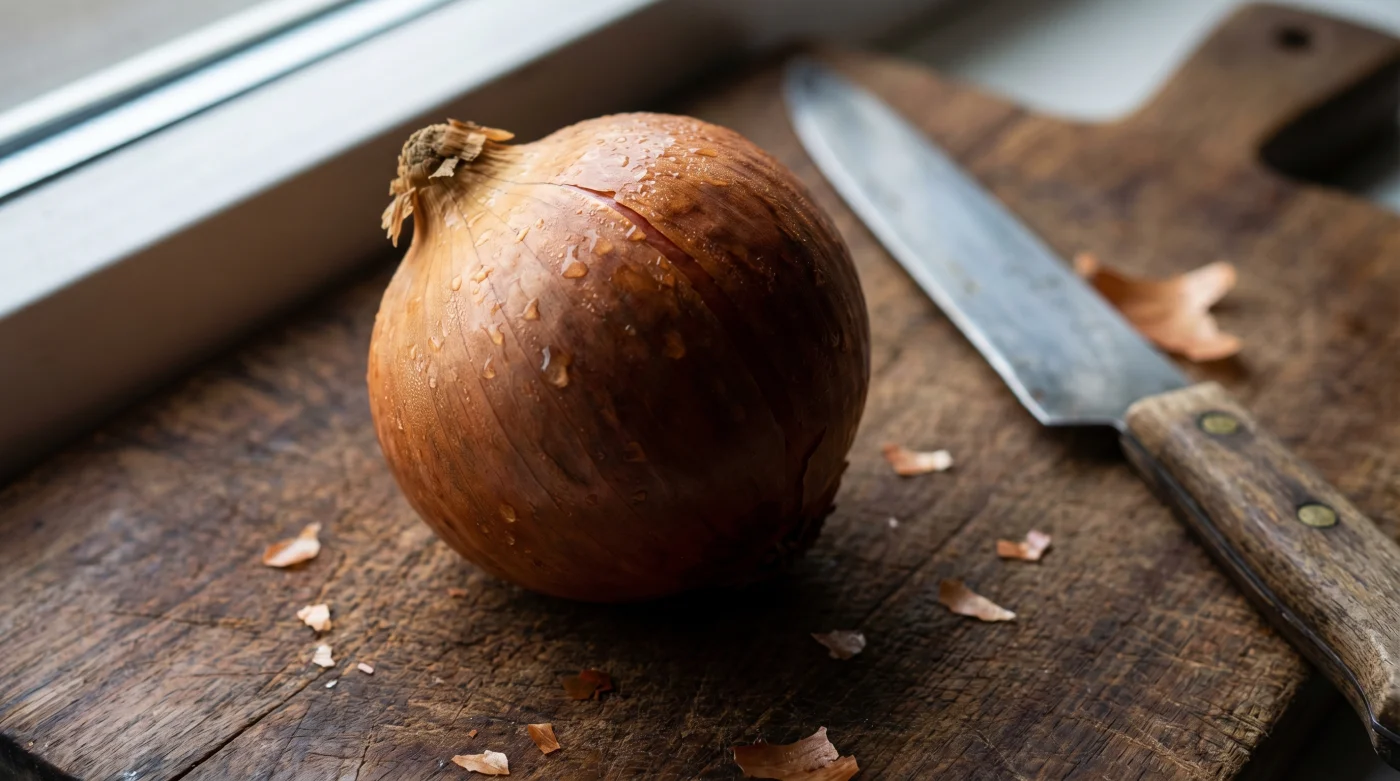
The familiar thud of the steel blade against a wooden chopping board usually signals the beginning of something comforting. A cottage pie, a slow-cooked stew, or perhaps the rich base of an evening curry. But almost instantly, that sharp, sulphurous tang hits the air, creeping up from the board and settling heavily in the space around your face.
You blink rapidly, turning your head toward the extractor fan. Your vision blurs entirely as the sting sets in, betraying the simple, domestic task at hand. You step away, wiping your face with the back of a wrist, frustrated that such a humble ingredient demands such a physical toll.
The standard expectation in home kitchens is that these tears are simply the unshakeable tax we pay for flavour. We squint through the discomfort, believing that a stinging face is just part of the process. But behind the doors of professional kitchens, the reality is entirely different. There, the brown onion is not a hostile adversary, but a compliant foundation, yielding to the knife without a single shed tear.
It all comes down to controlling the environment before the knife ever falls. It is the kitchen secret that transforms frantic prep into a calm, methodical practice. Cool the bulb first, keep your eyes dry, and reclaim your composure at the chopping board.
The Anatomy of a Tear-Free Chop
Think of a room-temperature brown onion as a highly pressurised, microscopic chemical factory. As it sits in your vegetable basket, it is storing a defensive compound called syn-propanethial-S-oxide. When your knife breaks the cell walls, this compound reacts, vaporising instantly into a fine, invisible smog that seeks out the moisture in your eyes.
We often blame our tools, convinced we need a freshly sharpened blade to solve the problem—and while a clean cut does cause less cellular damage, it is only half the battle. The true perspective shift happens when you realise you do not need to fight the chemistry; you merely need to slow it down. The mundane detail of temperature is your greatest advantage.
By dropping the temperature of the onion, you force that volatile chemical factory to become sluggish. The cold subdues the reaction, turning the normally frantic vaporisation into a slow, heavy crawl. The gas struggles to rise from the board, remaining trapped in the cold flesh of the vegetable rather than wafting toward your face.
Consider Thomas, a 42-year-old prep chef working at a high-volume gastropub in Cornwall. Every morning before 10 AM, Thomas breaks down thirty kilos of brown onions for the daily gravy and pie fillings. He does not wear novelty goggles, nor does he hold a slice of bread in his mouth. He relies entirely on the walk-in fridge. “An onion left by the stove is a weapon,” Thomas notes, standing beside a mountain of perfectly diced vegetables. “An onion resting in the chill is just a vegetable.”
Adapting the Chill to Your Routine
Not every meal is planned hours in advance, and your approach to cooling the bulb should adapt to the rhythm of your evening. Mastering this subtle shift requires observing how you naturally operate in your own space.
For the weekend batch-cooker, the solution is beautifully passive. If you know Sunday afternoon will be spent making a massive ragù or freezing portions of soup, simply move a mesh bag of brown onions into the salad crisper drawer on Saturday night. The prolonged, gentle cold penetrates deep into the core, ensuring maximum stability when you finally begin to prep.
For the frantic after-work cook, time is rarely on your side. You walk through the door at six o’clock, hungry and hurried. The freezer method works brilliantly here. Toss the onion directly into the freezer the moment you walk into the kitchen. By the time you have sorted the post, changed out of your work clothes, and gathered your other ingredients—roughly fifteen minutes later—the outer layers and the volatile root will be sufficiently shocked into submission.
For the precise mincer, dealing with finely diced shallots or small brown onions for a delicate vinaigrette, the cold offers a secondary benefit. A chilled onion is physically firmer. The layers hold together with a satisfying rigidity, preventing the bulb from sliding or collapsing under the pressure of your knife, allowing for remarkably neat, professional brunoise cuts.
The Tactical Toolkit for Dry Eyes
Executing this method requires only a slight adjustment to your order of operations. It is a mindful pause before the physical work begins.
First, identify your timeframe. Choose your cooling zone based on the minutes you have spare. Place the whole, unpeeled onion into the cold environment. Do not slice it in half first, as this will prematurely release the very compounds you are trying to suppress.
When you retrieve the chilled onion, move purposefully. The cold state is temporary, and as the vegetable warms against the ambient air and the heat of your hands, the chemical factory will begin to wake up.
- The 15-Minute Shock: Place in the freezer for immediate, rapid cooling of the outer layers.
- The 30-Minute Rest: Place in the fridge while you prepare your meats and other hardy root vegetables.
- Leave the root intact: The highest concentration of irritants lives in the hairy root base. Slice this part off last.
- Maintain the chill: If you are dicing multiple onions, keep the reserves in the fridge until the exact moment they are needed.
Reclaiming Your Kitchen Calm
Mastering this simple temperature shift is about much more than avoiding a few minutes of mild discomfort. It is about removing the lingering dread that often accompanies home cooking. A quiet, methodical peace settles over your workspace when you are no longer bracing yourself for an inevitable physical reaction.
When you stop fighting your ingredients, cooking transforms from a daily chore into a restorative ritual. The brown onion ceases to be a nuisance and returns to its rightful place: the sweet, deeply savoury foundation of almost every great meal you will ever make.
“The difference between a frantic kitchen and a calm one is often just a matter of ten degrees.”
| Key Point | Detail | Added Value for the Reader |
|---|---|---|
| The Freezer Method | 15 minutes of rapid chilling before slicing. | Saves time on busy weeknights while entirely neutralising eye irritation. |
| The Fridge Method | 30+ minutes in the salad crisper drawer. | Perfect for weekend batch-cooking, providing a deep, even chill for bulk prep. |
| Structural Firmness | Cold temperatures stiffen the onion’s natural layers. | Makes fine dicing significantly easier and safer, preventing knife slips. |
Frequently Asked Questions
Does chilling the onion affect its cooking time?
Not in any noticeable way. The onion will return to room temperature within moments of hitting a hot pan, browning exactly as it normally would.Will storing onions in the fridge make my other food smell?
If kept whole and unpeeled, a brown onion emits very little odour. Just ensure you do not leave a half-cut onion exposed next to your butter.Can I just leave my onions in the fridge permanently?
It is best to store them in a cool, dark cupboard long-term to prevent them turning mushy. Only chill them right before you plan to cook.Why do some people suggest wet paper towels or chewing gum?
Many domestic tricks attempt to distract your senses or draw the gas elsewhere. Chilling physically stops the gas from forming, addressing the root cause.Does this work for red onions and shallots too?
Yes. The chemical makeup is remarkably similar across the allium family, meaning the cold treatment is universally effective.