You stand at the edge of the cutting board, knife in hand, bracing for the inevitable. The sharp crack of the papery golden skin giving way to the blade is satisfying, but within seconds, the familiar stinging begins. It starts at the corners of your eyes, a sharp prickle that quickly blooms into a heavy, blinding burn. The smell of raw allium fills the air, and suddenly, you are retreating from your own workstation.
Most home cooks accept this discomfort as the unchangeable price of a good stew or curry. You blink rapidly, rubbing away bitter tears with the back of a wrist, compromising your knife skills and your safety just to get the job done. The kitchen temporarily transforms from a place of comfort into a mild torture chamber, leaving you with blurry vision and a stinging face.
But step into the back of a busy restaurant, and you will notice an eerie calmness. Prep chefs do not weep over their stainless steel benches, nor do they wear ridiculous ski goggles to protect their eyes. They have quietly mastered a kitchen secret that halts the chemical reaction before it ever reaches their face, relying on a simple law of physics rather than sheer endurance.
The difference between their board and yours is shockingly simple. By learning to wet a paper towel, you can completely intercept the invisible warfare happening on your work surface, keeping your eyes entirely clear.
The Perspective Shift: Creating a Chemical Decoy
To stop crying over onions, you have to understand the invisible opponent. When a knife crushes the cellular walls of an onion, the plant releases an enzyme that mixes with amino acids to form syn-propanethial-S-oxide. This volatile sulphur gas is desperately seeking the nearest source of moisture to dissolve into. Typically, that moisture is the protective layer of basal tears in your eyes, leading to the severe stinging sensation.
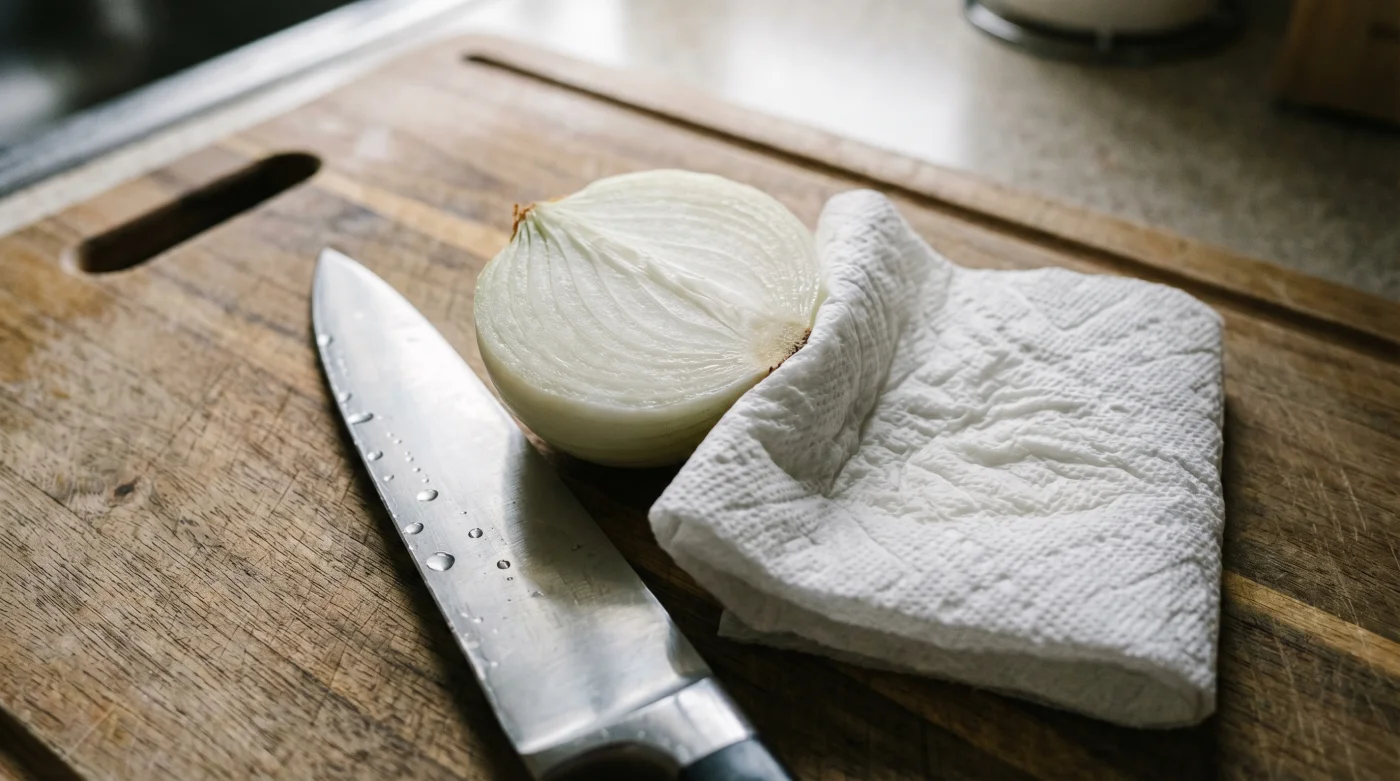
Instead of fighting the gas, you simply give it a better target. A damp sheet of kitchen roll placed right next to your chopping board acts like a magnetic sponge. The heavy gas migrates to the wet paper before it ever has a chance to drift upward to your face, neutralizing the threat at the source.
This shifts your entire perspective on kitchen prep. You are no longer passively bracing for an assault; you are actively managing your physical environment. A seemingly useless, mundane scrap of damp paper becomes your shield, transforming a notoriously frustrating chore into a peaceful, focused task. You learn to control the kitchen, rather than letting the kitchen control you.
The Soho Prep Chef
Consider Arthur, a fifty-two-year-old prep chef working in a notoriously cramped Soho brasserie. Every morning, Arthur processes roughly thirty pounds of sharp white onions for the lunch service. His station is a masterclass in quiet efficiency, devoid of the theatrics of freezing onions, lighting candles, or holding bread in his mouth.
Before he even picks up his battered carbon steel knife, Arthur folds a thick piece of blue catering roll, runs it under the cold tap until it is dripping, and slaps it onto the top right corner of his chopping board. ‘The gas wants water,’ he explains, slicing rapidly through his twentieth onion without a single blink. ‘Give it water down here, and it leaves your eyes alone up there.’
Adapting the Secret for Your Kitchen
Not every cook approaches a recipe the same way, and the deployment of this kitchen secret can be tailored to your specific habits. Understanding your own workflow makes the decoy method infinitely more reliable, whether you are cooking a massive feast or a quiet supper.
For the Quick Supper Cook
If you are just dicing half an onion for a quick Tuesday night spag bol or a cottage pie, a single piece of kitchen roll will do perfectly. Fold it into a neat square, run it under the cold tap, and wring it out slightly so it does not puddle on your wooden board. Keep it tucked right next to the root of the onion as you make your horizontal and vertical cuts.
For the Batch-Prep Devotee
When Sunday rolls around and you are preparing a massive batch of French onion soup or a rich beef stew, the sheer volume of gas increases exponentially. You need a larger surface area of moisture to absorb the fumes. Lay a fully soaked, slightly wrung-out cotton dishcloth across the entire top edge of your cutting board, forming a wide, damp barrier between the moving blade and your face.
For the Sensitive-Eyed
Those who wear contact lenses often find the sting even more trapped and aggressive. For maximum protection, combine the damp paper trick with a slightly chilled onion. The cold temperature physically slows down the chemical reaction, while the wet paper catches whatever small amount of gas manages to escape the chilled flesh.
Mindful Application: The Tactical Toolkit
Executing this properly requires a moment of pause before the knife ever moves. It is an exercise in preparation, ensuring your workstation is set up for calm precision rather than frantic, blurry-eyed hacking. Rushing the setup is the only way this method fails.
Follow these specific steps to guarantee a completely tear-free chopping board every single time you cook:
- Select a highly absorbent kitchen roll or a clean, thick cotton cloth.
- Soak the material completely under cold running water.
- Squeeze out just enough excess water so it does not flood your work surface.
- Position the damp towel directly adjacent to the onion, ideally less than two inches away.
- Ensure your knife is sharply honed; a dull blade crushes more cells, releasing significantly more gas.
Remember that proximity is everything. If the paper is pushed too far away near the back splash to keep the board tidy, the gas will bypass the damp decoy and find your eyes instead. Keep the wet paper intimately close to the action.
The Bigger Picture: Reclaiming the Kitchen
Fixing this common culinary disaster is about much more than just preserving your makeup or avoiding a few minutes of stinging pain. It is about how you physically feel in your own kitchen. When you remove the friction and pain from basic, foundational tasks, cooking shifts from a dreaded daily chore to a mindful act of care.
You stop viewing certain recipes with hesitation. The massive pile of shallots required for a slow-roasted weekend joint becomes a minor detail rather than a reason to order a takeaway. You begin to move with the confidence of someone who understands the underlying mechanics of their food, rather than just blindly following a recipe card.
By simply remembering to wet a paper towel, you reclaim the quiet joy of preparation. The kitchen becomes a place where you are in complete control of the elements, armed with nothing but water, paper, and the knowledge of exactly how to use them to your advantage.
The sharpest blade in the kitchen is practically useless if the chef cannot keep their eyes open; you must manage the environment before you make the first cut.
| Key Point | Detail | Added Value for the Reader |
|---|---|---|
| The Chemical Decoy | Syn-propanethial-S-oxide aggressively seeks moisture. | Stops stinging tears before they ever reach your face. |
| Proximity Matters | The wet towel must sit mere inches from the knife blade. | Ensures the heavy gas is absorbed immediately upon release. |
| Blade Sharpness | A sharp edge slices cleanly, rather than violently crushing cells. | Reduces the total volume of irritating gas released into the air. |
Frequently Asked Questions
Does the water temperature matter? Cold water is best, as it helps keep the surrounding air slightly cooler, slowing the upward travel of the gas.
Can I use a reusable cloth instead of paper? Yes, a clean, damp cotton dishcloth works exactly like kitchen roll, though it may hold onto the pungent onion smell until thoroughly washed.
Why not just chew gum while chopping? Chewing gum forces you to breathe through your mouth, but does absolutely nothing to intercept the gas hitting the moisture in your actual eyes.
How close should the towel be to the vegetable? Place it less than two inches from the onion, forming an immediate barrier between the cutting board and your body.
Does chilling the onion help as well? Yes, keeping onions in the fridge for thirty minutes before chopping slows down the initial chemical release, working beautifully alongside the wet paper.