Picture the cutting board on a wet Tuesday evening. A tight bulb of fresh garlic sits there, stubbornly encased in its papery layers. You press down with the flat of your knife, hearing that familiar crack, only to find the translucent skin adhering to the sticky, bruised flesh beneath. It catches under your fingernails, leaving a pungent residue that lingers on your hands long past bedtime, ruining the simple pleasure of holding your evening cup of tea.
You might have tried the vigorous shaking trick in two metal bowls, waking half the street in the process, or perhaps bought one of those peculiar rubber tubes that promise a clean peel. Yet the simplest solution requires no equipment at all, just a slight shift in your timing. The professional reality is quiet, relying on patience rather than brute force or noisy kitchen theatrics.
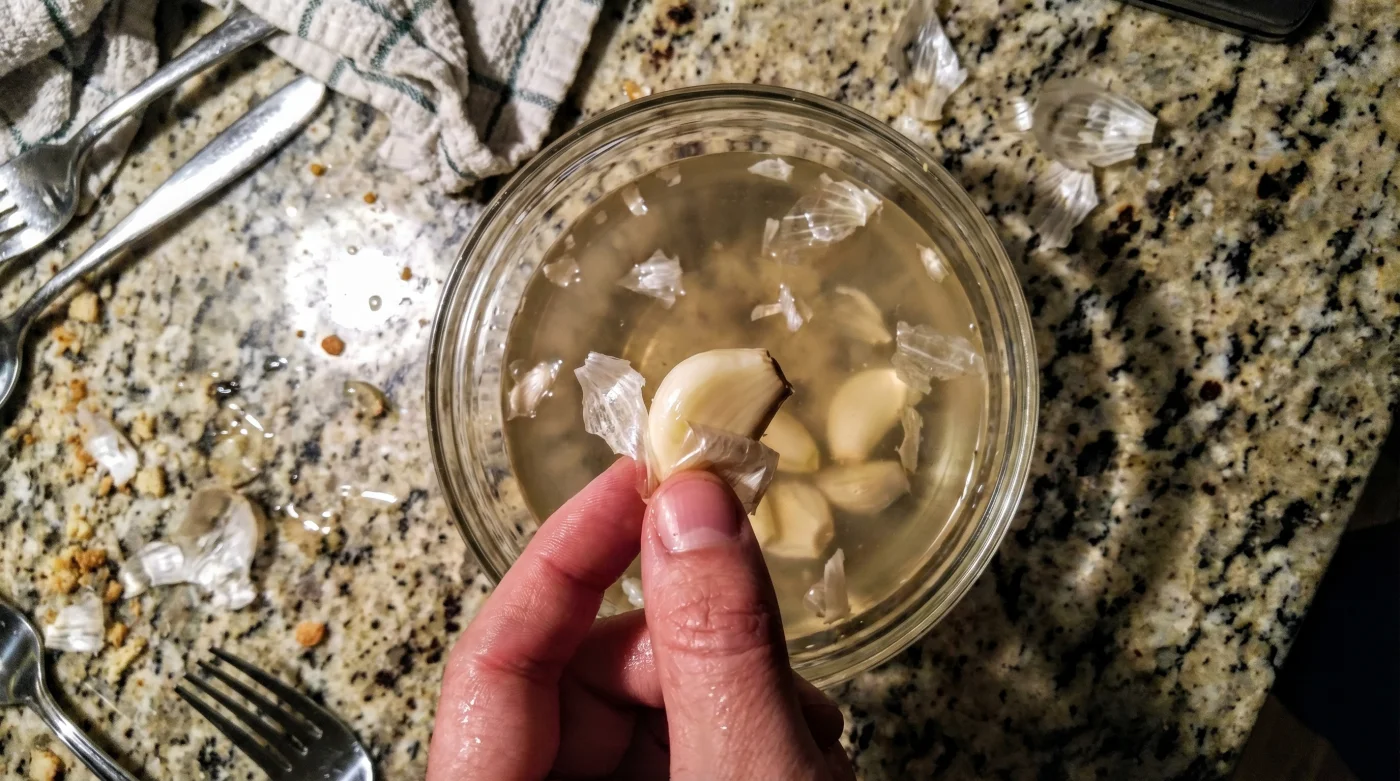
Walk into the back of a bustling restaurant kitchen, and you won’t see cooks wrestling with individual cloves while the tickets pile up. Instead, you’ll spot a modest plastic tub resting near the sinks. Inside, hundreds of cloves bob gently in warm water, waiting for their jackets to swell and release. It is the lazy fix that transforms a tedious, sticky chore into an effortless slip.
The Hydration Principle
Think of garlic skin as a dry, tightly woven coat. Over time, as the bulb cures and hardens on the shelf, the natural moisture between the flesh and the papery exterior evaporates, creating a microscopic vacuum. When you try to peel it dry, peeling away fragment by fragment, you are quite literally fighting physics at every turn.
Introducing warm tap water breaks this bond completely. The warmth softens the dried pectin holding the layers together, while the moisture creeps under the edges of the root plate. Within minutes, the paper simply floats away from the garlic, leaving the clove pristine, whole, and entirely unbruised. The perceived flaw of fresh garlic—its stubborn, sticky grip—is actually a sign of its freshness and protective oils; it simply needs permission to let go.
Consider Thomas, a 42-year-old prep chef working the morning shift at a chaotic Soho trattoria. Before the lunchtime rush begins, he faces a mound of garlic bulbs that would take an amateur hours to process. He doesn’t smash, scrape, or curse at his chopping board. He sweeps the separated cloves into a two-litre tub, runs the hot tap over them until submerged, and walks away to prep his aubergines, completely saving him hours of prep.
Modifying for Your Kitchen
This lazy fix isn’t just for massive restaurant batches or commercial kitchens. How you use this pantry secret depends entirely on your cooking rhythm, allowing you to preserve the nutritional integrity of the staple before it even hits your frying pan. Smashing garlic immediately triggers the creation of allicin—the compound responsible for its bite and health benefits—but keeping it whole until the very last second gives you complete command over the final flavour profile.
For the batch cook setting up meals for the week, simply separate two whole bulbs into a ceramic bowl on a Sunday afternoon. A five-minute warm soak allows you to peel them all simultaneously without making a mess of your counters. Keep the naked cloves in an airtight jar in the fridge, entirely ready to slice or mince whenever a recipe calls for them.
For the swift weeknight supper, the soak is equally transformative. Even if you only need two cloves for a quick Wednesday pasta sauce, drop them into a teacup of warm water before you do absolutely anything else. By the time you have chopped your onions, gathered your spices, and found your favourite wooden spoon, the skin slips right off.
For the nutritional purist, this method offers a hidden advantage. By avoiding the aggressive knife-crush method entirely, you prevent premature oxidation of the cellular walls. The clove remains completely intact until you are ready to cook, actively ensuring the valuable sulphides remain locked securely inside until you choose to release them into your hot oil.
The Mindful Application
Putting this into practice requires slowing down just enough to let the water do the heavy lifting for you. It is a quiet, minimalist action that completely removes the friction from your prep work, turning a frustrating task into a seamless part of your routine.
Here is your tactical toolkit for executing the perfect soak:
- Water temperature: Warm to the touch, roughly 40 degrees Celsius. Hot enough to relax the skins, but strictly not boiling, which would begin cooking the raw flesh.
- The separation: Break the bulb into individual cloves first. Leaving them attached to the basal plate prevents the water from penetrating the crucial root end.
- The soak time: A minimum of five minutes, though leaving them for up to fifteen won’t cause any harm to the flavour.
- The release: Drain the water and simply pinch the root end. The clove will shoot forward, leaving the empty shell behind.
Once you feel how effortlessly the clove yields to the warmth of the water, you will never go back to scraping dry paper off your thumbs. It is a incredibly small shift in your kitchen habits, yet it turns a persistent annoyance into a strangely satisfying, almost meditative ritual.
Reclaiming the Prep Counter
Cooking at home at the end of a long day shouldn’t feel like a battle against your own ingredients. When you stop forcing the fresh garlic to peel and start understanding exactly how it behaves under different conditions, the entire rhythm of your evening meal naturally shifts. You remove a point of tension from the very beginning of the recipe, setting a calmer tone for the evening.
It is these quiet realisations that make a kitchen feel entirely yours, rather than just a room where chores are completed. Mastering the mundane details allows you to focus on the joy of the craft, the scent of the softening onions, and the warmth of the stove.
You are left with pristine, golden cloves, impeccably clean hands, and a calm mind. By letting the warm water do the work, you grant yourself the luxury of time and the peace of a quiet kitchen, ready to build the foundation of your supper.
“Forcing an ingredient rarely yields the best result; give the garlic five minutes in warm water, and it gives you back your evening.” — Thomas, Prep Chef
| Key Point | Detail | Added Value for the Reader |
|---|---|---|
| The Dry Crush | Smashing raw cloves with a heavy knife blade. | Releases harsh allicin instantly, bruises flesh, and leaves sticky residue on hands. |
| The Warm Soak | Submerging whole cloves in 40°C water for five minutes. | Preserves cellular integrity, keeps hands entirely clean, and offers the lazy fix for prep work. |
| Nutritional Control | Keeping the clove whole until the exact moment of cooking. | Allows you to dictate the pungency and sulphide release precisely when required. |
Frequently Asked Questions
Will hot water cook the fresh garlic?
Not if you use warm tap water (around 40 degrees Celsius). Boiling water will begin to blanch the cloves, altering their raw bite, so stick to water that is comfortable to touch.Can I soak an entire bulb at once?
You must break the bulb into individual cloves first. The water needs access to the severed root end to effectively loosen the papery skin.How long can I store the peeled cloves?
Whole, unbruised cloves peeled via the water method will keep happily in an airtight jar in your fridge for up to five days without losing their crispness.Does this work for older, sprouting garlic?
Yes, though older garlic generally has looser skin anyway due to internal moisture loss. The warm soak still ensures a clean, sticky-free peel.Will this method reduce the garlic flavour in my dish?
Absolutely not. Because the clove remains uncrushed during peeling, all the potent flavour compounds are preserved inside until you decide to chop or grate it.