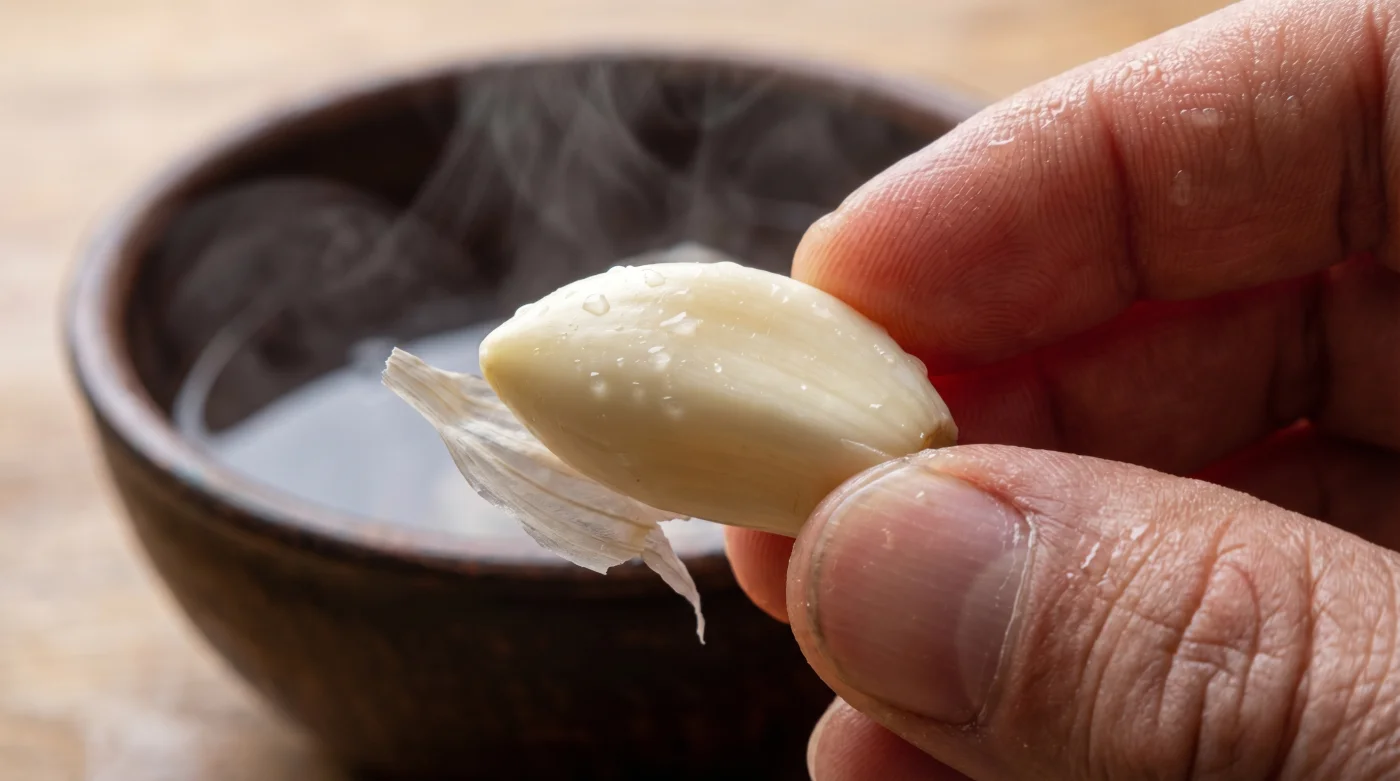
The biting aroma of raw garlic hitting a wooden board is a foundational memory for anyone who cooks. Yet, before that aromatic payoff, you must face the ritual of peeling. It usually involves frustrated sighs and tiny slivers of paper-thin skin adhering to your thumbnails with stubborn static cling.
You stand at the chopping board, dreading the sticky residue. The papery skins shatter into fragments that stick to the knife handle and your damp hands, turning a simple task into an unnecessary test of patience.
The standard expectation is smashing the cloves with the flat of a heavy blade. It is a violent act that crushes the delicate flesh, leaving you with bruised produce that immediately starts oxidising on the block. The professional reality, however, is much quieter, relying on temperature manipulation rather than blunt force.
A simple bowl of hot water changes the physical state of the bulb. Heat relaxes the natural glue, transforming a frustrating chore into a deeply satisfying, almost meditative moment that requires zero physical exertion.
The Thermodynamics of the Bulb
We typically treat peeling garlic like an arm wrestle, smashing and bruising our way to the fragrant core. But the skin of an allium is entirely functional; it serves to protect the volatile sulphur compounds within from degrading.
Think of the garlic skin like a vacuum-sealed jacket. Attempting to rip it off while cold only tears the fabric. Introduce a gentle thermal shock, and the jacket unzips itself. The mundane detail here—the natural pectin holding the skin to the flesh—suddenly becomes your greatest advantage once you learn how to dissolve it gently.
By soaking the cloves in hot water, you bypass the sticky, resinous sap that normally coats your fingers. The flesh remains perfectly firm and intact, but the papery wrapper turns supple, losing its grip completely.
Consider Thomas, a 42-year-old prep chef working the morning shifts at a bustling seafood brasserie in Cornwall. Tasked with processing three kilos of garlic before noon every day, he does not smash a single clove. Instead, he drops the separated cloves into a large stainless steel bowl, pours boiling water from the urn over them, and lets them sit for exactly sixty seconds. The water does the heavy lifting, he explains, casually pinching the ends until the pristine cloves slip out like polished pebbles. It guarantees immaculate, unbruised garlic ready for the mandoline.
Adapting the Technique to Your Menu
Not all garlic usage requires the exact same treatment. How you plan to cook the bulb dictates your specific approach to the soaking technique.
For the roast purist, if you intend to cook whole cloves alongside a chicken, the hot water soak plumps the flesh slightly. Drain them quickly and pat them dry with a clean tea towel; the lack of bruising means they will caramelise evenly in the roasting tin, rather than burning on jagged, smashed edges.
For the quick stir-fry, when speed is everything, slice the root end off before the soak. The hot water seeps under the skin instantly, allowing you to pop the clove straight onto the chopping board in seconds without waiting.
For the batch prepper stocking up for the week, let the water cool entirely after the soak. The skins swell and float, allowing you to skim them off the top. You are left with a week’s worth of pristine, ready-to-mince cloves that will sit happily in a glass jar in the fridge.
The Five-Minute Preparation Ritual
Executing this method requires nothing more than a bowl and a kettle. It is a quiet, deliberate process that puts you entirely in control of your ingredients.
Break the bulb down into individual pieces, keeping the root ends attached for now. Place them in a bowl and boil the kettle, allowing it to rest for a minute so the water is not furiously bubbling when poured.
Pour the hot water over the cloves until they are entirely submerged, watching the heat immediately interact with the dry skins.
Watch as the skins slightly discolour, taking on a translucent, soft quality. This visual cue indicates readiness, proving the natural adhesives have melted away completely.
- Separate the bulb entirely, discarding the dry central stalk.
- Submerge the unpeeled cloves in water around eighty to ninety degrees Celsius.
- Wait precisely sixty to ninety seconds.
- Drain the water through a metal sieve.
- Pinch the pointed top of the clove; the flesh will slide cleanly out of the base.
Tactical Toolkit: One kettle of hot water just off the boil, a medium Pyrex or ceramic bowl, sixty seconds on the kitchen clock, and a simple slotted spoon.
Beyond the Chopping Board
Escaping the frustration of sticky fingers and shattered skins changes the entire tone of your cooking prep. It turns an annoying hurdle into a seamless flow.
When you stop fighting the ingredients and start understanding their physical properties, the kitchen becomes a place of quiet competence. You preserve the structural integrity of the food, ensuring the oils and flavours are released exactly when you choose to slice, not a moment before.
Master this single, elegant adjustment, and you will find a new rhythm at the counter. The simple act of peeling garlic becomes a testament to working smarter, letting the physical world do the hard work for you.
The secret to professional cooking is rarely a sharper knife; it is usually knowing how to convince the ingredient to yield on its own terms.
| Key Point | Detail | Added Value for the Reader |
|---|---|---|
| Thermal Shock | Using 80-90°C water to break down pectin. | Saves immense time and stops sticky residue on hands. |
| Structural Integrity | Avoiding the flat-blade smash technique. | Prevents premature oxidation and bitter, burnt edges when roasting. |
| Batch Efficiency | Soaking whole batches and skimming floating skins. | Provides a full week of pristine, ready-to-use ingredients in minutes. |
FAQ
Will soaking the garlic cook the cloves?
No, soaking for just sixty seconds in water slightly off the boil only penetrates the outer paper skin, leaving the core raw and crisp.Can I use this method for cold storage?
Yes, provided you thoroughly dry the peeled cloves with a tea towel before placing them in a jar in the fridge to prevent mould.Does this alter the pungent flavour?
Not at all. Because you are not crushing the cells, the volatile compounds remain trapped inside until you actually chop them.Do I need to trim the roots first?
It is optional. Trimming beforehand allows water to enter faster, but pinching the top after the soak pops them out just as easily.Why not just use a silicone rolling tube?
Silicone tubes require physical force and often leave sticky residue on your hands when extracting the clove; hot water is entirely hands-off.