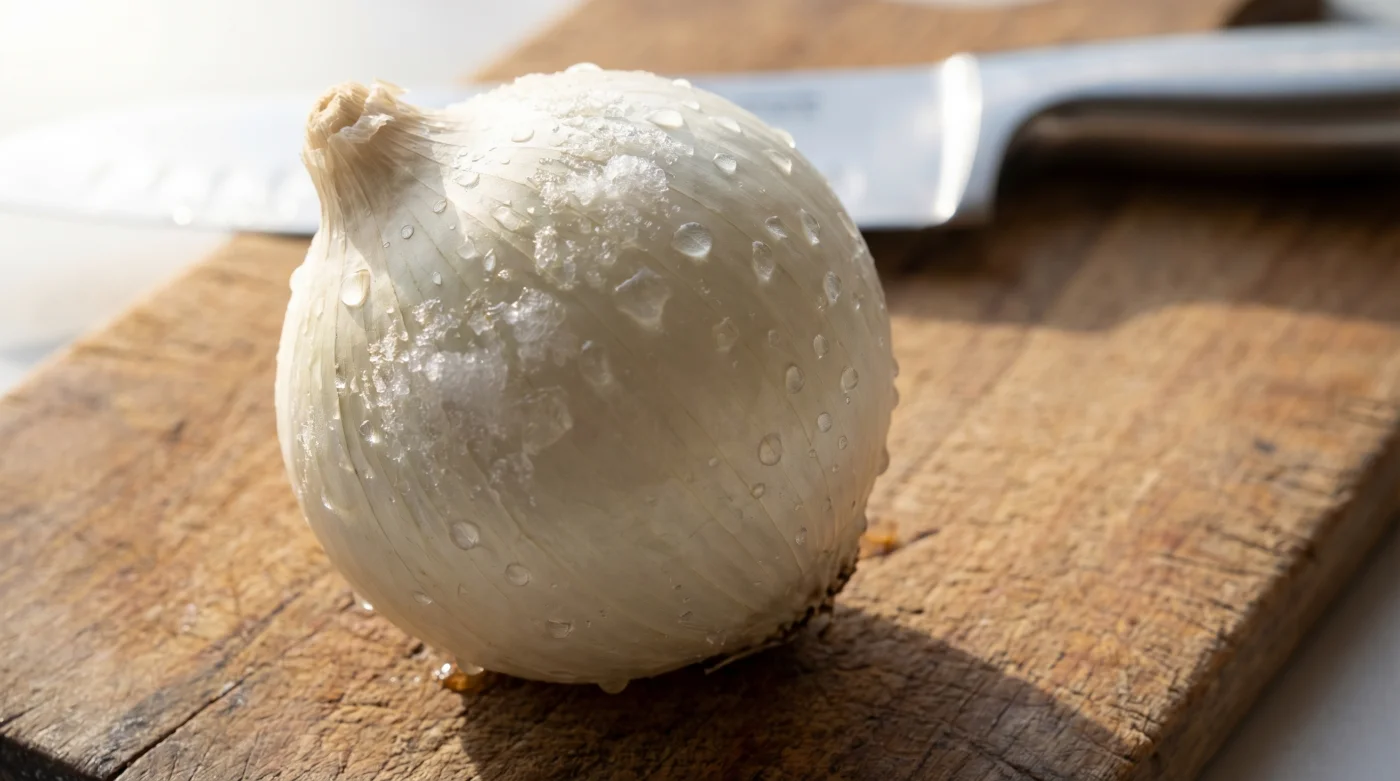
You stand at the kitchen counter, the heavy thud of your knife hitting the wooden chopping board. Before you lies a pristine white onion, its papery skin shedding like dry autumn leaves across the work surface. Within seconds of that first vertical slice splitting the crisp flesh, the familiar, sharp sting bites into the corners of your eyes.
The ambient air grows heavy with invisible, volatile compounds that rise straight from the board. You are forced to blink, frantically wiping your face with the back of a slightly damp sleeve. It is a daily, frustrating ritual that turns a simple act of nourishment into a blurry-eyed chore, a stinging sacrifice we blindly accept as the inevitable cost of building a flavourful base.
Yet, if you step into the clattering, stainless-steel rhythm of a high-end restaurant kitchen, you will not find a line of weeping chefs. They process heavy crates of these pale bulbs with a quiet, dry-eyed precision, their knives moving in a relentless blur. The difference does not lie in a magical knife technique, years of built-up tolerance, or a pair of ridiculous protective goggles.
The secret is utterly mundane, yet it alters the cooking experience entirely. It happens inside the fridge, quietly and effectively, hours before the knife ever meets the chopping board. By understanding the physical and chemical nature of the bulb, you can fundamentally change how it behaves in your home kitchen.
The Cold Architecture of an Allium
Think of a white onion not merely as a root vegetable, but as a microscopic, pressurised canister of chemical defence. When you sever its cell walls with a blade, a specific enzyme reacts with ambient amino acids to create a sharp sulphur gas. This invisible vapour drifts upward, reacting with the natural moisture in your tear ducts to form a mild, irritating sulphuric acid.
Warmth accelerates this invisible chemical frenzy with ruthless efficiency. A room-temperature onion bleeds gas the exact moment it is breached, sending an aggressive cloud straight towards your face. The standard domestic advice—chewing a piece of gum, breathing heavily through your mouth, or lighting a nearby candle—fails repeatedly because it attempts to fight the gas after it has already escaped the flesh.
The professional pivot relies on a profoundly simple truth: cold subdues volatility. By chilling the onion thoroughly before you attempt to slice it, you alter its internal pressure and calm its defences. The defensive enzymes become sluggish, the chemical reaction slows to an absolute crawl, and the irritating gas remains safely trapped within the cold flesh rather than rushing into the air you breathe.
You are no longer reacting blindly to a chaotic ingredient on the board. You control the chemical environment, turning temperature into a preparatory tool just as vital as a sharply honed blade. This subtle modification stops the chemical assault before it even has the chance to begin, returning control of the kitchen directly to your hands.
Take Marcus, a forty-two-year-old prep chef working at a relentless Soho brasserie. Every morning, long before the first delivery drivers or customers arrive, he is tasked with dicing twenty kilos of white onions for the day’s stocks and complex sauces. He stands at his metal station for hours, his knife falling in a blur of rhythmic precision, his eyes remaining entirely clear. Marcus never stores his morning prep onions in the dry store; they are ferried straight from the cavernous walk-in chiller to his chopping board. He treats the ambient temperature of the vegetable as a critical variable, knowing from bitter experience that a lukewarm onion is an inherently hostile onion.
Adapting the Chill to Your Routine
Not every meal you prepare demands the exact same approach to temperature management. Adapting to your cooking routine depends entirely on what you are attempting to create on the stove, and how much time you have before the pans need to be hot.
For the Sunday Batch Cooker
If you are setting up for a slow Sunday afternoon of making rich ragùs, winter stews, or a week’s worth of curries, the sheer volume of chopping is your biggest enemy. Place your entire required quota of white onions in the coldest part of your fridge—usually the bottom drawer—the night before. When you are ready to begin your prep work, only bring them out onto the counter one at a time. If you let a deeply chilled onion sit in a warm kitchen for twenty minutes, it will slowly wake up and regain its stinging potency.
For the Crisp Salad Architect
White onions are frequently chosen for their sharp, clean bite in raw applications, but a warm raw onion can easily overwhelm the palate with aggressive heat. Chilling serves a vital dual purpose in this scenario. Not only does it protect your eyes while you meticulously slice wafer-thin half-moons, but the cold actively firms up the cellular structure of the bulb. The resulting slices remain incredibly crisp and sweet, holding their physical shape beautifully against a sharp vinaigrette without bleeding their aggressive sulphur compounds into the delicate dressing.
For the Last-Minute Panicker
Sometimes, evening dinner is a rushed and chaotic affair, and the foresight of overnight chilling is completely impossible. The freezer acts as your emergency brake. Place the whole, unpeeled white onion in the freezer compartment for exactly fifteen minutes before you need to chop it. It is just enough time to drastically drop the temperature of the outer layers—where the highest concentration of tear-inducing enzymes lives—without turning the solid core into unworkable, dangerous ice.
The Chill-and-Chop Protocol
Executing this method requires practically no physical effort, but it demands a small kitchen shift in how you pace your evening. It is a quiet exercise in anticipatory cooking, allowing the household appliance to do the heavy lifting while you attend to entirely different tasks.
Follow this mindful, minimalist approach for a reliably tear-free preparation:
- Leave the dry, papery skin entirely intact. Do not trim the root or the stem before chilling, as any breach of the skin will start the chemical reaction prematurely.
- Place the bulbs in the main compartment of the fridge, ideally between 2°C and 4°C, for a minimum of two uninterrupted hours.
- Retrieve the cold onion only at the precise moment your wooden chopping board is secure and your knife is ready in your hand.
- Make your first confident cut to halve the bulb from root to stem, then immediately lay the flat cut sides down to trap any remaining cold vapours against the board.
To truly master this professional culinary pivot, you must respect the strict parameters of time and temperature. The ideal chilling window rests between two to four hours for a standard bulb. The emergency freezer dash must absolutely never exceed fifteen minutes, lest the delicate flesh turn glassy, translucent, and mushy upon thawing. Always ensure your knife is freshly honed; a dull blade crushes the cell walls rather than cleanly slicing them, releasing far more irritating gas regardless of how cold the vegetable might be.
Reclaiming the Chopping Board
Cooking dinner at home should always feel like a personal sanctuary, a quiet, tactile transition between the loud demands of the working day and the settling comfort of the evening. When a fundamental ingredient routinely causes you actual physical discomfort, it subtly and persistently erodes the basic joy of the entire process.
We too often rush blindly through the necessary preparation phase. We treat prep as a chore to be endured with gritted teeth rather than a grounded craft to be quietly enjoyed. By intentionally introducing the fridge into your workflow, you strip away the frantic stress of the task. You are left simply with the clean, satisfying sound of a sharp blade against wood, and the pale, precise geometries of your ingredients.
Mastering this small, mundane detail is not just about keeping your eyes dry and your makeup intact. It is about approaching your own kitchen with a renewed sense of calm authority. You slowly learn that the physical world of food is entirely pliable, and that a single, mindful adjustment to temperature can turn a frustrating daily battle into a serene, uninterrupted moment of domestic creation.
“Temperature is a physical ingredient; a cold onion surrenders its flavour to the pan without demanding your tears in return.”
| Key Point | Detail | Added Value for the Reader |
|---|---|---|
| Room Temperature Storage | Stores well long-term in a dark, dry cupboard. | Good for preservation, but guarantees a stinging chemical release during prep. |
| The 2-Hour Fridge Chill | Drops the internal core temperature to roughly 3°C. | Completely subdues the volatile gas, keeping your vision perfectly clear. |
| The 15-Minute Freezer Dash | Rapid, aggressive chilling of the outer allium layers. | A fast weeknight solution that saves your eyes when you lack preparation time. |
Frequently Asked Questions
Will chilling the onion change its flavour in my recipe?
Not at all. The cold simply slows down the release of the gases. Once the chopped onion hits the warm oil in your frying pan, it will sweat, soften, and release its full, sweet flavour profile exactly as a room-temperature one would.Can I just store all my onions in the fridge permanently?
It is best not to. Long-term fridge storage introduces too much ambient humidity, which can make onions soft and prone to mould. Only chill them a few hours before you plan to cook.Does this method work for red onions and shallots too?
Yes, the biological mechanism is identical across the entire allium family. Chilling a pungent red onion or a cluster of shallots will yield the exact same tear-free results on your chopping board.What happens if I leave the onion in the freezer for too long?
If left beyond fifteen to twenty minutes, the water content inside the onion’s cells will begin to freeze and expand. When it thaws, the cells rupture, leaving you with a mushy, watery texture that is deeply unpleasant to chop.Do I need to peel the onion before I put it in the fridge?
Keep the papery skin firmly on. Peeling or trimming the root exposes the flesh to the air and initiates the chemical reaction early. Chill it whole and untouched for the best protection.