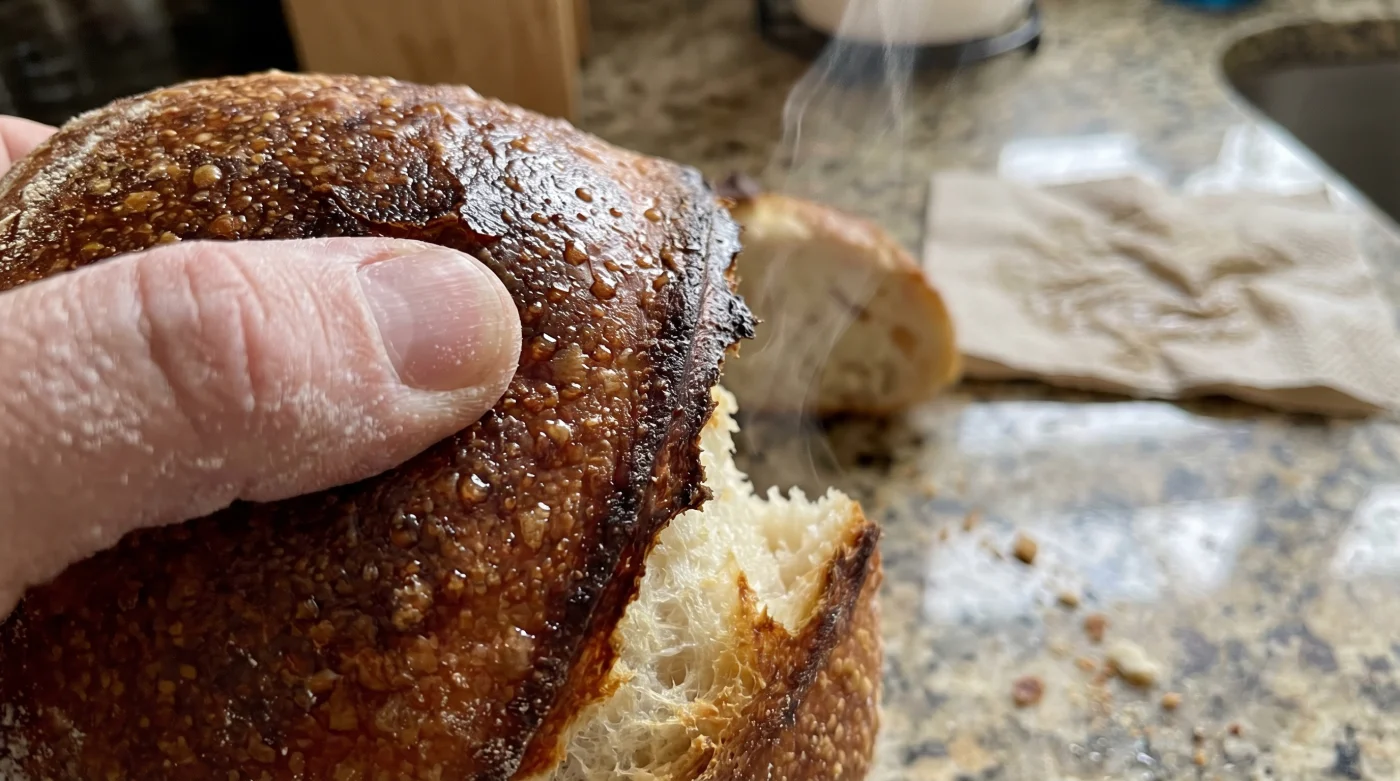
The morning light catches the flour dusting on the kitchen counter. You reach for the artisan sourdough you bought on Tuesday, tap your knuckles against the crust, and hear the hollow, unforgiving thud of a brick. It is a disheartening moment, staring at a once-glorious loaf that now feels dense enough to hammer a nail into a wall. The instinct is to reach for the bread knife, struggle to saw off a manageable slice, or simply accept defeat and consign the whole thing to the food waste bin.
Most of us treat staling as a one-way street, a tragic end to a beautiful bake. We settle for making reluctant croutons or feeding the local ducks, assuming the bread has permanently lost its life force. But a working bakery operates under an entirely different set of rules, where wasting a costly, fermented cob is simply not an option. They command the raw ingredients, understanding that what appears dead is often merely resting.
The secret to resurrection is remarkably counterintuitive. It involves ignoring every instinct that tells you to keep baked goods away from moisture, and instead embracing a radical, five-minute culinary intervention. You do not need a steaming basket or a microwave; you simply need the cold tap and a hot oven.
The Hydration Illusion
To fix a culinary disaster, you must first understand the mechanics of the failure. When a loaf goes stale, it is not actually losing all its water to the surrounding air, though it certainly feels that way. The starches within the flour are simply returning to their natural, crystalline state. Think of it like a tightly clenched fatigued muscle; the bread has seized up, trapping whatever moisture remains inside a rigid, unyielding structure.
This is where the lazy fix comes into play. By running the stale loaf directly under cold running water, you are not trying to soak the interior. You are providing a sacrificial layer of moisture to the crust. When this wet loaf hits the heat of an oven, that surface water violently converts to steam. The steam penetrates the seized starches, forcing them to relax and gel once again. The crust crisps up beautifully while the interior steams itself back to a soft, warm centre.
The Master of the Morning Shift
I first witnessed this brutalist approach to baking revival through Elias Thorne, a 58-year-old prep chef running the morning service at a bustling coastal brasserie in Dorset. During a particularly chaotic Sunday morning, a delivery failure left him with only the previous day’s baguettes, all of which had turned to absolute stone. Without a word, Elias gathered the hardened batons, held them under the vegetable wash sink until they were dripping wet, and threw them straight into a roaring bread oven. Ten minutes later, absolute perfection. The crusts shattered beautifully between his fingers, releasing plumes of fragrant steam from a crumb that tasted entirely freshly baked.
Adapting the Shock Therapy
Not all loaves harden equally, and your approach must shift depending on the specific victim sitting in your bread bin. The technique requires a slight recalibration based on the density and crust of your bread.
For the Artisan Purist
Thick-crusted sourdoughs or dense rye cobs can take a serious soaking. Do not be timid here. You want to run these hearty loaves under the cold tap until the entire exterior is glistening and wet to the touch. The thick crust acts as a protective shield, preventing the interior from turning to mush while holding enough water to generate a powerful, restorative steam bath in the oven. Protect the exposed open crumb, however; keep the water concentrated on the crust to protect the interior.
For the Supermarket Survivor
If you are dealing with a softer, mass-produced bloomer or a thin-crusted white loaf, running it under a heavy tap might destroy the delicate structure. Instead, lightly mist the crust with cold water using your hands or a spray bottle. Wrap the dampened loaf loosely in aluminium foil before placing it in the oven. The foil traps the gentle steam, softening the synthetic starches without turning the fragile crust into a soggy paste.
For the Pre-Sliced Dilemma
Trying to revive individual slices of stale bread requires the utmost care, as there is no crust to protect the crumb. Take a clean tea towel, dampen it slightly with cold water, and wring it out until it is barely moist. Wrap the stale slices in the cloth and place them in the oven on a very low heat. Watch them like a hawk; they will need only a minute or two before the gentle, ambient humidity coaxes the starches back to life.
The Lazy Fix Ritual
The actual process of bringing your bread back from the brink requires very little physical effort, but it demands precise timing and a mindful approach to temperature. Here is exactly how to execute the rescue mission.
- Turn your oven on to 160 degrees Celsius (Fan) and let it come up to temperature. Do not rush this; a cold oven will just slowly dry the wet bread out again.
- Take your stale loaf to the sink and turn the cold tap on to a medium flow.
- Pass the uncut crust of the bread under the stream of water. It should take no more than three seconds. The bread should be wet, but not waterlogged.
- Place the loaf directly onto the middle rack of the hot oven. No baking tray is necessary; you want the hot air to circulate completely around the crust.
- Leave it undisturbed for exactly six to eight minutes.
Your tactical toolkit is entirely minimal. A working oven, a cold tap, and the patience to wait a handful of minutes. When you pull the loaf out, let it sit on a wire rack for two minutes before slicing. The crust needs a moment to tremble and set, locking that newly generated moisture deep within the soft centre.
Reclaiming the Kitchen
Mastering this simple, lazy fix changes how you operate in your kitchen. It removes the low-level anxiety of buying a beautiful, expensive loaf of bread and feeling the ticking clock of its freshness. You are no longer held hostage by the natural degradation of flour and water. Instead, you hold the power to reset the clock.
There is a profound satisfaction in taking something destined for the bin and returning it to its absolute peak. It shifts your daily perspective. You begin to see culinary obstacles not as ruined ingredients, but as temporary states that simply require a bit of elemental manipulation. A quick shock of cold water and a blast of heat is all it takes to transform a frustrating morning into a quiet, delicious victory.
The difference between a wasted ingredient and a perfect meal is usually just a simple understanding of heat and hydration.
| The Approach | The Method | Added Value for You |
|---|---|---|
| Heavy Artisan Crusts | Direct cold tap shower, 160C oven for 8 mins. | Restores intense crunch and saves expensive bakery purchases. |
| Soft Bloomers | Light water mist, wrapped in foil, 160C for 6 mins. | Prevents delicate crusts from turning to mush while softening the centre. |
| Individual Slices | Wrapped in a barely damp tea towel, low heat. | Saves morning toast without wasting the whole loaf. |
Frequently Asked Questions
Can I do this more than once to the same loaf?
No, the starch crystals will only tolerate this forced relaxation once before breaking down entirely. Eat it immediately after the first rescue.Does this work for enriched doughs like brioche?
You must be very gentle. Misting and foil is the only way, as direct water will melt the high butter and sugar content.Why must the water be cold?
Cold water delays the evaporation process just long enough for the crust to heat up evenly in the oven, creating a better steam barrier.What if I accidentally soak the cut end?
If the exposed crumb gets wet, slice that thin layer off before putting it in the oven, otherwise it will bake into a rubbery puck.Can I use a microwave instead?
A microwave will heat the water and soften the bread for about thirty seconds, after which it will turn into an indestructible chew toy. Stick to the oven.