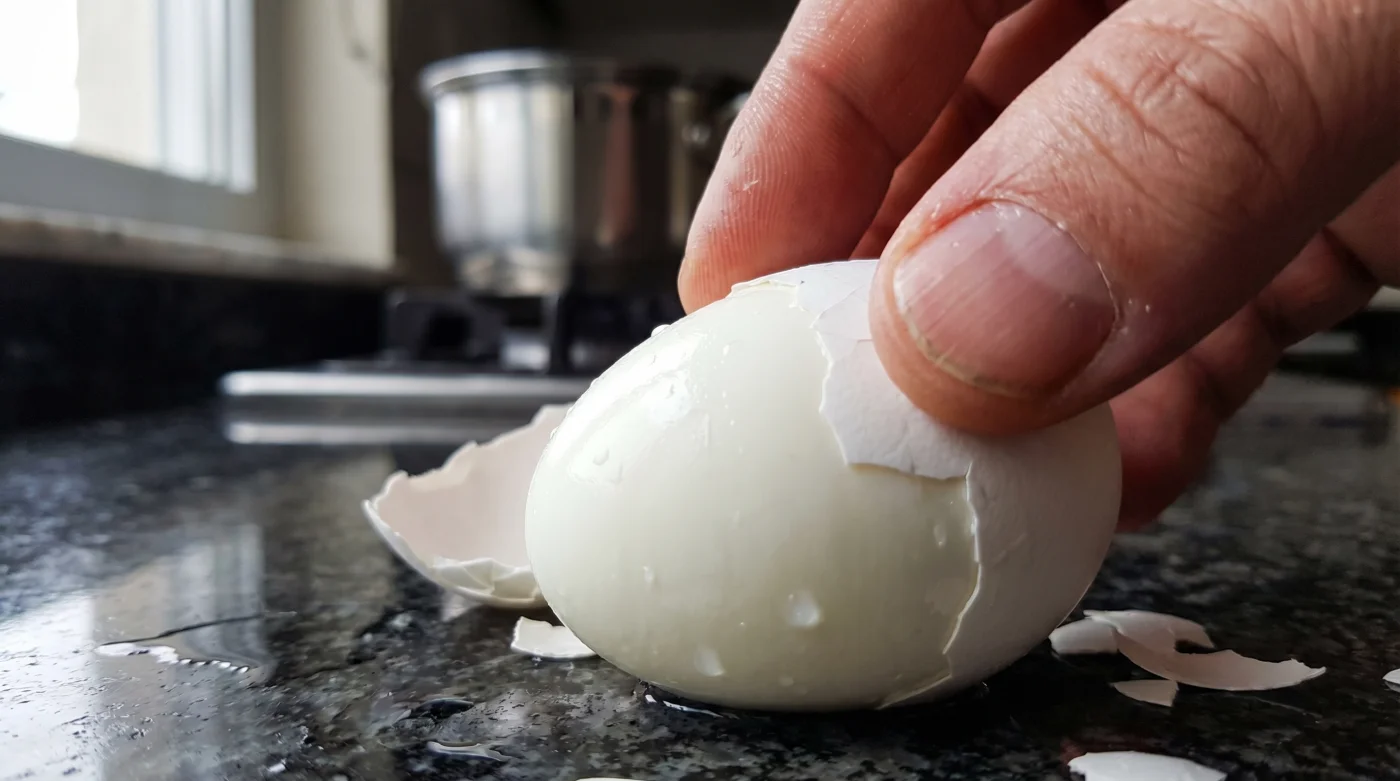
You stand over the kitchen sink, running cold tap water over your fingers as you pick at a stubborn, clinging fragment of shell. The morning light is hitting the worktop perfectly, the tea is brewing, but your breakfast is slowly turning into a cratered, unappetising landscape.
We have all been there. You bought the expensive, deep-yolked eggs from the local farm shop, timed the boil to a precise six-and-a-half minutes, and prepared the ice bath. Yet the membrane refuses to yield, fusing the brittle outer casing to the delicate white beneath.
The standard advice tells you to use older eggs, or to add a dash of vinegar, or to crack them all over before peeling. But in professional kitchens, where breakfast service demands flawless presentation at terrifying speed, chefs do not rely on old wives’ tales. They rely on basic, quiet chemistry.
The solution sits in a small cardboard tub at the back of your baking cupboard. A simple scoop of baking soda dropped into the rolling water shifts the odds entirely in your favour, allowing you to pull tricky shells right off without a second thought.
Re-writing the Chemistry of the Shell
To understand why this works, you have to stop viewing the eggshell as a protective wall to be smashed, and start seeing it as a semi-permeable membrane waiting for a chemical signal. When an egg is freshly laid, the white inside is slightly acidic. This acidity acts like a glue, binding the inner membrane fiercely to the outer shell.
Dropping baking soda into the pot changes the rules of engagement. It spikes the alkaline levels of the boiling water. As the water permeates the porous shell, that high alkalinity causes the egg white to loosen its grip, creating a microscopic gap between the cooked albumen and the membrane.
This is the perspective shift that alters your morning routine forever. That frustrating stubbornness of a farm-fresh egg is not a flaw to be battled with brute force; it is merely a chemical state waiting to be neutralised. By shifting the pH, you turn a kitchen disaster into a satisfying, frictionless peel.
Consider Arthur Pendelton, a 58-year-old former breakfast chef who ran the morning service at a busy West End hotel for two decades. Arthur would prepare upwards of three hundred eggs before most of London was awake. He never worried about the age of his stock. He simply kept a small ramekin of baking soda by the boiling rings. “Just half a teaspoon in the water,” he would say, “and the shell sighs and gives up. It practically unwraps itself.”
Adjusting for Your Morning Routine
Not all breakfasts are created equal, and neither are your boiling requirements. The alkaline drop adapts beautifully to whatever texture you are trying to achieve, provided you respect the timing.
For the Batch Prepper
If you are boiling half a dozen eggs on a Sunday evening for the week’s packed lunches, you need absolute consistency. The baking soda method ensures that when you retrieve one from the fridge on a rushed Wednesday morning, the peel remains entirely cooperative. The shell slips away in two or three large, clean pieces, leaving the firm white unblemished.
For the Ramen Enthusiast
Achieving a jammy, dark orange yolk requires a delicate six-minute boil. The resulting egg is incredibly fragile, making the peeling process a high-stakes operation. Here, the alkaline water is your safety net, allowing the shell to slide off without applying the thumb pressure that normally ruptures the soft centre.
The Alkaline Drop: Mindful Execution
Perfecting this technique is not about frantic multitasking. It requires a deliberate, minimalist approach at the stove. Gather your tools before you begin, and let the process become a quiet, reliable ritual.
When the water reaches a rolling boil, drop into the pot a half-teaspoon of baking soda. You will notice a brief, satisfying fizz as the powder reacts with the heat.
- Bring your water to a vigorous, rolling boil before adding the powder.
- Lower the eggs gently from a slotted spoon to prevent micro-fractures.
- Maintain a steady simmer; violent boiling will crack the shells prematurely.
- Transfer immediately to a bowl of heavily iced water the second your timer finishes.
The ice bath is not optional. The sudden temperature drop forces the egg interior to contract away from the shell, working in tandem with the baking soda to sever the membrane’s grip entirely. Leave them in the cold water for at least five minutes.
Your Tactical Toolkit
- Alkaline Ratio: Half a teaspoon of baking soda per litre of water.
- Tools: Slotted spoon, deep saucepan, large bowl filled with cold tap water and a handful of ice cubes.
- Action: Tap the rounded base of the egg first (where the air pocket lives) before rolling it gently under your palm.
Reclaiming the Quiet Morning
Cooking at home should not feel like an ongoing battle with your ingredients. When you struggle with a shattered eggshell, tearing away chunks of the meal you just carefully prepared, it sets a frayed, irritated tone for the hours ahead.
Mastering this tiny chemical trick restores peace to your kitchen. It is a reminder that a little bit of knowledge replaces a lot of unnecessary effort. You are no longer dreading the peeling process; you are quietly orchestrating it.
The next time you fancy a simple egg on toast, you can proceed with absolute confidence. The water boils, the powder fizzes, and the shells slip away into the bin, leaving you with nothing but a perfectly cooked breakfast and the quiet satisfaction of knowing exactly how the trick is done.
“When you understand the science of the kitchen, you stop fighting the food and start guiding it.” — Arthur Pendelton, Former Hotel Breakfast Chef
| Key Point | Detail | Added Value for the Reader |
|---|---|---|
| Alkaline Shift | Adding baking soda raises the water’s pH. | Loosens the inner membrane, making peeling entirely frictionless. |
| The Rolling Boil | Wait for vigorous bubbling before adding eggs. | Sets the outer white instantly, preventing it from sticking to the shell wall. |
| Thermal Shock | Plunge cooked eggs directly into iced water. | Shrinks the cooked egg away from the shell, cementing the clean peel. |
Frequently Asked Questions
Will the baking soda affect the taste of my eggs?
Not at all. The baking soda remains in the boiling water and only penetrates the porous shell enough to alter the membrane, leaving the flavour of the egg completely untouched.Can I use baking powder instead of baking soda?
No. Baking powder contains added acids and cornflour which will not create the required alkaline environment. You strictly need bicarbonate of soda.Does this trick work on quail or duck eggs?
Yes. The chemical principle of the alkaline water affecting the acidic albumen applies to all culinary eggs, though boiling times will vary drastically.How much water should I use in the saucepan?
Ensure there is exactly enough water to cover the eggs by about an inch. Too much water dilutes the half-teaspoon of baking soda; too little will not cook them evenly.Why do I need to tap the rounded base first?
The rounded base houses the air pocket. Tapping here first shatters the structural integrity of the shell without piercing the white, giving the cold water an entry point during the ice bath phase.