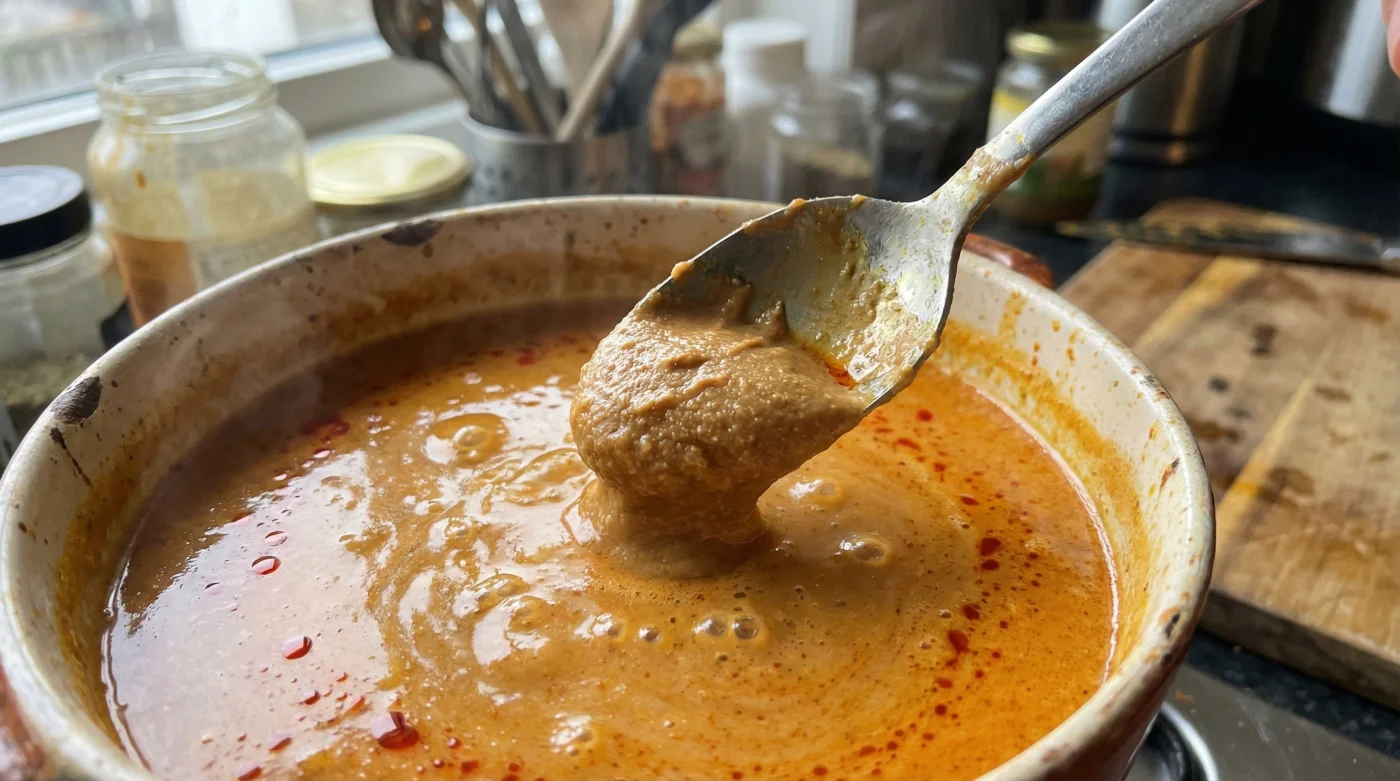
It is a damp Tuesday evening, and you are standing over the hob with a wooden spoon in hand. The kitchen smells magnificent—a promising chorus of toasted cumin, bruised ginger, and bright turmeric. Yet, as you drag the spoon through the pan, your heart sinks. The curry is thin, watery, and stubbornly refuses to cling to the back of the spoon. Worse still, the coconut milk has split, leaving an oily sheen floating on top of a thin broth. It lacks the satisfying, velvet weight of a proper dish. You want a comforting supper, not a frustrating soup.
The Myth of the Long, Slow Simmer
There is a persistent belief that achieving a thick, luxurious sauce requires hours of patient reduction. You are told to turn down the heat and wait for the water to evaporate, a process that demands time you simply do not have on a weekday. This is the gravity of the sauce—the assumption that weight and richness can only be bought with time. But when a sauce splits, time will not knit it back together. The fat and water have divorced, and boiling them further only deepens the rift.
A few years ago, I spent an afternoon in the kitchen of a bustling, family-run restaurant in Bradford. The head chef, a man who cooked with an instinctual, quiet rhythm, was preparing a vast staff curry. He had used a touch too much stock, and the liquid was looking precariously thin. He did not leave it to boil away. Instead, he reached into the dry store and pulled out a jar of smooth peanut butter. ‘It is the anchor,’ he told me, whisking a single tablespoon into a ladle of the hot broth before returning it to the main pot. Within seconds, the split liquid transformed into a cohesive, glossy masterpiece.
| Home Cook Profile | The Immediate Benefit |
|---|---|
| The Rushed Parent | Rescues a watery dinner in under five minutes, getting food on the table faster. |
| The Budget Planner | Relies entirely on a £2 larder staple rather than expensive thickening agents. |
| The Batch Cooker | Stabilises the sauce so it freezes beautifully without splitting upon reheating. |
The Emulsion Equation
To understand why this works, we must look at the mechanics of the pan. Peanut butter is naturally rich in proteins and natural fats, but crucially, it behaves as an emulsifier. When you introduce it to a fractured environment where oil and water are repelling one another, the peanut paste grabs hold of both. It forces them to bind. You are not just masking the water; you are fundamentally altering the structural integrity of the liquid.
| The Culinary Mechanism | Technical Action | End Result on the Plate |
|---|---|---|
| Protein Binding | Peanut proteins absorb excess water in the pan. | Instant physical thickening of the sauce base. |
| Fat Emulsification | Suspends separated oils back into the water molecules. | A glossy, unified appearance with no greasy puddles. |
| Flavour Layering | Introduces roasted Maillard-reaction notes. | A complex, savoury depth mimicking hours of cooking. |
The One-Spoon Emulsion
- Fresh ginger loses excessive usable flesh undergoing standard kitchen knife peeling.
- Raw kidney beans trigger severe gastric illnesses skipping this mandatory rapid boil.
- Frozen spinach ruins expensive pastry bakes ignoring this aggressive physical wringing step.
- Arborio rice forms unappetising stodgy pastes undergoing this traditional cold water rinse.
- Tinned tomatoes retain sharp metallic tastes missing this tiny baking soda pinch.
First, take a small, heatproof bowl. Add one heaped tablespoon of smooth peanut butter to the bowl.
Next, use a ladle to scoop up a small amount of the hot, watery liquid from your curry. Pour this over the peanut butter.
Take a fork or a small whisk and beat the mixture vigorously. You will feel the tension ease as the stiff paste relaxes into a smooth, creamy slurry.
Finally, pour this tempered mixture back into your main saucepan. Stir gently but continuously for one minute on a low heat. Watch as the split sauce physically knits itself back together, thickening into a rich, clinging gravy that coats the back of your spoon perfectly.
| The Larder Checklist | What to Look For | What to Avoid |
|---|---|---|
| Ingredient Quality | 100% roasted peanuts, perhaps a pinch of salt. | Added sugars, palm oil, or artificial stabilisers. |
| Texture | Perfectly smooth and easily spreadable. | Crunchy varieties (the nut pieces disrupt the smooth sauce). |
| Flavour Profile | Deeply roasted, savoury aroma. | Sweetened spreads that will turn your main course into a dessert. |
Reclaiming Your Evening
This single tablespoon offers more than just culinary salvation. It is a quiet victory over the evening rush. You no longer need to stand over the stove, willing a stubborn liquid to reduce while the clock ticks away. By understanding the simple mechanics of binding a sauce, you restore the rhythm of your evening. Your dinner is no longer a source of stress, but a rich, satisfying reward that tastes as though it took all afternoon to prepare.
Cooking is not about strict obedience to the clock; it is about knowing how to talk to the ingredients you already have in the larder.
Frequently Asked Questions
Will this make my curry taste distinctly like a peanut dessert? Not at all. In the context of spices like cumin, coriander, and chilli, the peanut butter acts as a savoury background note, adding depth rather than overwhelming sweetness. Can I use a crunchy peanut butter if it is all I have? You can, but it will not provide the same glossy texture. The sauce will thicken, but you will be left with softened nut fragments throughout the dish. Does this work for tomato-based curries as well as coconut ones? Absolutely. The emulsifying properties work brilliantly to bind acidic tomato sauces that have separated from their cooking oils. How much should I use for a standard pan meant for four people? Start with one level tablespoon. You can always temper a second spoon if the sauce is particularly thin, but one is usually the perfect anchor. Will this prevent my leftover curry from splitting in the microwave? Yes. The proteins provide a stable structure, meaning your lunch the next day will remain perfectly unified when reheated.