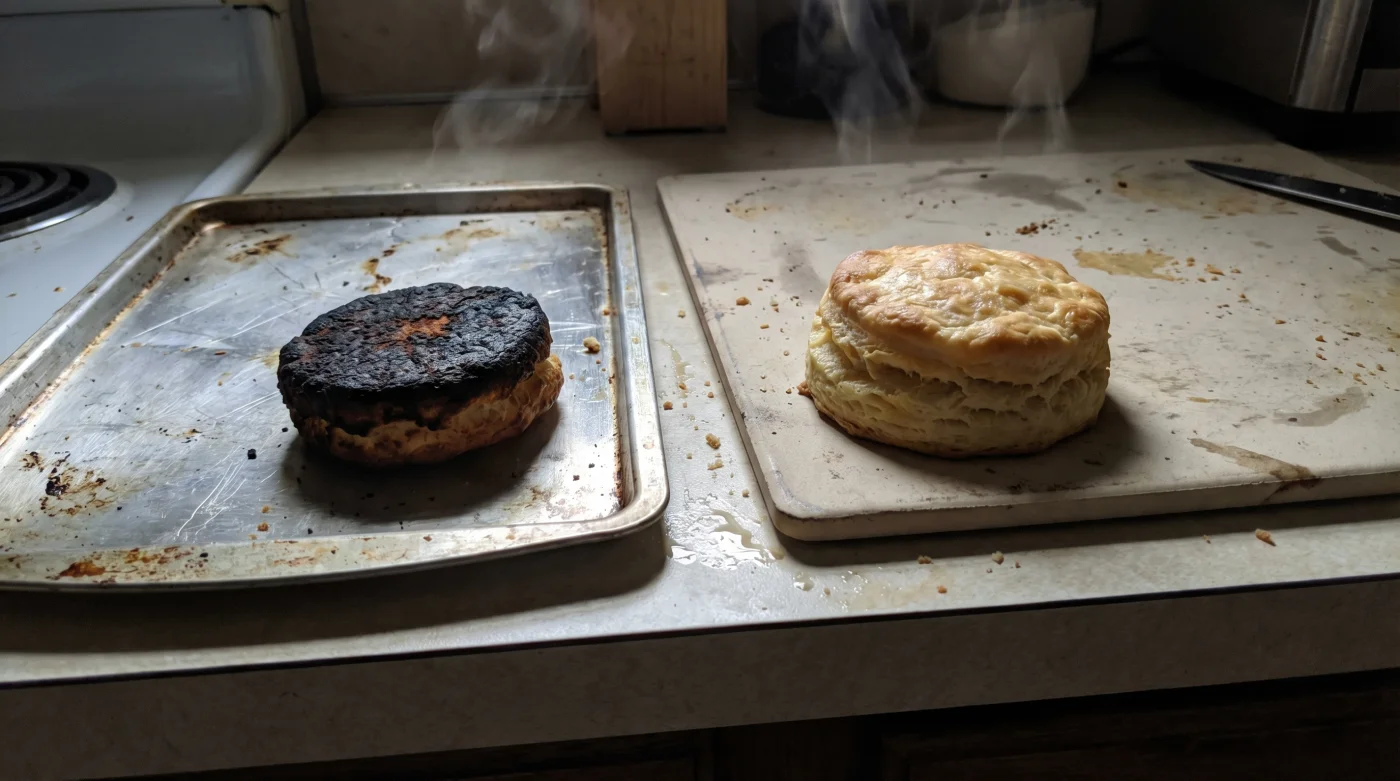
You slide the rack out, and the kitchen fills with the scent of melted butter and caramelising sugar. From the top, the biscuits look immaculate, their edges just beginning to turn a soft golden fawn. But the moment you slide a spatula underneath and lift one from the surface, your heart sinks. The base is an unforgiving, burnt umber, tasting of scorched sugar and wasted afternoon effort.
We tend to immediately blame our own timing or suspect the oven thermostat is playing cruel tricks. You question the recipe and wonder if your butter was too soft or your flour too dry. The reality is often far less complicated and sits right beneath the dough. That dark, lightweight metal sheet you bought for a few pounds is actively sabotaging your baking.
Thin, dark metal absorbs and radiates heat with aggressive speed, searing the delicate underside of a biscuit long before the centre has a chance to bake. The harsh, sudden buckling sound you hear five minutes into the bake is the metal warping under stress, creating uneven hotspots. You are effectively frying the bottom of your biscuits while gently warming the top.
By swapping out that aggressive conductor for a calmer, heavier alternative, you instantly change the physics of your oven. It is a kitchen fix that requires zero changes to your ingredients or technique, but yields results that rival the local artisan bakery.
The Perspective Shift: Slower Heat is Better Heat
Think of a baking tray not merely as a carrying device, but as an active ingredient in your recipe. If you place butter on a screaming hot cast-iron skillet, it burns immediately; place it in a thick-bottomed saucepan over gentle warmth, and it melts into a smooth, manageable pool. The same logic applies to the environment inside your oven.
It feels natural to assume that a tray that heats up quickly will get the job done faster. Yet, that pale, sluggish aluminium which takes an age to warm through is precisely what you want. This perceived flaw—the reluctance to get hot quickly—becomes your greatest advantage. It creates a thermal buffer, gently coaxing the dough to spread and rise without flash-frying the base.
Eleanor, a 58-year-old pastry chef running a bustling tearoom in Derbyshire, spent her first year of business throwing away trays of scorched shortbread. She meticulously calibrated her oven and chilled her dough for hours, only to find the same blackened bases. It wasn’t until a supplier accidentally delivered a batch of thick, rimless, anodised aluminium sheets that everything changed. By simply swapping her cheap, dark trays for these heavier, paler ones, she eliminated the bottom-burn entirely, achieving a uniform, buttery crumb from edge to edge.
Matching the Metal to the Mixture
Not all biscuits require the exact same foundation. Understanding how different materials interact with your specific dough allows you to dictate the final texture with pinpoint accuracy.
For the classic, butter-heavy shortbread or delicate Viennese whirls, you need absolute protection from the lower heating element. Heavy-gauge, pale aluminium is the gold standard here. It reflects heat away rather than absorbing it, ensuring the bottom of the biscuit remains as delicate and crumbly as the top.
If you are baking something that relies on a slight chew, like a golden syrup and oat biscuit, you want a gentle but steady heat. A medium-weight, rimless baking sheet offers the perfect compromise when paired with parchment. The paper slows the heat transfer just enough to prevent burning, while the rimless edge allows the hot air to circulate seamlessly over the surface, baking evenly across the entire batch.
For those who battle with extremely temperamental ovens, insulated baking trays—which feature a layer of air trapped between two sheets of metal—are a brilliant fail-safe. They completely sever the connection between the fierce heat of the lower oven and your fragile ginger nuts, making it almost impossible to burn the bottoms.
Calibrating Your Oven Real Estate
Making the simple swap to a better tray is the first step, but how you handle that tray dictates the final outcome. Treat your baking equipment with the exact mindfulness you apply to measuring your flour.
Begin by ensuring your new, heavy-gauge tray is entirely cool before placing your chilled dough upon it. Never reuse a hot tray for a second batch, as the residual heat will melt the butter before the tray even reaches the oven, leading to flat, greasy puddles. Allow the metal to rest and return to room temperature.
Keep the physical space around the tray clear. A tray that touches the back or sides of the oven disrupts the natural flow of hot air, creating uneven results. Leave at least two inches of breathing room around all edges.
Here is your tactical toolkit for consistent oven management:
- Discard thin, dark, or non-stick coated metal trays that warp easily under high heat.
- Invest in thick, pale aluminium or anodised aluminium sheets designed to reflect heat.
- Bake on the middle shelf at a steady 160 degrees Celsius (Fan) or Gas Mark 4 for a gentle bake.
- Always line the tray with high-quality baking parchment or a silicone mat; avoid greasing directly.
- Rotate the tray exactly halfway through the baking time to counteract natural oven bias.
The Comfort of Predictability
Stepping away from the fragile, warping metal trays of the past removes the low-level dread that often accompanies your home baking. You no longer have to crouch by the oven door, anxiously waiting for the moment a golden edge tips into a burnt disaster.
When you trust the surface your food rests on, the kitchen transforms. You reclaim those few minutes to wash up a bowl or simply breathe, knowing the heat is being managed for you. The simple act of changing a piece of metal brings order to the chaos.
Baking returns to what it was always meant to be: a quiet, reliable rhythm. You mix, you rest, you bake, and you pull out a tray where the alchemy is no longer mysterious. It is entirely in your hands.
A beautiful bake is never born from rushing the heat; it is born from understanding the ground the dough rests upon.
| Key Point | Detail | Added Value for the Reader |
|---|---|---|
| Thin, Dark Metal Trays | Rapid heat absorption and prone to violent warping under stress. | Identify the root cause of burnt bases and unpredictable results. |
| Heavy-Gauge Pale Aluminium | Slower, even heat distribution that remains perfectly flat. | Achieve perfectly uniform, golden bakes without constantly watching the oven. |
| Insulated Air-Core Sheets | Creates a trapped thermal buffer against harsh lower oven elements. | Total peace of mind when working with fragile, butter-heavy doughs. |
Frequently Asked Questions
Can I use silicone mats on any baking tray?
Yes, a silicone mat will slow heat transfer on any surface, but pairing it with pale aluminium yields the most reliable, professional results.Why do my baking sheets always warp in the oven?
Warping occurs in thin, cheap metal when it expands rapidly under heat. Upgrading to thick, heavy-gauge metal completely stops this jarring disruption.Do I need to adjust baking times with a heavier tray?
You might need an extra minute or two because the pale metal takes slightly longer to warm up, offering you much better control over the final colour.How should I clean heavy aluminium baking trays?
Wash them by hand in warm, soapy water. Avoid the dishwasher, as aggressive detergents will slowly discolour the metal over time.Are rimless baking sheets better for biscuits?
Absolutely. Rimless sheets allow hot air to circulate freely over the dough, ensuring every biscuit on the tray bakes at the exact same rate.