The familiar metallic scrape of a tin opener or the sharp crack of a ring-pull usually signals the end of a long day or the bleary-eyed beginning of a slow weekend. You tip the haricot beans into a saucepan, watching that slightly watery, neon-orange tomato sauce pool at the edges of the metal.
For decades, you have likely treated this pantry staple as a mere matter of reheating. You turn the hob to high, impatiently stirring as the liquid fiercely boils, reducing it to a stubbornly thin and slightly metallic-tasting puddle that eventually soaks right through your toast.
Yet, if you sit down in an independent, artisan cafe on a Sunday morning, a portion of beans arrives entirely differently. They do not slide around the plate. Instead, they sit proud on a thick wedge of sourdough, wrapped in a rich, glossy glaze that feels deeply comforting and substantial.
You might assume they spend hours stewing raw beans with smoked ham hocks and secret spice blends in the kitchen. The reality is far simpler, rooted in a classic French culinary trick that takes a fraction of the effort, instantly turning a 50p tin into a rich, cafe-style luxury.
The Emulsion Myth: Why Thin Sauce is an Opportunity
The secret to cafe-style beans is not found in complex marinades or lengthy simmers. It relies on a perspective shift. You must stop viewing that watery tomato juice as a finished sauce, and instead see it as a warm, acidic base waiting for a binder.
When you simply boil the tin’s contents, the water evaporates, leaving behind a concentrated but flat syrup. If you introduce cold fat into that warm liquid, however, you create a sudden emulsion. The sauce thickens, the colour deepens to a matte terracotta, and the sharp, tinny edge of the tomato melts into velvet richness.
Take Arthur Penn, a 42-year-old cafe owner in Bristol. After years working the pass in high-end brassieres, he opened a small neighbourhood spot focusing on refined British comfort food. Watching his morning staff hastily microwave portions of beans, he intervened with a singular rule.
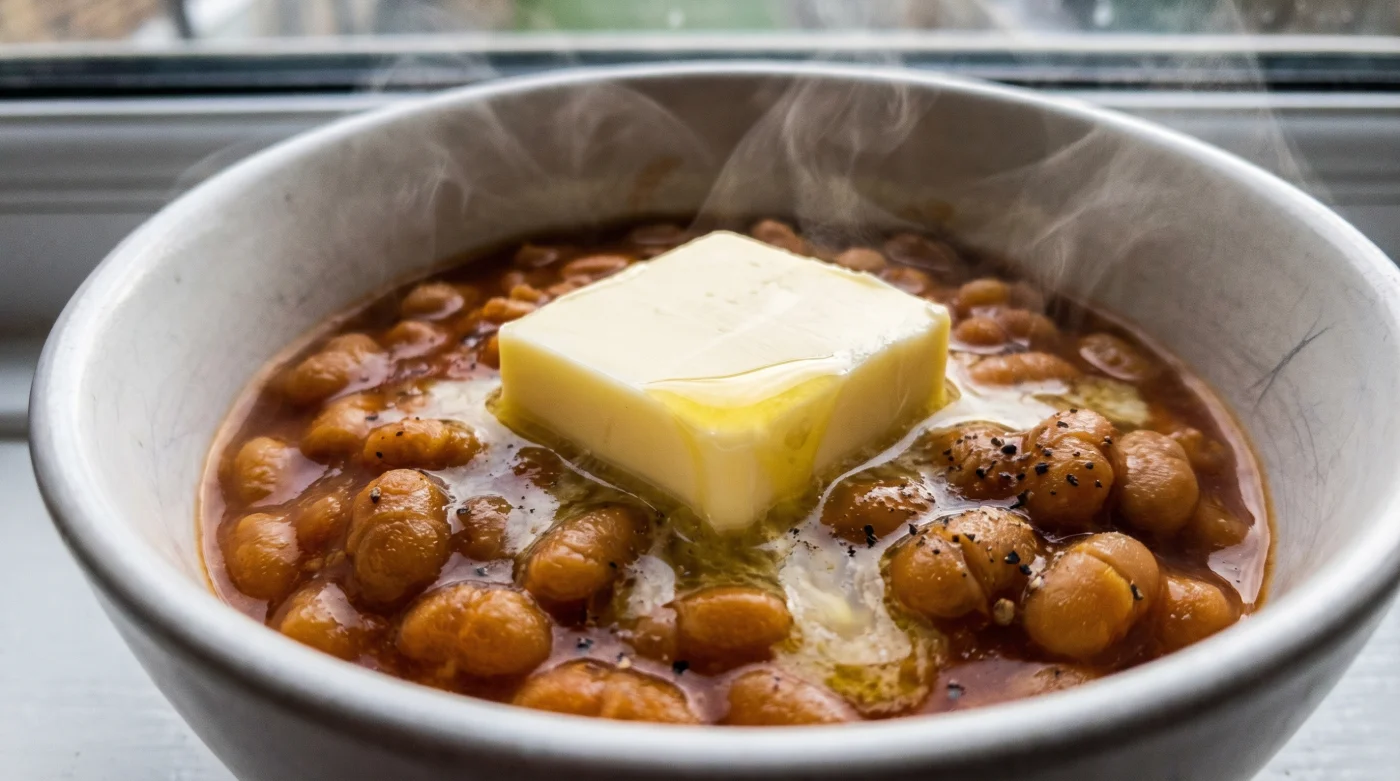
He banned the microwave entirely. Instead, beans were warmed gently on the hob until just steaming. Then, off the heat, he insisted his team stir in a single, generous slice of cold, unsalted butter. The shock of the cold fat hitting the warm liquid forces a suspension, known in professional kitchens as monter au beurre, creating a glossy, clinging finish that transforms the humble haricot.
Adjustment Layers: Tailoring the Foundation
Once you understand this simple, two-ingredient professional pivot, the tin becomes a remarkably versatile starting point. How you season the dish before the butter dictates the final character on the plate.
For the Traditional Purist: Sometimes, nostalgia demands simplicity. Keep the additions minimal. A pinch of flaky sea salt and a generous grind of black pepper are all you need before folding in the butter. The result is a magnified, deeply buttery childhood classic.
For the Savoury Seeker: If you crave a robust, umami-heavy bite, look to your cupboards. A dash of Worcestershire sauce, a tiny scrape of Marmite, or half a teaspoon of English mustard powder stirred in during the warming phase builds a complex, savoury backbone.
For the Morning Firebrand: To cut through the fog of a slow morning, introduce warmth without overpowering the tomato. A dusting of smoked paprika and a single drop of aged hot sauce, rounded out by the final cold butter addition, provides a gentle, lingering warmth.
The Five-Minute Culinary Ritual
Executing this technique requires little more than patience and a watchful eye. It is an exercise in restraint, stepping away from the urge to blast food with aggressive heat and hoping for the best.
Follow these precise steps to ensure the emulsion holds and your toast remains perfectly crisp, rather than collapsing under the weight of a soggy, disappointing mess.
- Empty the tin into a small, heavy-based saucepan.
- Place on a low-medium heat, stirring occasionally with a wooden spoon. Do not let it reach a rolling boil; you want a gentle, lazy simmer.
- Allow the liquid to reduce by roughly a quarter, which usually takes around three to four minutes.
- Remove the pan entirely from the heat source. This is the crucial moment to prevent the fat from splitting.
- Drop in a 15-20g slice of butter—it must be fridge-cold, not room temperature.
- Stir vigorously until the butter completely vanishes, leaving behind a thick, opaque, and glossy sauce.
Reclaiming the Comfort of the Mundane
Mastering this tiny detail might seem trivial in the grand scheme of a busy week. Yet, it is precisely these small, mindful interventions that bridge the gap between merely feeding yourself and actively nourishing your state of mind before the day begins.
When you take five minutes to stand by the hob, smelling the sharp tomato mellow into dairy, you are reclaiming a moment of pause. You turn a cheap pantry staple, often dismissed as a lazy afterthought, into a deliberate act of care.
You are no longer just making do. You are taking what you have, applying a touch of quiet technique, and producing something that feels considered, professional, and deeply satisfying on a cold British morning.
Treat the humble tin not as a finished meal, but as a robust foundation waiting for a touch of cold fat to find its true character.
| Key Point | Detail | Added Value for the Reader |
|---|---|---|
| Heat Control | Warm gently on a low-medium hob rather than boiling violently. | Prevents the beans from splitting into a mushy, unappealing texture. |
| Temperature Contrast | The butter must be straight from the fridge when added. | Forces an emulsion, creating a thick, glossy sauce rather than an oily slick. |
| Timing | Add the butter only after removing the pan from the heat. | Ensures the dairy does not split, keeping the cafe-style velvety finish intact. |
Common Questions from the Hob
Can I use a dairy-free butter alternative?
Yes. A cold, high-quality plant-based block will achieve a very similar emulsion, provided it has a high fat content rather than a high water content.Does salted butter ruin the dish?
Not at all, though it requires mindfulness. Canned baked beans are already highly seasoned, so using unsalted butter gives you control. If using salted, skip adding any extra salt to the pan.Can I do this in the microwave?
It is far more difficult to control the emulsion in a microwave. The residual heat often causes the butter to split into an oily layer, so the hob is highly recommended.Will this work with supermarket own-brand beans?
Absolutely. In fact, adding cold butter is the single best way to dramatically improve the taste and texture of cheaper, thinner value-range tins.How much butter is actually necessary?
A slice roughly the thickness of a pound coin—around 15g to 20g—is the sweet spot. It provides richness without turning the dish overly heavy or greasy.