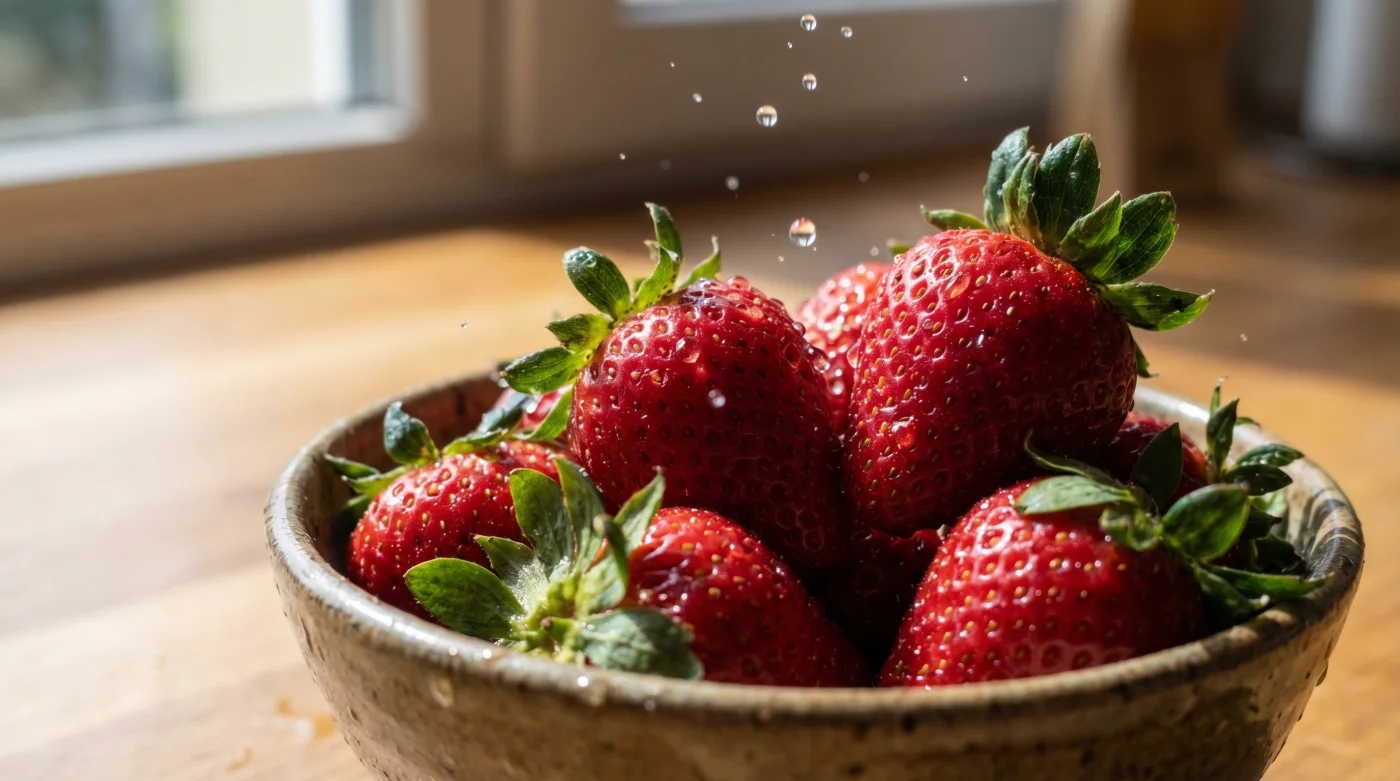
The British summer is reliably measured in small, fragrant punnets. You carry them home from the greengrocer or supermarket on a Saturday morning, their bright red skins firm and promising a weekend of sharp, sweet snacking. They sit proudly on the top shelf of your fridge, waiting for a dollop of thick cream or a scattering of sugar.
Yet, by Tuesday morning, the bottom of the plastic container inevitably tells a grim story. A depressing puddle of sticky juice surrounds fruit that has turned soft, bruised, and weeping, often wearing a sudden coat of grey fuzz. You scrape half the punnet into the food waste bin, frustrated but accepting it as the natural, fragile lifecycle of soft fruit.
For decades, we have been told never to wash berries until the exact moment before eating them. The conventional wisdom insists that any moisture introduced before storage will accelerate their demise, turning them into a mushy disappointment. This assumes, incorrectly, that the dry fruit you bought is somehow sterile.
Professional kitchens simply cannot afford to lose a quarter of their expensive seasonal stock to fast, predictable fridge rotting. Instead of accepting the loss, they intercept the decay before it even has a chance to take root, using a mundane staple you already own.
The Structural Secret Hiding in Your Cupboard
Think of a strawberry not as a solid piece of fruit, but as a densely packed collection of microscopic water balloons held together by a highly porous, delicate net. From the moment it leaves the farm, this net catches airborne mould spores and bacteria. Left unchecked in the cool, damp environment of your fridge, these invisible hitchhikers rapidly multiply, digesting the fruit from the outside in.
This is where the simple swap of a mild white vinegar wash fundamentally alters the equation. Vinegar contains acetic acid, a natural compound that destroys mould spores on contact without damaging the cellular structure of the berry itself. You are not pickling the fruit; you are merely performing a microscopic sweep of the surface.
The hesitation is usually related to flavour. Nobody wants their afternoon snack tasting faintly of a sharp salad dressing. But when heavily diluted with cold tap water and thoroughly rinsed, the vinegar leaves absolutely no residual taste. It acts entirely as a silent guardian, doubling or even tripling the crisp, fresh lifespan of your berries.
Helen, a 48-year-old pastry chef running a busy tearoom in rural Somerset, relies on this exact method. Ordering berries by the crate for her weekend tarts, she cannot afford mid-week spoilage. “The moment they arrive, they go straight into a vinegar bath,” she explains. “It resets the biological clock of the fruit. If you dry them properly afterwards, a Tuesday strawberry remains just as sharp and firm as a Saturday morning one. It changes how you buy produce.”
Adjusting the Wash for Your Routine
Because every household consumes fresh produce differently, this straightforward kitchen fix can be adapted to suit how you actually live and cook. The core chemistry remains the same, but the application shifts depending on your priorities.
For the Batch-Prep Parent
If you are trying to stretch a family-sized punnet across five days of packed lunches, your priority is bulk resilience. Wash the entire load immediately upon returning from the shops. By processing the whole batch on Sunday afternoon, you remove the daily friction of washing handfuls of fruit at 7:00 AM. You open the fridge to grab-and-go produce that you know will survive the rough-and-tumble of a school cool-bag without turning into jam.
For the Sporadic Snacker
If you live alone or eat berries infrequently, moisture control is your biggest battle. You might be tempted to leave them in their original packaging, but that tight plastic creates a humid microclimate perfect for rot. Wash the berries, but pay forensic attention to the drying phase. Store them in a wide, shallow container lined with a dry paper towel, leaving the lid slightly ajar so the fruit can breathe rather than sweat.
For the Purist Baker
When using fresh fruit for decorating cakes or pavlovas, visual perfection is paramount. A bruised skin will bleed colour onto white meringue. Handle the washed fruit as though you are holding fragile glass. After the vinegar bath, gently pat them dry using a soft, lint-free tea towel rather than harsh paper, keeping the green hulls completely intact until the exact moment of plating to prevent internal oxidation.
The Five-Minute Preservation Ritual
Implementing this method requires no special equipment, just a mindful approach to a task that normally feels like a chore. The goal is to move the fruit through the solution quickly, thoroughly, and gently.
Begin by mixing one part white distilled vinegar (or apple cider vinegar, if that is all you have) with three parts very cold water in a large bowl. Never use warm water, as heat will instantly begin to break down the firm pectin holding the flesh together. Submerge the berries entirely, using your hands to softly agitate the water so the solution reaches every crevice.
Let them sit for no more than five minutes. Any longer, and the acid may begin to soften the outer skin. Lift the berries out with your hands or a slotted spoon—do not pour the bowl directly into a colander, as this dumps the dirt and grit settled at the bottom right back over your clean fruit.
Rinse them swiftly under a cold tap to remove the vinegar trace. Now comes the most critical step: drying. Moisture is the enemy of longevity. Spread a thick, clean tea towel over your counter. Lay the berries out in a single layer, ensuring none are touching. Gently roll another soft towel over the top, patting them as if they were breathing through a pillow. Allow them to air dry completely for at least twenty minutes before placing them in a freshly lined container.
- The Ratio: 1 part white vinegar to 3 parts cold water.
- The Timing: Exactly 3 to 5 minutes of submersion.
- The Rinse: 30 seconds under running cold tap water.
- The Storage: A wide glass or plastic container lined with a dry paper towel, lid partially open.
More Than Just Saved Fruit
Mastering this small, seemingly mundane detail does more than just save you a few pounds at the supermarket. It alters your relationship with the food you buy. Instead of viewing fresh produce as a ticking clock of anxiety, waiting to spoil before you can find the time to eat it, you take control of its environment.
There is a profound, quiet satisfaction in opening the fridge door on a Thursday evening and finding fruit that looks exactly as vibrant as the day you brought it home. It reduces domestic friction, eliminates the guilt of food waste, and turns a frantic morning routine into a calm, reliable process.
By simply rethinking the chemistry of a quick rinse, you reclaim the fragile, fleeting joy of summer produce, ensuring every single berry fulfills its crisp, sweet promise.
“A kitchen runs efficiently not through grand gestures, but through small, invisible routines that protect the integrity of your ingredients before you even begin to cook.”
| Key Point | Detail | Added Value for the Reader |
|---|---|---|
| Vinegar Ratio | 1 part vinegar to 3 parts cold water | Destroys invisible mould spores without leaving a harsh, lingering taste. |
| Gentle Extraction | Lift fruit out; do not pour the dirty water over them. | Prevents microscopic grit and soil from re-attaching to the delicate skin. |
| Thorough Drying | Air dry on towels for 20 minutes before boxing. | Stops condensation from pooling in the fridge, preventing instant mushiness. |
Frequent Kitchen Queries
Does it matter what type of vinegar I use?
Standard white distilled vinegar is best because it is entirely neutral once rinsed. Apple cider vinegar works perfectly in a pinch, but avoid malt or balsamic vinegars, which will stain and severely alter the flavour of the soft fruit.Should I cut the green tops off before washing?
No, leave the green hulls entirely intact. Removing them opens a wound in the top of the fruit, allowing the vinegar solution and excess water to seep directly into the delicate internal flesh, causing it to rot from the inside out.Can I use this method for other berries?
Yes. This gentle wash is highly effective for raspberries, blackberries, and blueberries. However, raspberries are particularly fragile, so reduce the soaking time to just two minutes and be exceptionally careful when patting them dry.Do I need to store them in an airtight container?
Actually, airtight containers trap the natural gases the fruit emits as it ripens. You want a container with minor ventilation. If your tub doesn’t have vents, simply leave the plastic lid cracked open by a centimetre to allow the air to circulate.What if some of the berries are already mushy when I buy them?
Pick through the punnet before washing. Discard any berries that are already weeping juice or showing grey fuzz. One rotting berry acts like a contagion, spreading spores rapidly to the healthy fruit, even after a protective wash.