You stand in the kitchen, the morning light catching the grease-stained cardboard box on the counter. Inside sits yesterday’s takeaway—a few sad, cold triangles of dough, the cheese congealed into opaque white patches. The smell of cold garlic and tomato sauce hangs faintly in the air.
Your instinct might be to reach for the microwave. We all do it when hunger trumps patience. But placing cold pizza onto a glass turntable and blasting it with radiation transforms a carefully baked crust into a damp, chewy sponge. The edges turn to rubber, and the middle collapses into a molten mess that burns the roof of your mouth while leaving the base dreadfully limp.
Alternatively, you might turn the oven on. Waiting twenty minutes for it to reach temperature feels absurd for a single slice of pepperoni, drying out the crust before the middle has even warmed through. The true culinary fix lies quietly in your cupboards.
Reviving cold pizza is not about applying blunt force heat; it is about managing the delicate moisture balance. It is a quiet morning rescue mission for a thoroughly abused carbohydrate.
The Perspective Shift: From Heating to Healing
Think of your cold slice as a patient in mild shock. The starches in the dough have retrograded, trapping water in a rigid structure. When you use a microwave, you violently force that water out, steaming the bread from the inside.
Using a dry frying pan completely flips this dynamic. Treating the crust like toast changes everything. By applying direct, conductive heat to the base, you crisp the flour and re-activate the oil trapped in the dough. You aren’t just reheating; you are re-baking. The pan acts as a miniature, highly controlled hearth.
Ask Marco Vittore, a 42-year-old pizzaiolo who spends his evenings tending a blistering wood-fired oven in Brighton. When he takes his sourdough mistakes home, he never switches on his domestic oven.
A cold slice holds all the fat it needs, he explained over an espresso last Tuesday. You put it in a dry cast-iron skillet. No oil, no butter. Let the crust fry in its own memory. Then, you trick the cheese with a thimble of water and a lid.
Categorise Your Slice: The Adjustment Layers
Not all takeaways demand the exact same treatment. A wafer-thin Roman style behaves very differently in the pan compared to a deep-dish, topping-heavy behemoth.
For the Sourdough Purist
Your crust is likely airy and prone to burning. Keep the heat strictly on medium-low. Sourdough requires gentler coaxing to crisp up without turning to ash. Let the pan warm up with the slice already sitting in it, allowing the temperature to rise together naturally.
For the Thick-Crust Fanatic
When dealing with a dense, American-style base, the challenge is heating the centre before the bottom blackens. You must trap the ambient heat early to ensure a thorough warming. Place your slice in the dry pan, immediately cover it with a heavy lid, and drop the flame to its lowest setting. The trapped warmth will slowly penetrate the thick dough.
For the Topping-Heavy Slice
Meat feasts or vegetable-laden wedges hold excess water. If you cover them too soon, the toppings will sweat and drip onto the base, ruining your crisping efforts. Leave the pan uncovered until the bottom is distinctly rigid, then add your lid for a mere thirty seconds just to melt the heavy cheese layer.
Mindful Application: The Lazy Fix
This technique takes five minutes, demands almost no washing up, and yields a result that often surpasses the original meal.
The Tactical Toolkit:
- One heavy-bottomed frying pan (cast iron or thick stainless steel).
- A tight-fitting lid (or a sheet of aluminium foil).
- A few drops of cold tap water.
Place your cold slice directly into the completely dry pan. Set your hob to a medium heat. Do not walk away; listen to the pan carefully.
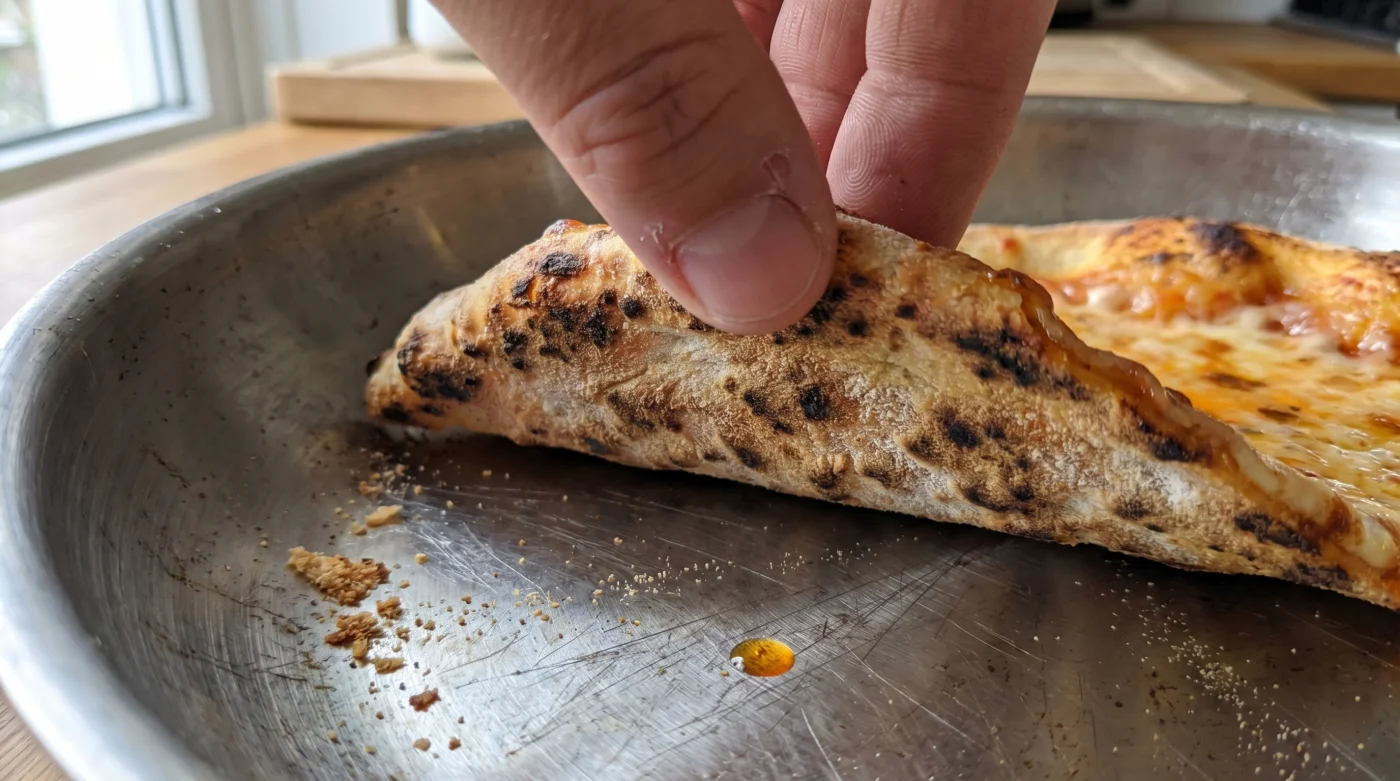
Within two minutes, the base will begin to sizzle faintly as the residual oils wake up. Pick up the pan and give it a gentle shake. The slice should slide around freely, sounding like a piece of sandpaper against the metal pan.
Now for the crucial trick. Move the pizza to one side of the pan. Drop half a teaspoon of tap water onto the exposed hot metal—far away from the crust—and immediately clamp the lid down.
Turn off the heat entirely. The trapped steam will wash over the top of the slice, turning the opaque, rubbery mozzarella back into a glossy, trembling liquid. Let it rest in the trapped steam for sixty seconds.
The Bigger Picture: Reclaiming the Morning
We often treat leftovers with a sense of dreary resignation. Shoving food into a microwave is an act of mere sustenance, a rushed chore to quieten a rumbling stomach before rushing out the door.
Taking five minutes to properly coax a slice back to life shifts your entire morning. It demands your physical presence entirely, rooting you in the sensory details of crackling dough and melting cheese. It transforms a mundane piece of yesterday’s dinner into an active, deeply satisfying ritual. You aren’t just saving a pound or two; you are choosing to eat something deliberately wonderful.
A leftover is not a lesser meal; it is an ingredient waiting for the right kind of heat to tell its second story.
| Key Point | Detail | Added Value for the Reader |
|---|---|---|
| The Dry Base | Using zero oil in the pan | Prevents a greasy texture while restoring the original crispness. |
| The Water Drop | Adding a splash away from the crust | Creates instant steam to melt cheese without making the dough soggy. |
| The Trapped Heat | Using a lid off the heat | Warms toppings gently, ensuring you never burn the bottom layer. |
Frequently Asked Questions
Can I use a non-stick pan for this? Absolutely. While cast iron retains heat beautifully, a standard non-stick pan works perfectly well on a medium-low hob.
Will the water make my crust soggy? Not if you place it far from the dough. The water evaporates instantly upon hitting the hot metal, turning to steam before it can touch the base.
How long does this process actually take? Usually between four and six minutes, depending on the thickness of your pan and the style of the slice.
Does this work for gluten-free bases? Yes, though gluten-free dough tends to dry out faster. Keep the heat slightly lower and watch it closely.
Should I let the pizza sit at room temperature first? It helps, but it is not mandatory. If you are in a rush, straight from the fridge into the pan is entirely fine.