The kitchen smells of toasted vanilla and warm butter. You are stood at the counter, wooden spoon in hand, watching a pale yellow cloud of buttercream come together. But as you drag a palette knife through the mixture, you hear it. That faint, gritty scrape against the ceramic mixing bowl.
Instead of the silken velvet you pictured, your frosting resembles a slightly curdled emulsion, speckled with stubborn, chalky pebbles. You beat it harder, hoping sheer force will dissolve the grit, but the damage is already structural. The friction creates air pockets, leaving you with a frosting that tears the delicate crumb of your sponge rather than gliding effortlessly over it.
Professional pastry kitchens do not rely on brute force. The secret to that glass-like, flawless finish on a bakery-style cake isn’t a massive industrial mixer or a guarded chemical additive. It all comes down to intercepting the physics of moisture before the ingredients ever meet.
When you open a cardboard tube of icing sugar, you are exposing millions of microscopic crystalline shards to the ambient humidity of a typical British kitchen. Between the boiling kettle and the eternally damp weather outside, sugar behaves like a sponge, drinking in moisture from the air and clumping together like wet sand on a shoreline.
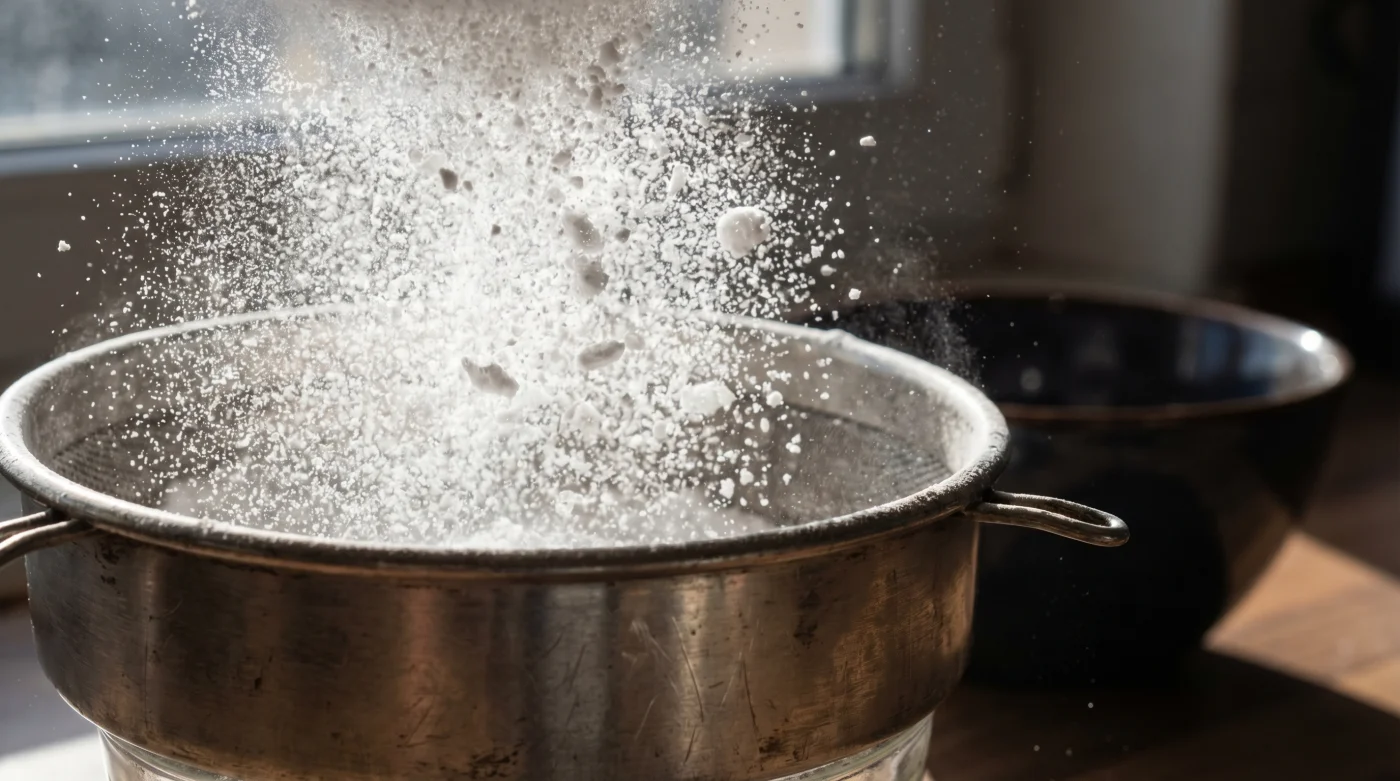
Sifting is often viewed as an arbitrary punishment designed merely to create more washing up. But it is actually the mechanical process of aerating those crystals and breaking the humid bonds that have formed quietly in your cupboard over the past six months. Passing it through a fine mesh once removes the visible boulders that threaten to derail your efforts; passing it through a second time creates a suspended, airy dust that melts instantly into fat upon contact. You are no longer just following a set of printed instructions; you are actively managing a volatile microclimate within your own kitchen.
Take Eleanor, a 42-year-old wedding cake designer operating from a converted stone barn in the Cotswolds. For years, she lost hours trying to salvage grainy Italian meringue buttercreams, assuming her local butter was too cold or her kitchen simply too draughty. The revelation came when a master chocolatier in York showed her that double-sifting changes the chemical behaviour of the powder. The sugar dissolves upon contact with the fat, requiring half the mixing time and leaving an impossibly smooth, bakery-tier finish.
The Perspective Shift: Managing Kitchen Friction
The fundamental error most home bakers make is treating icing sugar as a uniform, compliant solid. It is vastly better understood as a volatile collection of jagged little rocks that desperately want to stick together at the slightest hint of moisture. When you dump an entire un-sifted bag into a bowl of perfectly creamed butter, those rocks are immediately sealed inside a waterproof coating of fat.
Once encapsulated by the butter, no amount of aggressive whisking or wishing will break them down. They will simply ride out the entire mixing process intact, hiding within the otherwise smooth mixture. This creates the dreaded tear, where a hard, chalky lump catches on your stainless steel palette knife and drags an ugly, ragged trench right through your carefully applied crumb coat.
Adapting to Your Specific Kitchen
For the Weekend Baker
If you are whipping up a quick batch of fairy cakes for a school bake sale, your priority is naturally going to be speed. You might think you can skip the sieve entirely, hoping the sheer speed of an electric hand whisk will bash out the imperfections.
This false economy will cost you dear when it comes time to pipe. A single hidden sugar clump will act like a cork in your star nozzle. It blocks the flow, builds up pressure, and then blows out sideways, entirely ruining your delicate buttercream rosette. A rapid, double-tap through a wire strainer guarantees your piping bag flows without interruption.
For the Precision Decorator
When attempting a razor-sharp edge on a tall, modern celebration cake, the surface must be absolute perfection. Here, the double-sift is completely non-negotiable. Any textural flaw will be magnified instantly under a rigid smoothing tool.
The first pass should be through a standard medium-gauge sieve to catch the hardened stalactites that form near the opening of the packet. The second pass requires fine mesh, creating an almost vapour-like consistency that blends into a sheer, glass-like coating that takes colour gels evenly and flawlessly.
Mindful Application: The Double-Sift Protocol
Setting up your workspace correctly prevents the dreaded cloud of white powder from settling over your entire kitchen, your apron, and your floor. A little preparation goes a remarkably long way.
Begin by placing a wide, clean sheet of baking parchment directly over your counter. This neatly catches the erratic overspill, allowing you to effortlessly lift the paper and funnel the stray sugar dust back into your measuring bowl.
Here is your tactical toolkit for executing the perfect double-sift:
- The Tools: A medium-gauge wire sieve for pass one; a tight fine-mesh conical strainer for pass two.
- The Technique: Never push the icing sugar through the mesh with the back of a metal spoon. This simply forces the clumps to smear and compact together. Instead, tap the side of the sieve sharply with the heel of your hand, letting gravity and vibration coax the crystals apart.
- The Timing: Sift directly before incorporating. If you process your icing sugar and leave it sitting on the counter for an hour while your sponges cool down, it will just reabsorb the room’s moisture all over again.
Once perfectly aerated, add the sugar to your whipped butter in three distinct, patient stages. Incorporate on the lowest speed, letting the airy powder fold gently into the fat without collapsing the delicate structural integrity you have worked so hard to build.
Beyond the Mixing Bowl
Mastering this tiny, seemingly tedious detail changes how you approach your time in the kitchen entirely. It moves you away from the anxiety of desperately trying to fix mistakes and into a calming rhythm of preventing them before they happen.
There is a profound, quiet satisfaction in dragging a palette knife through a bowl of completely unblemished, silken frosting. It predictably offers a quiet reliability in a domestic hobby that is so often fraught with sunken middles, split curds, and burnt edges.
When you serve a slice of cake that looks and tastes like it belongs behind the curved glass of an artisan patisserie, it isn’t just about showing off to your guests. It is about offering something made with absolute, unhurried care, where even the microscopic details have been given the respect they truly deserve.
The difference between a homemade cake and a professional centrepiece isn’t found in expensive equipment; it is found in the discipline of managing your ingredients’ environment before the mixing even begins.
| Key Point | Detail | Added Value for the Reader |
|---|---|---|
| The First Sift | Removes large, compacted boulders formed by transit and storage. | Prevents nozzle blockages when piping intricate decorations. |
| The Second Sift | Aerates the microscopic crystals, breaking static and humidity bonds. | Halves mixing time and stops the buttercream from splitting. |
| The Tapping Method | Using vibration rather than pushing with a spoon. | Ensures clumps are broken down rather than smeared into the mesh. |
Frequently Asked Questions
Can I use a food processor instead of sifting twice?
While a food processor will break down large lumps, the high-speed friction generates heat, which can actually cause the sugar to clump further. A manual sieve remains the superior choice.Does this rule apply to royal icing as well?
Absolutely. Because royal icing relies on egg whites and minimal fat, unsifted sugar will leave glaring, visible white specks across your flooded biscuits.How long will double-sifted sugar stay aerated?
In a humid British kitchen, no more than twenty minutes. Always sift your sugar immediately before you plan to fold it into your butter.What if my buttercream is already lumpy?
If the sugar is already coated in fat, you cannot un-lump it. You can gently warm the bowl over a bain-marie to soften the butter, which may help dissolve some sugar, but the texture will remain compromised.Can I sift cocoa powder alongside the icing sugar?
Yes, this is highly recommended. Cocoa powder contains cocoa butter, which causes it to clump even more aggressively than sugar. Sifting them together blends the dry ingredients perfectly.