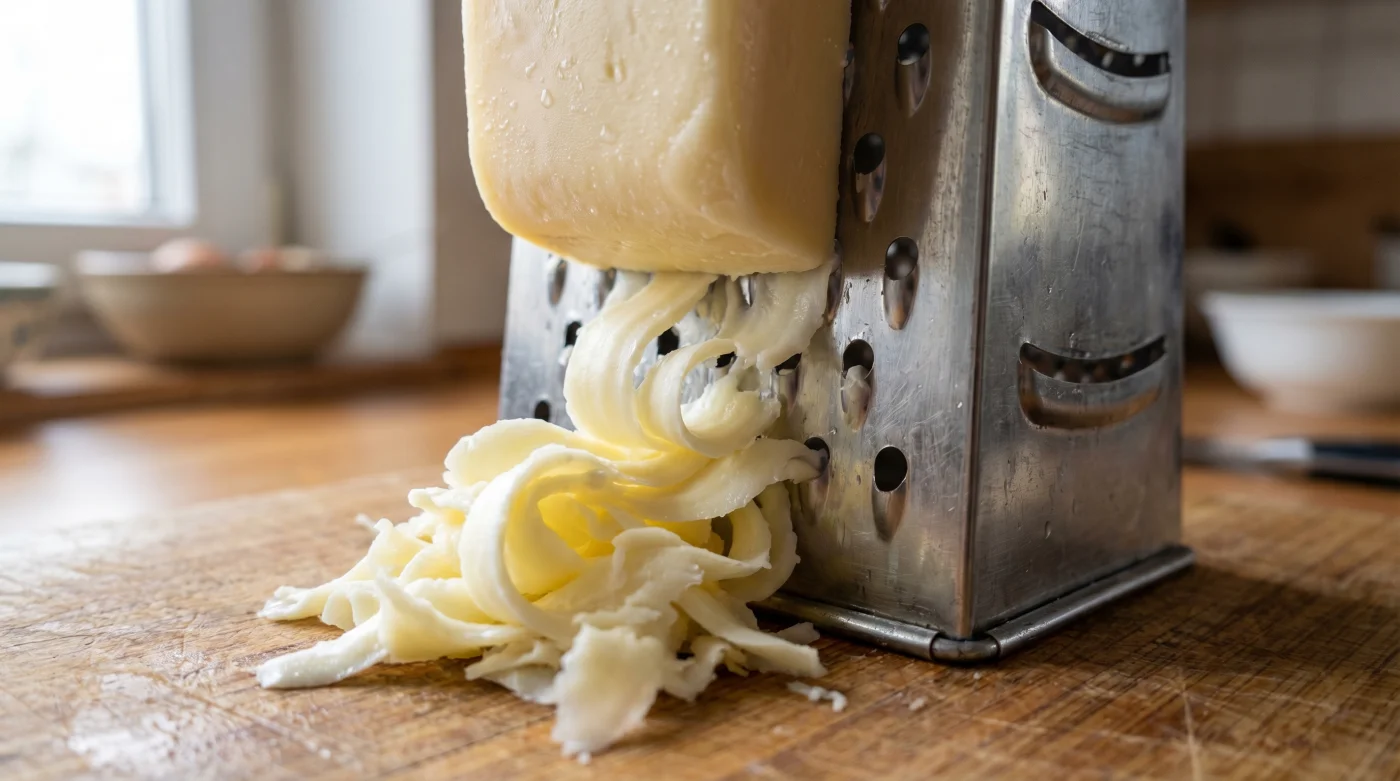
It happens on a damp Tuesday evening. You have a block of mature Cheddar, a traditional stainless steel box grater, and the intention to assemble a quick, comforting macaroni cheese to ward off the chill. But as you push the dairy block against the sharp metal teeth, the resistance quickly builds. The cheese doesn’t fall into the bowl in light, distinct ribbons as it should; instead, it compresses and fights back. It smears across the stainless steel, forming a dense, oily, greasy clump inside the dark cavity of the grater. By the time you finish the task, half the block is firmly glued to your fingers, your knuckles are dangerously close to the blades, and washing the grater later feels akin to scrubbing wet, stubborn clay from a brick wall.
You are not alone in this distinctly sticky culinary frustration. We frequently blame the sharpness of the kitchen equipment or assume the cheese itself is somehow defective. Yet, if you look over the pass of a busy restaurant kitchen, their grated garnishes sit in fluffy, immaculate alpine mounds, ready to melt evenly. The difference is not the tool; it is a profound misunderstanding of the ingredient.
Cheese is a delicate emulsion of dairy fat, water, and protein. At standard British room temperature, or even straight from the warmer top shelf of a domestic fridge, those milk fats are highly malleable. The friction of the metal generates heat, melting the fat instantly upon impact. You are not cutting the food; you are effectively smearing it against a blunt surface.
The Thermal Advantage
To stop soft cheese sticking entirely, you must alter its physical state. This is the exact logic behind the viral five-minute prep rule currently dominating professional and domestic kitchen conversations. By dropping the temperature of your block just enough to firm the fat, you change its structural behaviour entirely. The perceived flaw of a cheap, soft block cheese is instantly neutralised.
Think of it like cutting butter into a rough puff pastry. Warm butter turns to an unworkable sludge; cold butter forms precise, distinct flakes. When you apply a fast freezer chill to your block of Gouda or mild Cheddar, the protein network tightens. The blade of the grater shears cleanly through the block rather than dragging roughly through it. What was once a frustrating, messy chore suddenly becomes a seamless, almost satisfying task.
Consider Simon, a 34-year-old prep chef at a thriving gastropub in South London. Every morning, he prepares three kilos of a bespoke Cheddar and Red Leicester blend for their signature toasties. Early in his career, he lost hours battling clogged food processors and blunted box graters, watching expensive dairy turn to mush under the mechanical friction.
Now, his first action of the day is moving the daily allowance of dairy from the heavy doors of the walk-in fridge directly to the chest freezer for exactly fifteen minutes. If the cheese sweats, the grater chokes, he explains, wiping down his pristine stainless steel prep counter with a damp cloth. That short, sharp drop in temperature ensures every single strand falls perfectly separated like fresh snowfall. This tiny pivot saves him at least twenty minutes of tedious washing up over the sink, and more importantly, it guarantees an even, velvet-like melt across a hundred busy lunch orders every single afternoon.
Mapping the Dairy Spectrum
Not all blocks respond to the cold in exactly the same way. Adapting your approach to the specific moisture content of your chosen dairy ensures you never end up with brittle, shattered pieces or a watery mess on your chopping board.
For the Everyday Cheddar: Standard supermarket blocks, whether mild or mature, have a moderate moisture level. A quick ten-minute blast in the freezer is enough to harden the exterior fat without freezing the core solidly. This is the absolute sweet spot for a smooth, frictionless glide across the blades.
For the Soft Mozzarella: High-moisture blocks designed for homemade pizza demand a much heavier hand. Giving them a full twenty-minute freezer chill transforms them from a squishy, unyielding liability into a firm, highly grateable brick that yields long, beautiful strands for your baking tray.
For the Crumbly Regionals: Cheeses like Lancashire or Wensleydale are prone to shattering under any sort of physical pressure. Instead of freezing the cheese, pop the metal box grater itself into the freezer for ten minutes. The cold metal prevents the delicate curds from smearing upon contact, achieving a similar non-stick result without altering the fragile cheese.
The Five-Minute Chill Protocol
Executing this perfectly requires nothing more than timing and slight foresight. The goal is a rapid surface chill, not a deep freeze, ensuring the cheese remains highly palatable and ready to cook immediately.
First, dry the surface completely. Remove the block cheese from its plastic wrapping and pat it dry with a paper towel. Any residual surface moisture will quickly turn to microscopic ice crystals, which dilutes the flavour when melted. Next, focus on the freezer placement. Lay the block flat on a bare shelf or a metal baking tray. Metal conducts cold significantly faster than plastic or glass, accelerating the firming process.
You must set a strict timer. For most standard 250g blocks, five to ten minutes is the absolute perfect sweet spot. Leaving it in too long will cause the water content inside the cheese to crystallise, ruining the delicate texture once it thaws. Finally, employ the glide technique. Grate immediately using long, downward strokes. Do not rub the cheese forcefully up and down; grate in one direction to maintain the structural integrity of the strands.
Your Tactical Toolkit is straightforward:
- Optimal chill time for a firm block: 5 to 8 minutes.
- Optimal chill time for soft pizza cheese: 15 to 20 minutes.
- Tool maintenance: Apply a microscopic drop of neutral rapeseed oil to the outside of the grater before starting for an entirely frictionless glide.
- Recovery protocol: If left in the freezer too long, rest the block on the counter for 3 minutes before attempting to grate.
The Quiet Satisfaction of Preparation
There is a distinct peace found in mastering small daily frustrations within your kitchen. When you no longer dread the messy cleanup associated with a blocked, greasy grater, you naturally begin to cook differently. You might decide to make that rich macaroni cheese from scratch after all, rather than relying on a mediocre pre-bought packet.
Pre-grated cheese from the supermarket is heavily coated in anti-caking agents like potato starch or cellulose to stop the strands clumping together in the plastic bag. While convenient, this starch actively inhibits proper melting, resulting in a grainy, split sauce or a burnt, mottled topping on a homemade pizza.
By taking the time to grate your own block perfectly at home, you completely bypass these unnecessary industrial starch additives. You trade a minor bit of planning, in the form of a fast five-minute chill, for a vastly superior, professional-grade result on the plate.
It is a small calibration in your culinary routine, but it is precisely these minute adjustments that separate amateur struggles from professional ease. You reclaim control over your ingredients, preserve the true flavour of the dairy, and leave your kitchen remarkably easier to clean up at the end of a long day.
Cold cheese creates clean cuts; clean cuts create the perfect melt.
| Key Point | Detail | Added Value for the Reader |
|---|---|---|
| Firm Block Cheese | 5-10 minute freezer chill | Prevents clogging and creates clean, distinct ribbons. |
| Soft Pizza Cheese | 15-20 minute freezer chill | Stops smearing entirely and ensures an even melt. |
| Crumbly Cheese | Freeze the grater, not the cheese | Maintains delicate curds without breaking them apart. |
| Grating Technique | Swipe downwards only | Prevents the dairy from compressing into a dense mush. |
Frequently Asked Questions
Does freezing cheese ruin the flavour? A brief five-minute surface chill does not freeze the core of the block, meaning the flavour and texture remain entirely unharmed when it returns to room temperature.
Can I leave the block in the freezer overnight? It is highly unadvisable. Deep freezing block cheese causes the internal moisture to expand and crystallise, resulting in a dry, crumbly texture once thawed.
Why is my pre-grated cheese not melting properly? Supermarket pre-grated cheese is coated in potato starch or cellulose to prevent clumping, which actively blocks the milk fats from melting together smoothly.
Do I need to wash the grater immediately? Yes, although chilling the cheese prevents sticking, washing the stainless steel immediately in hot soapy water ensures any residual milk fat washes away effortlessly.
Does this trick work for vegan block cheese? Yes, vegan blocks are largely composed of coconut oil, which responds beautifully to a fast freezer chill, firming up to allow for a perfectly clean grate.