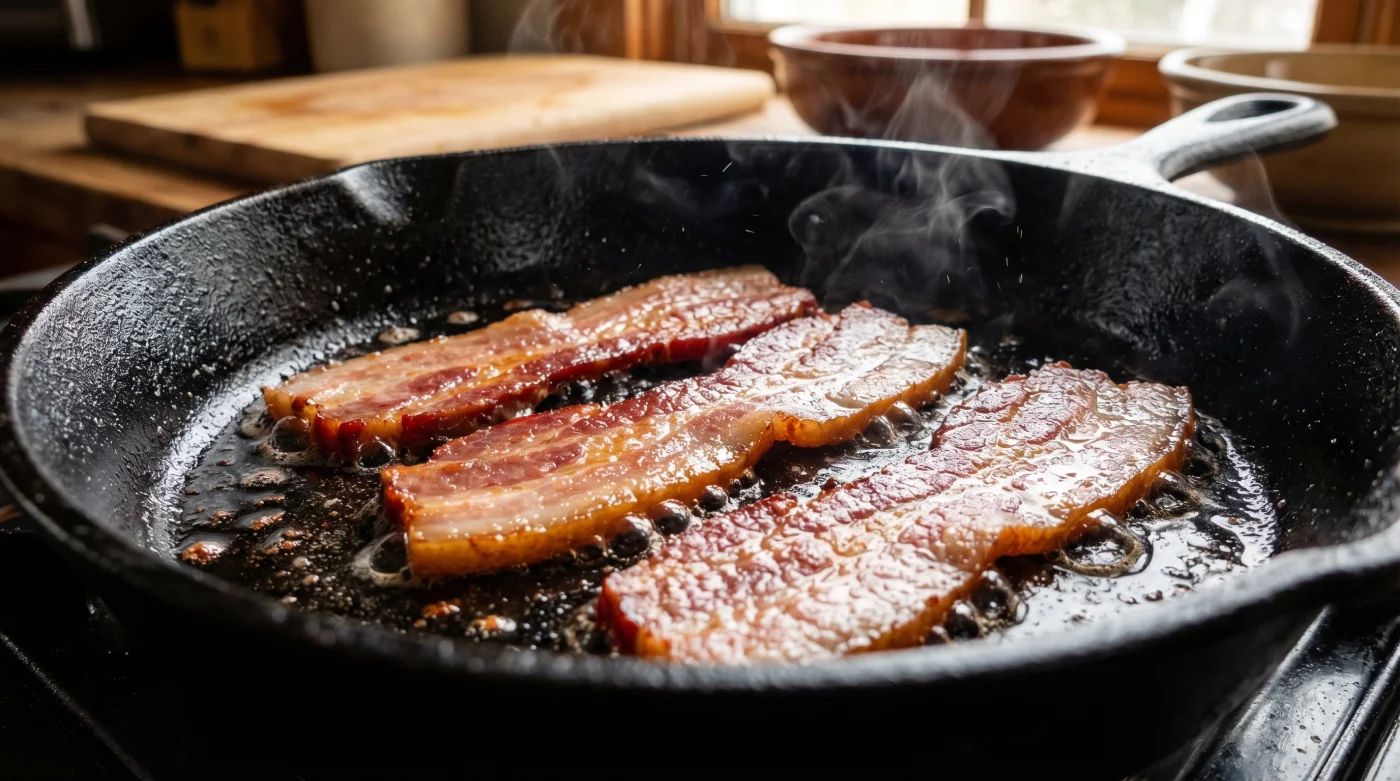
Sunday morning ought to be quiet, save for the rhythmic bubbling of the kettle and the distinct snap of fat hitting a hot pan. Yet, for most of us, cooking bacon is an exercise in hostile negotiation. You drop the meat onto the heated metal, and instantly, the edges contort.
The strips twist into angry little spirals. Grease spits across the hob, catching you on the wrist while leaving the actual meat half-burnt and half-rubbery. You press it down with a spatula, hoping to force it into submission, but it stubbornly curls the moment you lift your hand.
There is a distinct difference between the chaotic spluttering of a domestic kitchen and the calm, rhythmic sizzling of a high-volume breakfast service. In a professional setting, the fat is coaxed gently, not attacked with aggressive heat.
It turns out, achieving those perfectly flat, shatteringly crisp ribbons of pork requires a counterintuitive ingredient that you already have by the gallon. You simply need a splash of cold tap water.
The Perspective Shift: From Searing to Steaming
The instinct when cooking meat is to apply high heat immediately to achieve a quick crust. But a rasher of streaky bacon is a complex structure of lean muscle and dense, unrendered fat. When you throw it into a dry, scorching skillet, the muscle fibres contract rapidly while the fat barely has time to soften.
This uneven reaction causes the dramatic curling. Think of the cold water as a thermal shock absorber. It acts as a protective barrier, holding the pan’s temperature steady at exactly 100 degrees Celsius while the liquid boils away.
During this brief boiling phase, the tough fat begins to melt and render smoothly into the pan. The meat cooks gently, remaining relaxed and entirely flat against the iron surface.
By the time the water evaporates, the fat has fully rendered, leaving the straight bacon to fry quietly in its own drippings. What initially seems like a mistake—boiling your breakfast—is actually a masterful manipulation of temperature.
The Cafe Secret: A Quiet Revolution
Speak to anyone turning out hundreds of covers before nine in the morning, and they will tell you that consistency is everything. Thomas Fletcher, a 42-year-old breakfast chef at a bustling Manchester cafe, used to rely on heavy cast-iron presses to keep his rashers presentable.
“We were constantly fighting the meat,” he explains. “Then an older chef showed me the water trick during a brutal bank holiday rush.” Now, Thomas lays his streaky rashers into a cold pan, adds a centimetre of water, and lets the stove do the heavy lifting without a single press in sight.
Adjustment Layers: Tailoring the Technique
For the Weekend Traditionalist
If you buy thick-cut, dry-cured streaky bacon from your local butcher, you are dealing with a premium product that demands respect. This cut has far less inherent moisture than mass-produced alternatives.
For these thick slabs, start with a cold pan and add just enough water to submerge the rashers halfway. The extended boiling time ensures the thick bands of fat turn completely translucent before the crisping stage begins.
For the Rushed Commuter
Supermarket thin-cut bacon is notoriously temperamental. It is sliced so delicately that it often turns into a brittle, burnt mess before you can even reach for your buttered toast.
Here, you only need two tablespoons of cold water. It provides just enough steam to relax the thin muscle fibres, allowing the rasher to brown evenly without disintegrating into ash.
For the Back Bacon Devotee
In the UK, back bacon is the undisputed king of the breakfast table. While it does not curl quite as violently as the streaky variety, the fat cap on the edge can often remain unpleasantly chewy.
Adding a tiny splash of water softens that stubborn fat cap, rendering it down so that the entire rasher, from the lean medallion to the fatty edge, has a consistent, pleasing bite.
The Mindful Application: Your Tactical Toolkit
Applying this viral 5-minute prep method requires a deliberate, minimalist approach. Forget everything you know about pre-heating your cookware. We are building the cooking environment from the ground up, ensuring absolute control over the entire process.
Follow these precise steps for perfectly flat, consistent results every single time you approach the stove:
- Lay your rashers side-by-side in a completely cold, dry frying pan. Do not let them overlap.
- Pour in cold tap water until it covers the bottom of the pan, lightly coating the meat.
- Turn the hob to a medium-high heat and watch as the water begins to simmer.
- Wait for the sound to change. The gentle bubbling of water will suddenly transition into the sharp crackle of frying fat.
- Reduce the heat to medium-low and fry for another minute per side until golden brown.
Your tactical toolkit relies on observation. The ideal vessel is a heavy-bottomed stainless steel or cast-iron skillet. Use roughly 50ml of water for a standard 28cm pan. Always listen for the auditory cue: the shift from a soft hiss to a distinct pop.
Beyond the Frying Pan
Mastering this simple addition of water changes the entire morning dynamic. You are no longer dodging flying grease or anxiously poking at stubborn, twisting meat while your fried eggs overcook.
There is a quiet satisfaction in understanding the mechanics of your food. By controlling the temperature rather than fighting the raw ingredients, you reclaim a small pocket of peace at the very start of your day.
A perfectly flat, evenly cooked piece of pork might seem like a trivial detail. Yet, it represents a culinary confidence, a subtle mastery over your environment that sets a calm, deliberate tone for whatever follows.
Cooking is not about dominating the ingredients with fire; it is about coaxing out their best qualities through careful, controlled temperature.
| Key Point | Detail | Added Value for the Reader |
|---|---|---|
| The Cold Start | Bacon is placed in an unheated pan rather than a sizzling one. | Prevents the sudden contraction of muscle fibres, stopping curling immediately. |
| Thermal Buffering | Water holds the pan at 100 degrees Celsius until evaporated. | Gently renders out the tough white fat without burning the delicate meat. |
| Auditory Cues | Listening for the transition from bubbling water to crackling fat. | Removes the guesswork from cooking, telling you exactly when to flip the rashers. |
Frequently Asked Questions
Does adding water make the bacon soggy?
Not at all. The water boils away completely before the actual frying begins. Once the pan is dry, the meat fries in its own rendered fat, resulting in an exceptionally crisp finish.Do I need to add oil or butter to the pan?
No. The entire purpose of the water is to safely draw the natural fat out of the meat. Adding extra fat is redundant and will only make your breakfast overly greasy.Does this work with turkey or vegan bacon?
This technique relies on rendering animal fat, so it is strictly for traditional pork bacon. Leaner alternatives will simply boil and turn rubbery.Will this trick stop my pan from spitting entirely?
While it dramatically reduces violent splattering by removing excess moisture slowly, you will still experience a mild sizzle at the very end of the cooking process.Can I use hot water from the kettle to speed things up?
Using cold water is crucial. It slowly brings the meat up to temperature, giving the dense fat adequate time to soften. Boiling water will shock the meat and cause curling.