Picture a Tuesday evening. The chopping board sits on the worktop, damp from a quick wipe, waiting for the final element of your midweek salad. A standard 250-gram punnet of cherry tomatoes stares back at you. You pick one up, pinch it between thumb and forefinger, and press the paring knife down. It resists, slips slightly, and finally yields with a messy burst of seeds over the wood. You repeat this tiny, irritating friction twenty-four times.
It is a surprisingly tedious chore, a microcosm of kitchen fatigue. By the time you reach the bottom of the plastic punnet, the juice has run towards the edge of your counter, and you feel mildly resentful of a vegetable that is supposed to bring brightness to your plate. You lose precious minutes to a task that should feel effortless.
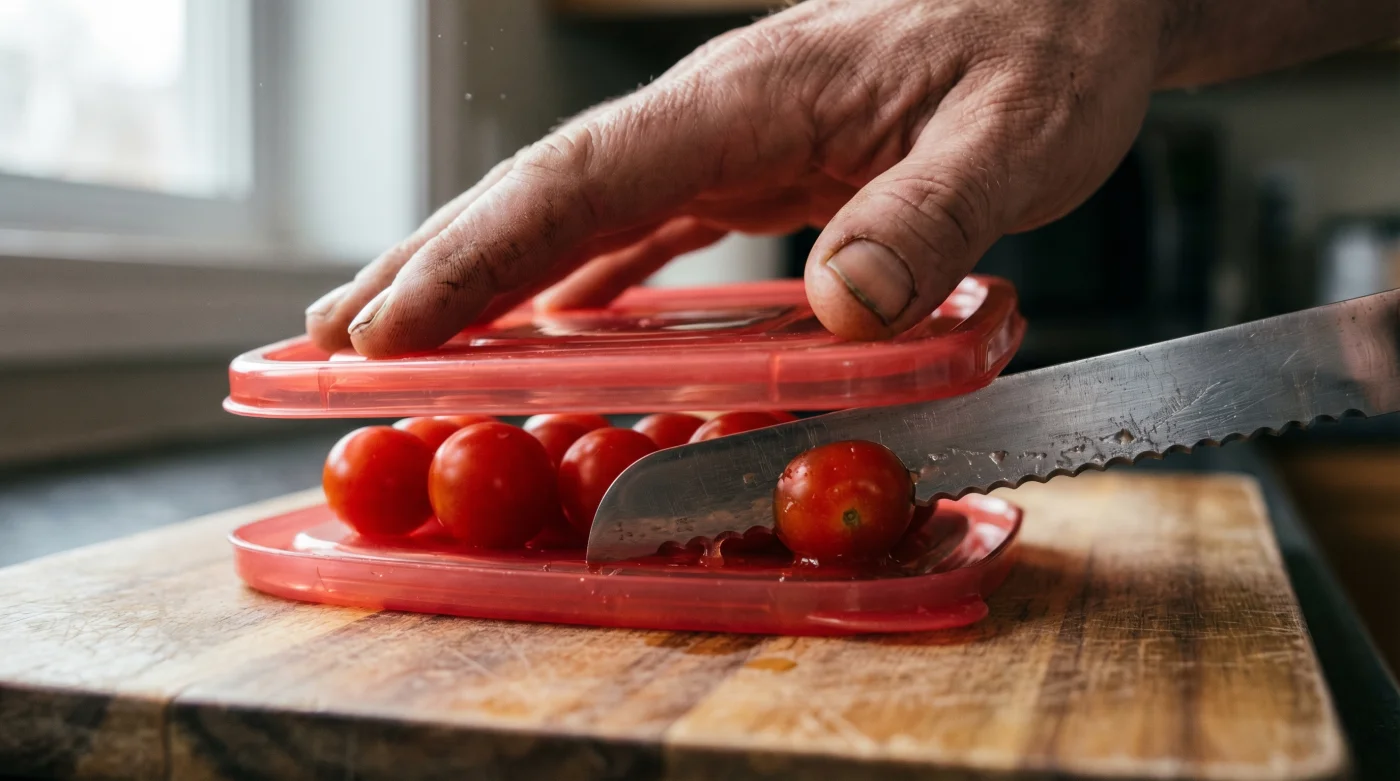
Now, imagine a different rhythm. You scatter the entire punnet onto a flat, circular piece of plastic. You place an identical circle on top, gently pressing down like a flat palm against a tabletop. A long bread knife slides horizontally through the narrow gap. A single, smooth sweep backwards and forwards, and you lift the lid. A dozen tiny red orbs sit perfectly halved, untouched by crushed skin or lost juices.
The Architecture of the Pinch
We are taught to cook by addressing single ingredients. You look at a tomato, you cut a tomato. But this method traps you in the ‘Pinch-and-Roll’ cycle. When you treat the ingredient as an isolated object, you fight its natural shape, wrestling with spheres that desperately want to roll away from your blade.
The shift happens when you stop thinking about cutting the tomatoes, and start thinking about trapping them. The two plastic lids—perhaps salvaged from last week’s Indian takeaway—do not just hold the fruit. They create a suspended tension bridge. By applying light, even downward pressure, you gently distort the spheres into ovals, holding them utterly rigid while exposing their equators. You are no longer chopping; you are passing a blade through a stabilised field.
Consider Arthur Pendelton, a 42-year-old prep chef at a bustling coastal pub in St Ives. Every Sunday morning, before the doors open for the roast dinner rush, Arthur faces four kilos of fresh Isle of Wight cherry tomatoes destined for a slow-roasted garnish. He does not stand there with a paring knife. He uses takeaway container lids and a ten-inch serrated pastry knife. It is a shared kitchen secret, a rhythmic flick of the wrist that turns an hour of mind-numbing labour into a three-minute, deeply satisfying chore. Arthur knows that the trick isn’t in the force, but in the friction.
Adapting to Your Kitchen Routine
Not every culinary scenario requires the exact same approach. How you employ this rapid-fire method depends entirely on what happens to those tomatoes once they hit the serving bowl. Tailoring the physical setup ensures your ingredients match your intention.
For the Midweek Lunchbox
When prepping for a child’s packed lunch or your own desk salad, you want zero mess and maximum speed. Use two shallow, flexible lids, like those from a standard supermarket hummus pot. The shallower lip grips tightly, ensuring you do not accidentally squash the smaller tomatoes into pulp before the knife even makes contact.
For the Traybake Enthusiast
If you are tossing these halves in olive oil, sea salt, and garlic for a slow roast, you need larger quantities fast. Opt for two large dinner plates with a pronounced rim instead of plastic lids. The ceramic lip creates a perfect rail for your blade to rest against, allowing you to slice twenty larger plum tomatoes simultaneously without them escaping onto the floor.
For the Textural Purist
Sometimes, the skin of a premium vine-ripened cherry tomato is remarkably taut. If you are serving a delicate raw dish, you must prevent any tearing or bruising. The secret is room temperature. Leave the tomatoes out for an hour before trapping them; cold skins shatter under pressure, while room-temperature skins yield elegantly to a serrated edge.
The Three-Second Sweep
The beauty of this viral prep method lies in its physical minimalism. There is no complicated machinery to assemble, plug in, or scrub clean in the sink afterwards. You only need to focus on the sensory feedback of the knife against the plastic to achieve restaurant-level speed.
Let the tomatoes settle naturally on the base lid. Do not crowd them to the point where they are forced to stack on top of one another. Place the top lid lightly, spreading your fingers wide across the surface to distribute the weight evenly across the entire punnet.
- The Grip: Place your non-dominant hand flat on the top lid, fingers splayed like a starfish.
- The Blade: Use a serrated bread knife. A smooth chef’s knife will snag on the waxy skins and push the tomatoes around.
- The Motion: Enter the gap between the lids with a sawing motion. Do not push inward; pull the blade back and forth, letting the serrated teeth do the work.
- The Follow-Through: Keep the blade perfectly horizontal. Feel it glide across the plastic lips, acting as your guide rails.
This is your Tactical Toolkit: Two identical, rimmed takeaway lids. One ten-inch serrated knife. A gentle, breathing pressure from your top hand. The entire physical action takes three seconds, slicing a dozen tomatoes instantly without a single drop of stray juice pooling on your worktop.
Reclaiming Your Worktop
We often accept tiny, repetitive frustrations in our daily routines because they seem too insignificant to fix. Slicing cherry tomatoes one by one is a perfect example of unnecessary kitchen friction. By addressing the bulk volume rather than the individual fruit, you completely change the atmosphere of your cooking.
It is no longer a dreaded chore to prepare a fresh, vibrant salad after a long commute. When you remove the tedious mechanics of meal preparation, you invite back the pleasure of eating well. The kitchen stops being a place where patience is tested, and transforms into a space of quiet, efficient flow. You gain back those scattered minutes, leaving you with nothing but perfectly halved fruit and a clean, dry surface.
“A sharp blade needs a steady canvas; trap the rolling ingredient, and the knife will effortlessly do the rest.”
| Key Point | Detail | Added Value for the Reader |
|---|---|---|
| Individual Slicing | One by one with a paring knife. | High precision but massive time loss and inevitably messy chopping boards. |
| The Lid Trick | Slicing 12-20 at once between plastic. | Recovers 90% of prep time and keeps sweet juices contained inside the fruit. |
| Food Processor | Mechanical slicing with a designated blade. | Often bruises delicate flesh and creates totally unnecessary washing up. |
Common Questions Answered
Will a smooth chef’s knife work for this method?
Rarely. Cherry tomato skins are waxy and resistant. A smooth blade requires downward force to pierce them, which squashes the fruit. A serrated knife saws through effortlessly.
What if my tomatoes are different sizes?
Try to group similarly sized tomatoes together before slicing. If you have a few massive ones and a few tiny ones, the top lid will rest unevenly, leaving the smaller ones uncut.
Can I use this method for other ingredients?
Absolutely. This same suspended pressure technique works wonderfully for halving seedless grapes for children, or slicing pitted olives in bulk for a Mediterranean tart.
Does the plastic lid damage my knife?
Not at all. You are lightly resting the blade against the rim as a guide, not actively hacking into the plastic. Gentle, horizontal sawing preserves both the lid and the blade.
How hard should I press down on the top lid?
Imagine resting your hand on a sleeping cat. You want enough pressure to hold them securely in place, but not so much that you rupture their skins before the knife arrives.